
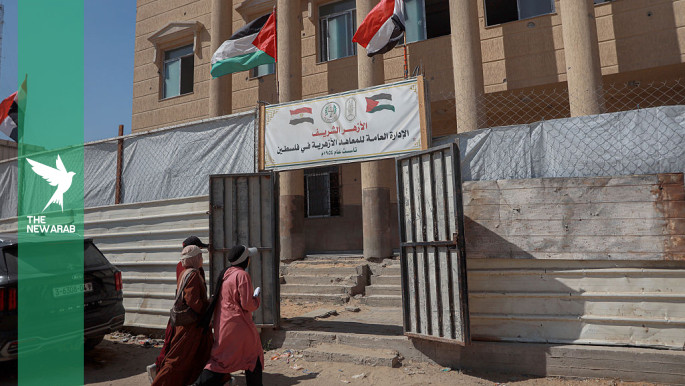
Palestinian high school students arrive at the Al-Azhar Institute campus in the Tel al-Hawa neighborhood, south of Gaza City, Gaza, Palestine to take their simultaneous ‘Tawjihi’ university entrance examinations on 2 June 2026. [Getty]
As Gaza’s high school students prepare for exams scheduled for 20 June, many said they have been forced to transform food aid boxes into makeshift notebooks amid severe paper shortages and soaring prices.
For students in the war-torn coastal enclave, notebooks are increasingly rare as Israel’s ongoing genocidal war devastates daily life, disrupts supply chains, and pushes educational needs down the priority list.
Many families struggling with food, water, and shelter find stationery an unaffordable luxury.
Mohammed Salem, 18, who is currently displaced west of Gaza City, told The New Arab that he spends part of his day searching for discarded aid boxes after residents empty their food parcels.
“I collect the boxes, cut them into different sizes and use them like pages […] I write lessons, summaries and practice questions on them. As exams get closer, I need to write every day, but finding paper has become very difficult,” he said.
He added he collects cardboard daily and values empty boxes. “Many students around me do the same. We can’t easily buy notebooks, but we want to keep studying. We’re trying to preserve our future despite everything around us.”
Palestinian students face increasing difficulties as exams approach. The Palestinian Ministry of Education announced that Gaza’s high school exams will start on 20 June via the “E-School” platform to preserve the academic year amid destruction and displacement.
Students, however, said the move to electronic examinations has not eliminated their need for traditional study materials.
Preparing for exams involves taking notes, solving practice questions, and summarising lessons, all of which are heavily reliant on paper.
The shortage of educational supplies occurs amid a tightening Israeli blockade on Gaza that has continued despite the October 2025 ceasefire.
Palestinians in Gaza face ongoing restrictions on commercial and essential goods, causing shortages and rising prices.
Humanitarian agencies warn that limited access to supplies worsens the crisis and disrupts daily life, including students’ access to exam materials.
Studying amid genocide
In another displacement camp in Gaza City, 18-year-old Mahmoud Abu Aser told TNA that he has resorted to reusing old school papers from previous years after exhausting all other options.
“I write between the lines, on the margins and on the back of old pages […] Sometimes I use papers that belonged to my brothers years ago. When I completely run out, I turn to aid boxes,” he said.
According to Abu Aser, obtaining paper has become a challenge in itself.
“Even one sheet of paper has become valuable,” he added. “I try to make use of every available space because I don’t know when I will be able to get more.”
The shortage of stationery is only one aspect of a broader educational crisis.
Many students study in overcrowded camps where privacy and quiet are hard to find. Frequent power cuts and unreliable internet hinder online learning and access to resources.
“Sometimes I spend hours trying to download lessons or connect to the internet, after that, I still need to write notes and summaries so I can review them later. Paper remains essential even when education is taking place online,” he explained.
Salem and Abu Aser are among thousands of Gaza students struggling to continue their education amid displacement, insecurity, and economic hardship.
Their families, once focused on buying school supplies, now prioritise food and water, leaving students to improvise with available materials. For many, aid boxes have become one of the few available alternatives.
The fight for education
The shortage of paper is not limited to school students. University students, particularly those studying scientific and medical disciplines, said they face similar challenges as they attempt to continue their education under wartime conditions.
Duha al-Shawaf, a medical student displaced west of Gaza City, told TNA that she has begun turning aid boxes into makeshift notebooks to keep up with her coursework.
“We study online and constantly need paper for taking notes and summarising lectures […] Paper has become scarce and expensive, so I started using aid boxes instead,” she said.
Medical studies require extensive note-taking and repeated revision, making access to writing materials especially important.
“Sometimes I spend a long time cutting the cardboard and preparing it before I can start studying. It’s not the way I imagined my university experience, but it has become the only available option,” she added.
Al-Shawaf explained that the displacement hinders learning, as her family shares limited space with relatives, and frequent electricity shortages and unstable internet disrupt lectures and studying.
Her father, Mohammed al-Shawaf, told TNA that the family is doing everything possible to support her education despite worsening economic conditions.
“She worked hard to enter medical school and was determined not to lose her future because of the war. We try to help her continue studying, even though life has become extremely difficult,” he said.
While some universities in Gaza have managed to partially restore facilities and resume limited in-person teaching, many students remain dependent on remote learning due to ongoing military operations, displacement, and transportation difficulties.
The challenges facing students are unfolding against the backdrop of widespread destruction across Gaza’s education sector.
According to the Palestinian Ministry of Education, over 21,700 education sector personnel have been killed or injured by the Israeli army since the genocidal war in 2023.
Israel has destroyed more than 284 schools and 63 university buildings across Gaza, disrupting access to education and hindering students’ studies, the ministry said.