
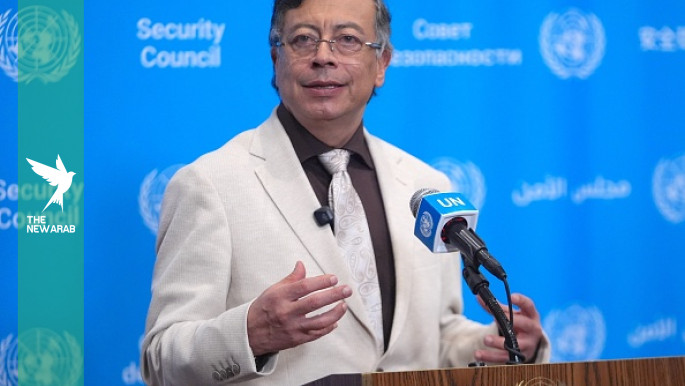
Gustavo Petro has been Colombia’s only left-wing leader so far, and has fiercely criticised Israel’s war in Gaza [Getty/file photo]
Outgoing Colombian President Gustavo Petro has accused Israel of interfering in Sunday’s presidential election, alleging that the country’s National Registry systems were compromised in a bid to influence the outcome, which saw far-right candidate Aberaldo de la Espriella declared the winner.
In a post on X, Petro said he had received evidence suggesting that the IP addresses of several servers belonging to Colombia’s National Registry had been altered, compromising electoral data and allowing unauthorised actors to enter information relating to polling stations and voting centres.
“The only entity in the world capable of doing that is the State of Israel,” Petro wrote.
The outgoing president said he had previously warned the Bautista brothers that the software used by the National Registry was vulnerable and should be replaced with publicly available software. He added that a request to audit the software before the election was rejected.
Fernando and Camilo Bautista are the owners of Colombian logistics and printing firm Thomas Greg & Sons, which operates software and pre-count election services for the National Registry.
The brothers have faced fraud allegations in the US and Mexico, contributing to longstanding concerns among some Colombians about the transparency of the electoral system.
Petro said he would submit the evidence to judges capable of carrying out a forensic audit of the electoral software.
He also called for a recount and a broader review of vulnerabilities in the voting system.
During Israel’s war on Gaza, Petro emerged as one of the Israeli government’s most outspoken international critics. He severed diplomatic relations with Israel and was among the first world leaders to refer to Israel’s war on Gaza as genocide.
He repeatedly condemned Israel’s assault on the territory, compared its siege of Gaza to Nazism and argued that “democratic peoples cannot allow Nazism to reestablish itself in international politics”.
Petro also took part in a pro-Palestinian demonstration in New York in September last year, calling on US soldiers to “disobey” President Donald Trump’s orders. The US State Department subsequently revoked his visa and described the remarks as “reckless and incendiary”.
Far-right victory in Colombia
On Sunday, far-right candidate de la Espriella was declared the winner of Colombia’s presidential election, defeating left-wing rival Ivan Cepeda.
He beat Cepeda by less than one percentage point, making it one of the closest presidential races in Colombia’s history.
De la Espriella, a wealthy lawyer backed by US President Donald Trump, has pledged to restore diplomatic ties with Israel, relocate Colombia’s embassy to Jerusalem and “defend the Judeo-Christian principles that form the foundation of Western civilisation”.
Defending Israel’s military campaign in Gaza, which has killed more than 73,000 Palestinians, de la Espriella said Israeli Prime Minister Benjamin Netanyahu was “doing what he has to do to defend his people”.
His victory marks a significant setback for pro-Palestinian solidarity in Latin America, where support for the Palestinian cause has long enjoyed broad public backing.
It also signals a return to the right after Petro led Colombia’s first left-wing government between 2022 and 2026.
During his campaign, de la Espriella gained support through promises to take a hardline approach to organised crime and drug trafficking, which have fuelled violence in Colombia for decades.
The president-elect has pledged to build 10 maximum-security “mega-prisons” and said criminals should be treated “like rats and cockroaches”. He has also argued that Colombia’s future depends on deepening ties with the United States.
De la Espriella’s victory is the latest in a series of electoral successes for Trump-aligned right-wing figures across Latin America, including Honduras’ Nasry Asfura and Chile’s José Antonio Kast.
Petro’s allegations now threaten to cast a shadow over the election result, setting up a fresh confrontation between Colombia’s outgoing left-wing government and the incoming administration before the transfer of power.