
The committee said its findings were based on oral testimony, documentary evidence, financial records and submissions received from government institutions, private organisations, purported employees and alleged victims.
The House of Representatives ad hoc committee investigating the purported establishment of the Presidential Foreign Intervention Promotion Council (PFIPC) says it has uncovered an elaborate scheme involving the alleged forgery of presidential documents, mutilation of an Act of the National Assembly and the unauthorised use of the names and identities of senior government officials to give legitimacy to the agency.
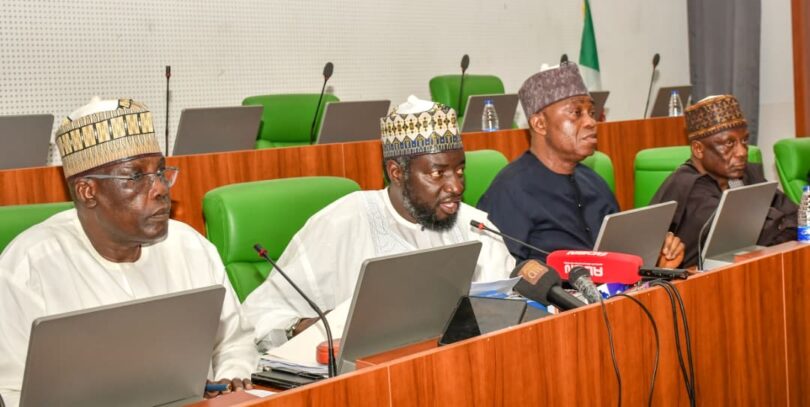
The committee, chaired by Yusuf Gagdi (APC Plateau), disclosed these while presenting its preliminary findings on Wednesday in Abuja
The committee presented the report after weeks of investigations into how the organisation operated within the federal bureaucracy despite the government’s position that it was never legally established.
The findings are a sequel to concerns about the processes by which a purported government agency was able to secure a place in the 2026 Appropriation Act, occupy an office within the Federal Secretariat, obtain official-looking number plates, and establish relationships with several government institutions.
The committee said its findings were based on oral testimony, documentary evidence, financial records and submissions received from government institutions, private organisations, purported employees and alleged victims.
It stressed that the findings were preliminary and did not constitute the committee’s final report or the final decision of the House.
The committee said it found no valid Act of the National Assembly, gazetted enactment, presidential executive order, administrative instrument or other lawful authority establishing the PFIPC.
It said none of the government institutions that appeared before it could produce an authentic record showing that the organisation was created, approved or authorised by President Bola Tinubu, the Federal Executive Council, the National Assembly, the Office of the Secretary to the Government of the Federation or any other competent authority.
The committee also noted that the organisation operated under different names, including the Presidential Foreign Intervention Promotion Council and the Presidential Economic Advisory Council.
“These inconsistencies, when considered alongside the documentary evidence before the committee, substantially undermine any assertion that the entity possessed lawful governmental status,” it said.
The investigation followed the House’s adoption of a motion sponsored by Mr Gagdi on 8 July, after lawmakers raised concerns about the inclusion of the purported council in the 2026 federal budget.
A review of the 2026 Appropriation Act had shown an allocation of about ₦1.3 billion to the Presidential Economic Advisory Council/Presidential Foreign Intervention Promotion Council under the Presidency.
The committee was also mandated to investigate a reported ₦27.4 billion take-off grant allegedly associated with the council.
However, the preliminary findings indicated that the committee was still determining whether any appropriation, warrant, cash backing, or actual financial release was made in favour of the purported council.
One of the most significant findings concerned a document that Mr Adeyemi used to present himself as the director-general of the organisation.
The committee said the document purported to show that the Presidency had appointed Mr Adeyemi and bore the authority and signature of the Chief of Staff to the President, Femi Gbajabiamila.
However, evidence from the State House, according to the committee, established that no such appointment was made or approved by the Presidency.
The Chief of Staff, it said, neither issued nor signed the letter.
The committee further found that the letterhead was not authentic State House letterhead, that its purported reference number was inconsistent with the State House’s official referencing system, and that its format, language, and administrative features differed materially from official correspondence.
“The committee therefore preliminarily finds that the purported appointment letter was fabricated and falsely attributed to the Presidency.
“Such conduct, if established through the applicable criminal process, would constitute a grave assault on the integrity of the Office of the President and the official identity of the federal government,” Mr Gadgi said.
PREMIUM TIMES had previously reported that the House claimed the appointment letter was fake after former Head of the Civil Service of the Federation, Didi Walson-Jack, appeared before the committee.
The committee said it also examined a document described as “Presidential Executive Order No. 5 of 24 February 2026,” which was presented as the legal authority for establishing or operating the organisation.
According to Mr Gagdi, evidence before them indicated that the document was neither issued nor approved through the lawful processes of the Presidency.
“The evidence presently available indicates that the document was not an authentic Executive Order of the President and was neither issued nor approved through the lawful processes of the Presidency,” he said.
It described the alleged fabrication of an instrument presented as an executive order as particularly serious because such an instrument carries the authority of the president.
The committee said any attempt to manufacture an executive order to obtain official recognition, financial advantage or public confidence amounted to an attack on the integrity of executive authority.
The committee said it also uncovered a document presented as an Act of the National Assembly establishing the purported organisation.
It said that either chamber of the National Assembly never passed the document, it was not assented to by the president, and it was not gazetted as an Act of the Federation.