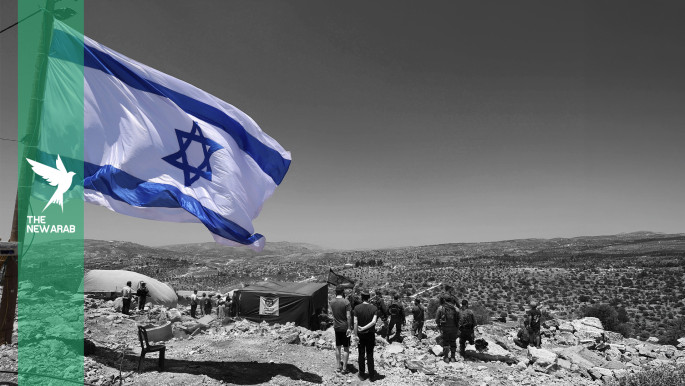
A large group of Israeli settlers stood atop a building in the Syrian village of Al-Hader in the occupied territory of Quneitra last week, waving the Israeli flag and chanting songs calling for the settlement of southern Syria.
In the video, soldiers from the Israeli military watched on, although according to an army statement, the soldiers and settlers clashed before some were detained, returned to Israel, and later transferred to the police.
The military described the incident in a statement as a “serious criminal offence that endangers civilians and Israeli military forces”.
This is just the latest incident that reflects the growing ambitions of Israel’s settler movement, as it increasingly seeks to expand its vision for a greater Israel beyond its traditional preoccupation with the West Bank, to new frontiers in Syria, Lebanon, and Gaza.
Equally, having occurred in a heavily militarised occupation zone, the incident raises further questions as to the overlapping interests and relationships between the state of Israel, its military, and the illegal settler movement, which has become increasingly celebrated in the heart of the Israeli government.
For those who face the reality of Israel’s occupation daily, such incidents provoke a deep fear that Israel’s occupation may become permanent.
“This is just another face of the occupation. As they occupied Palestine and the Golan Heights, now they seek to take this land,” Mohammed*, the mokhtar of a village a few kilometres from Al-Hader, told The New Arab.
“This intervention [by the settlers] was not the first we have seen. We face such interventions on a daily basis by the Israelis, entering homes, searching our people,” he added.
“We hear the phrase ‘Greater Israel’, and we hope by the will of God that we won’t face a Nakba here as the Palestinians did.”
Who are the ‘Pioneers of Bashan’?
The group that illegally entered Syria are part of a new settler movement called the ‘Pioneers of Bashan,’ which represents a new current within those in Israel who desire to create a ‘Greater Israel.’
The group, founded in April 2025, had previously crossed into Syria on several occasions. In August 2025, settlers laid the foundation stone for a proposed new settlement close to Tal Al-Hara.
Bashan refers to the biblical region that is now southwest Syria, encompassing the governorates of Quneitra, Deraa and Suweida. The Pioneers of Bashan seek to ‘reclaim’ these regions through the process of illegal settlement, mirroring the strategy that has led to the erosion of Palestinian lands in the occupied West Bank.
New settler groups have been cropping up in the years since 7 October, as Israel has launched invasions into Gaza, Lebanon, and Syria, seeking to expand the borders of the Israeli state into those areas newly under Israeli occupation.
These new settler movements represent “a transformation in Israel after 7 October,” explains Nedal Bitari, a Syrian-Palestinian writer and scholar, to TNA. “Its expansionist tendencies are becoming mainstream amid a greater sense that the country is fighting a war for a ‘Greater Israel’.”
In 2024, following Israel’s last invasion into Lebanon, a new settler group called Uri Tzafon was founded with the goal of promoting the settlement of southern Lebanon, under the informal motto of “occupation, expulsion, settlement.”
On 24 March, Israeli Defence Minister Israel Katz announced the Israeli army’s intentions to occupy southern Lebanon up to the Litani River and prohibit the return of hundreds of thousands of displaced residents.
Israel’s settler-military complex
Despite the Israeli military’s claims to have detained and handed over the settlers to the police, the two often operate hand in hand. In the occupied West Bank, settlers act with impunity to terrorise and murder Palestinians under the protection of the Israeli military.
Hundreds of thousands of weapons have been handed out to settlers by the Ministry of National Security to facilitate what amounts to ethnic cleansing.
As a result, there are serious questions about how dozens of individuals could have illegally entered a closed military zone without some degree of foreknowledge or complicity of the Israeli military.
Bitari believes that “it’s impossible” that the Israeli army was unaware. The Israeli military extensively surveils both the occupied Golan Heights and Quneitra. There are at least two ‘security walls’ separating the territories that settlers would have had to pass through, explains Bitari, and the military is heavily patrolling these areas. Despite that, more than forty Israelis managed to enter Syria.
“There will have been some level of collusion between the IDF and the settlers,” believes Robin Yassin-Kassab, a Scottish-Syrian analyst and author of a new book titled ‘The Blood Between Us: Syria After The Fall of Assad’.
“It may not necessarily be at a high level in this instance, but could be as simple as the fact that the Israeli military is unwilling to use force on fellow Israelis,” he told TNA.
“Although just imagine what the response would have been if a large group of Syrians tried to enter the occupied Golan Heights.”
It is equally clear that the settler movement finds itself increasingly championed in the heart of the Israeli government. “The lines between the state and the settlers are increasingly blurred,” explains Bitari.
Senior far-right ministers, most notably Minister of National Security, Itamar Ben-Gvir, and Minister of Finance, Bezalel Smotrich, are both settlers and now represent “the backbone of Netanyahu’s government”.
Damascus’ balancing act
President Ahmed Al-Sharaa’s strategy towards Israel can be summarised as “playing for time, trying to avoid inviting further Israeli aggression and hoping Washington will restrain Netanyahu,” says Yassin-Kassab. “Ultimately, it seems they’re hoping to re-establish the 1974 Deconfliction Agreement.”
Following the 1973 Yom Kippur war, an agreement was signed that established a UN-monitored buffer zone along the border that both Israeli and Syrian militaries were prohibited from entering, as a means to ensure conflict does not break out.
Following the fall of the Bashar Al-Assad regime in 2024, Israeli forces advanced beyond the so-called ‘Blue Line’ to occupy further territory in Syria. This occupation was ostensibly launched to create a security buffer for Israeli settlers in the occupied Golan.
In 1967, the Golan Heights were seized ostensibly to create a security buffer for settlements on the Galilee Sea. Israel expelled most of its residents and began settling the Golan within months of seizing it from Syria.
The obvious fear of Israel’s creeping occupation is that the presence of settlers in Quneitra will create the justification for deeper occupation into Syria, all underpinned by a logic of expansionist nationalism to create a ‘Greater Israel’.
The ‘Pioneers of Bashan’ acknowledge this process overtly in their messaging. According to Israeli media, in the movement’s WhatsApp group, the manager openly argues that, “settlement of the entire Bashan is a natural extension of settlement in the Golan that will help stabilise the area and strengthen Israel’s security”.
Such a threat poses significant difficulties for Al-Sharaa. “Videos like those from Al-Hader are humiliating for the government,” explains Yassin-Kassab. “There are limits to what the public can accept.”
Although opinion polls have shown that the public is largely supportive of the government’s avoidance of a showdown with Israel, Yassin-Kassab believes that “any actual settlement would likely generate local resistance, which Al-Sharaa probably couldn’t control and may place the government in a very difficult position”.
Damascus doesn’t want to end up in a position where it feels compelled to respond. Equally, however, it has little ability to deter Israeli aggression without risking an explosive response.
For Mohammed, the mokhtar in occupied Quneitra, “these provocations are intended to provoke a reaction from us against them which will allow them to commence a war against Syria,” he said.
“Of course, there is fear, but the route to establishing this project is reliant on our fear and anger. If we allow their provocations to anger us, it will give them a reason to expand the occupation.”
Cian Ward is a journalist based in Damascus, covering conflict, migration, and humanitarian issues
Follow him on X: @CP__Ward
Edited by Charlie Hoyle