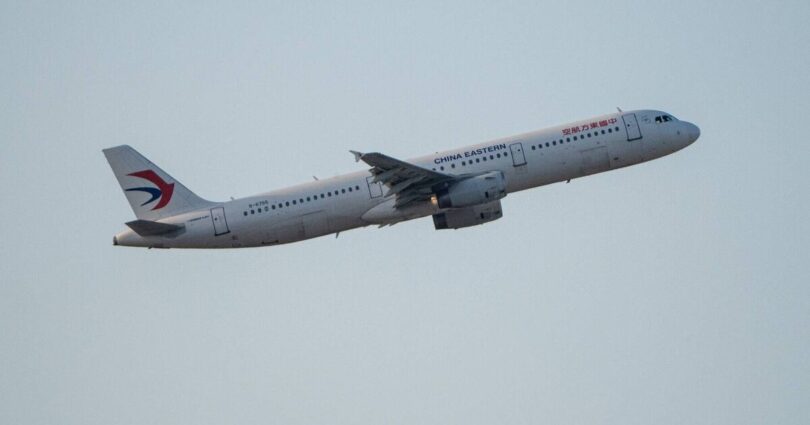
Authorities have officially refused to publish the final report which would determine the cause of the crash (Image: Vernon Yuen/Nexpher via ZUMA Press Wire/Shutterstock)
The catastrophic China Eastern Boeing 737-800 crash killed all 132 people on board, including nine crew members and 123 passengers.
Years later, Chinese aviation authorities have still not released the official cause of the disaster, formally refusing to publish the final report in June 2025 and stating that “disclosure may endanger national security and social stability”.
On that tragic day, China Eastern Airlines flight MU5735 suffered a catastrophic end, as the aircraft abruptly plunged into an almost-vertical nosedive before crashing into a mountainside in south China’s Guangxi province.
The horrific crash took every single life on board — 132 people perished in an instant.
What happened on the day of the fatal crash
The aircraft had been scheduled to fly from the city of Kunming to the city of Guangzhou, and while the flight departed without incident, shortly before the plane was due to commence its descent, it suddenly dropped from a cruising altitude of roughly 29,000 feet to 7,400 feet.
Flight data shows the aircraft briefly pulled up and levelled off, climbing back to 8,500 feet, before entering a second nosedive which sent the plane plummeting into the side of a mountain.

Rescuers searching for the ‘black boxes’ at the plane crash site (Image: Xinhua/REX/Shutterstock)
Remarkably, all of this took place within the space of roughly two minutes.
Investigators revealed that the pilots failed to respond to numerous attempts by air traffic controllers and nearby aircraft to establish contact, as the plane descended rapidly towards the ground.
Regarded at the time as the deadliest aviation catastrophe in China in three decades, the incident sent shockwaves across the globe, raising grave concerns throughout the international aviation industry — and leaving the families of those who perished utterly devastated.
Two “badly damaged” Black Box flight recorders were recovered from the remote, mountainous crash site.
The Civil Aviation Administration of China (CAAC) confirmed that no faults or indications of “anything abnormal” had been flagged prior to departure, with no issues identified concerning the aircraft, its engines, weather conditions or communications.
The Chinese regulator further confirmed that the crew held valid licences, had been sufficiently rested and had passed health checks on the day of the flight.
No hazardous materials were reported to be on board, and weather conditions presented no danger.

China Eastern Airlines flight MU5735 crashed into a mountain killing all 132 onboard (Image: Xinhua/REX/Shutterstock)
Sun Shiying, president of China Eastern Airlines, released a statement at the time confirming that all three pilots were fully licensed and in good health, saying: “Their behaviour had been good and their families were all quite harmonious.”
This was corroborated in a separate statement to the Wall Street Journal (WSJ) the following May, in which the airline confirmed that the pilots were in good health, that their family circumstances were stable and that their finances were also in good order.
Was the crash intentional?
According to a report published by the WSJ in May 2022, those familiar with US officials’ preliminary assessment of the cause of the crash indicated that recovered Black Box data reportedly pointed towards someone deliberately bringing the plane down, as it was suggested that inputs to the controls were what sent the aircraft into the fatal nosedive.
An expert familiar with American officials’ preliminary assessment said: “The plane did what it was told to do by someone in the cockpit.”
The statement followed an analysis of information extracted from recordings taken from the damaged flight-data recorders.
A separate source told Reuters that investigators were examining whether the crash could have been a “voluntary” act.
Following speculation that the crash may have been deliberate, the CAAC issued a statement on April 11 that year asserting that the conjecture had “gravely misled the public” and “interfered with the accident investigation work”.
On the one-year anniversary of the tragedy, the CAAS released a brief update report containing virtually no fresh information, stating the case was “very complex and extremely rare”.
Marking the second anniversary, little had changed, with the regulator continuing to describe the crash as “very complicated and rare” while failing to offer anything meaningful.
By June 2025, an official refusal to release the report had been formally recorded, with authorities citing that “disclosure may endanger national security and social stability”.
Four years on, the cause of the catastrophic crash remains shrouded in mystery, leaving both the victims’ families and the wider aviation industry still desperately seeking answers.