
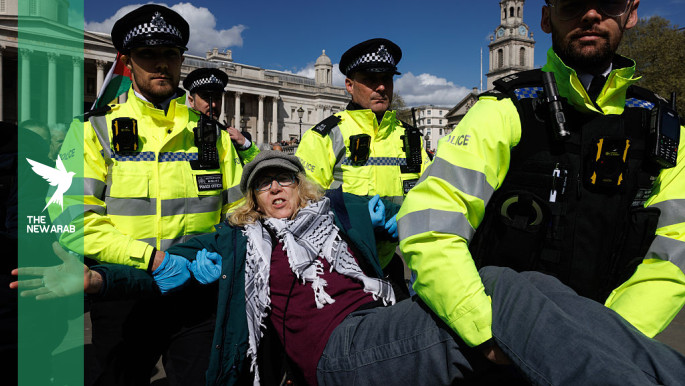
According to organising group Defend Our Juries (DOD), some 500 protesters are taking part in the action [Dan Kitwood/Getty Images]
The Metropolitan Police has begun arresting demonstrators protesting the outlawing of Palestine Action in London’s Trafalgar Square.
According to organising group Defend Our Juries (DOD), some 500 protesters are taking part in the action, holding signs reading “I oppose genocide. I support Palestine Action.”
Included in the protests is Massive Attack’s Robert Del Naja, who was quoted by DOD on X as saying, “the actions of Palestine Action were highly patriotic, because they were pretty much protecting our country from getting involved in serious war crimes, and breaking international law”.
London’s Metropolitan police said on X: “As of 16:50hrs officers have made 212 arrests. They are continuing to make arrests where people are showing support for a proscribed organisation”
Palestine Action, a direct-action group in the UK, was proscribed as a “terrorist organisation” by the UK government in July 2025, sparking condemnation and rolling protests by Defend Our Juries.
The ban came after numerous direct protest actions, specifically over a break in at RAF Brize Norton, damaging aircraft, though the group has focused on weapons factories. including those belonging to Israel’s Elbit Systems.
Alongside making membership of the group illegal, it also means expressions of support for the group are punishable by up to 14 years in prison. Nearly 3,000 people have been arrested since the ban was imposed.
The UK’s High Court ruled on 13 February that the proscription of the group was unlawful, “disproportionate” and a breach of freedom of expression.
DOD noted on X that the High Court ruled that the ban was unlawful, with its ruling stating to the government, “you are intentionally wrongly arresting hundreds of protestors for holding signs to protect a foreign genocidal regime”.
The government’s appeal against the ruling is set to be heard between 28 and 29 April.


