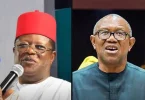
The Executive Secretary of the National Human Rights Commission, Chief Tony Ojukwu, SAN, has described Peter Obi’s statement that he may not be alive to contest the 2027 presidential election as deeply worrisome, warning that Nigeria’s civic space is shrinking as political tension rises ahead of the polls.
Ojukwu, who spoke during an interview on ARISE News, said the Commission had begun considering an appropriate response immediately after learning of the former Anambra State governor’s statement.
He said the right of opposition figures to operate freely, canvass for support and participate in the political process without intimidation was a legitimate democratic right that must be protected.
“When I read that news and listened to it, I had to call my team and ask, ‘What should be our response to this?’ The issue of the opposition being able to have space to do their bit is a legitimate right,” he said.
According to him, Obi’s statement must be viewed against growing concerns about freedom of expression, political participation and the gradual restriction of civic space as the country moves closer to another general election.
“The statement made by Peter Obi is a very worrisome statement, and every person who means well for this country should take it seriously,” Ojukwu said.
Ojukwu said the Commission did not necessarily have to wait for a formal petition before responding to a matter of national human rights concern.
He disclosed that the NHRC was considering issuing an advisory to the government and other political actors on the need to create an open and secure environment in which every prospective candidate could undertake political activities without fear.
He, however, distinguished between issuing a general advisory and commencing a detailed investigation into Obi’s specific allegations.
According to him, Obi had made the statement publicly but had not lodged a formal complaint with the Commission or provided it with details that could form the basis of an investigation.
Ojukwu said the Commission would investigate if Obi formally approached it, adding that the level of response triggered by a public statement differed from what would follow a direct complaint.
“He has not complained to us. He has complained to every Nigerian. Our approach to a case like this is to issue an advisory both to the government and the players on how to ensure that, going forward, there is free space for everybody to do their politicking without fear,” he explained.
He added that the Commission would have to consider whether Obi’s experience formed part of a broader pattern of shrinking civic space and restrictions confronting opposition politicians.
Ojukwu said Obi had alleged that his businesses were being targeted and had referred to an incident involving his vehicle at an airport, but maintained that further particulars would be required for a specific investigation.
“If he complains to us, we will investigate,” he said.
The NHRC chief maintained that the Commission was sufficiently independent and empowered to investigate allegations involving powerful state actors where evidence justified such action.
He cited the Commission’s investigation into allegations by Reuters concerning the Nigerian military in the North-East, saying senior military officers appeared before the investigative panel and gave evidence.
According to him, the Commission eventually concluded that the allegations were not substantiated, demonstrating its willingness to investigate sensitive matters involving major state institutions.
Speaking on the NHRC’s human rights situation dashboard, which recorded more than 326,000 complaints in one month, Ojukwu described the number of reported violations as alarming.
Violations of the right to life reportedly topped the complaints recorded during the period.
He said the figures could partly be attributed to increased public awareness, as more Nigerians now understood their rights and knew where to report violations.
However, he said the country’s worsening security situation remained a significant factor, with several communities under attack or living under persistent threats.
Ojukwu recalled visiting Maiduguri, Borno State, where, according to him, farmers required security escorts before they could access their farms.
He described the situation as dire and urged security agencies to intensify efforts to restore safety before the 2027 elections.
He warned that conducting a credible election would be difficult in communities where citizens lived under siege or could not move freely.
“In this kind of situation, it is going to be very difficult to have free and fair elections,” he said.
Responding to questions about the practical remedies provided by the Commission beyond documenting violations, Ojukwu said documentation remained essential because many abuses would otherwise go unrecorded.
He explained that the Commission also intervened to secure remedies for victims, but its effectiveness was affected by limited funding, personnel and physical presence.
Although the NHRC has offices in all 36 states, Ojukwu said the Commission generally operates from only one office in each state capital, despite the need to establish a presence across the local government areas.
He said the arrangement restricted the number of victims who could conveniently access the Commission.
Ojukwu listed unlawful arrests, demands for money before bail, domestic violence, abandoned children and the denial of access to education among the cases regularly handled by the NHRC.
He said Commission officials could intervene at police stations to secure the release of unlawfully detained persons and ensure that suspects were not compelled to pay for bail.
In cases involving children living on the streets or denied education, the Commission could engage the relevant education ministry, social welfare authorities and other institutions to seek assistance.
For domestic violence complaints, he said the NHRC could mediate between the parties or refer the matter to the police for prosecution where necessary.
Ojukwu noted that some cases become complicated when victims withdraw complaints because of pressure from pastors, traditional rulers, relatives or other influential persons.
He therefore cautioned that addressing human rights violations required sustained institutional engagement and could not be achieved through a “magic wand.”
Ojukwu also addressed the reported assault on a man identified as Godspower, who was allegedly stripped, assaulted and publicly flogged by community leaders over a Facebook post criticising abandoned road projects.
He disclosed that the Commission had directed its Delta State office to investigate the incident and submit a report.
According to him, the NHRC follows established procedures and would not make final pronouncements solely on the basis of a circulating video without first conducting an investigation.
He said that if the investigation confirmed the allegations, the Commission could request that the state Commissioner of Police prosecute those responsible and would follow the case through the courts.
Ojukwu added that the Commission could compel an investigation and recommend prosecution where its findings established a violation.
“We have sent a directive to our office in Delta State to investigate and give us a report. Once that report comes and is positive, we will request that the Commissioner of Police prosecute the case, and we will follow it through,” he said.
The NHRC boss said the Commission’s dashboard showed that Nigerians increasingly faced risks for expressing political opinions, whether online or offline.
He described the country’s civic space as being under attack, noting that journalists were among those frequently subjected to intimidation.
Ojukwu said the NHRC had established a team to examine attacks on journalists and had joined legal proceedings instituted by media practitioners seeking protection from intimidation and violations of their rights.
He added that the Commission had engaged the National Assembly over proposed legislation capable of further restricting civic space and had successfully persuaded lawmakers not to proceed with some of the measures.
According to him, the NHRC has also developed a protocol for investigating allegations involving attacks on journalists and is collaborating with media organisations to protect freedom of expression.
He advised anyone aggrieved by a publication to seek redress in court rather than deploy political influence or state power to silence the journalist or publisher.
“If you disagree with anybody’s publication, take the person to court and have your day in court. The solution is not to use political power to prevent people from expressing themselves,” Ojukwu said.
Ojukwu warned that rising political tension could discourage Nigerians from registering, collecting their permanent voter cards and participating in the 2027 elections.
He said widespread fear and disillusionment could cause citizens to withdraw from the electoral process, leaving a small number of voters to determine the country’s leadership.
The NHRC chief described participation in choosing political leaders as a constitutionally protected right and an essential component of democratic government.
He said low participation could create questions about the credibility and legitimacy of elected governments, making governance and law enforcement more difficult.
Ojukwu disclosed that the Commission had undertaken voter-mobilisation initiatives during previous elections and was considering similar programmes ahead of 2027.
He maintained that citizens must feel that they participated in choosing their leaders for democratic institutions to command public confidence.
Ojukwu warned political actors against pushing citizens to the extreme, saying they could not predict how a frustrated population might react.
He said Nigerian politicians appeared to conduct themselves as though there would never be consequences for their actions, warning that the country’s continued survival despite repeated political crises should not be taken for granted.
Ojukwu recalled visiting museums in Rwanda and said the experience gave him a sobering appreciation of the consequences of ignoring warning signs within society.
He urged politicians to reduce inflammatory rhetoric, respect the rights of political opponents and permit the civic space to thrive.
The NHRC chief also called on the government in power to guarantee opposition politicians and other citizens sufficient freedom to organise, express themselves and participate in public affairs.
“My advice to politicians is: please cool down the temperature. Respect the rights of others and the rights of your colleagues. For the government in power, allow the civic space to thrive because it will also help your credibility,” he said.
He warned that if political tension continued to rise, Nigeria could become engulfed in a crisis whose outcome would be difficult to predict or control.
Ojukwu referred to the EndSARS protests as evidence of the scale of public mobilisation that could occur when grievances accumulated.
He noted that young people constituted a significant proportion of Nigeria’s population and warned that widespread frustration among them could snowball into uncontrolled unrest.
“If the youth in this country decide to go on the rampage, you cannot control it because the numbers will overpower everybody. Let us not get to that situation,” he warned.
He urged political actors, in the interest of preserving the country, to allow every Nigerian to feel secure and free within their own country.
Ojukwu concluded by encouraging Nigerians whose rights had been violated to approach the NHRC, assuring them that the Commission would work with them to seek protection and remedies.
He also reiterated his support for state police, recalling that it was among the recommendations made by the presidential panel on the Special Anti-Robbery Squad, which he chaired between 2018 and 2019.
The post “Political Tension Could Snowball Into Uncontrollable Youth Unrest” — NHRC Boss Ojukwu SAN Warns Politicians Ahead Of 2027 appeared first on TheNigeriaLawyer.