
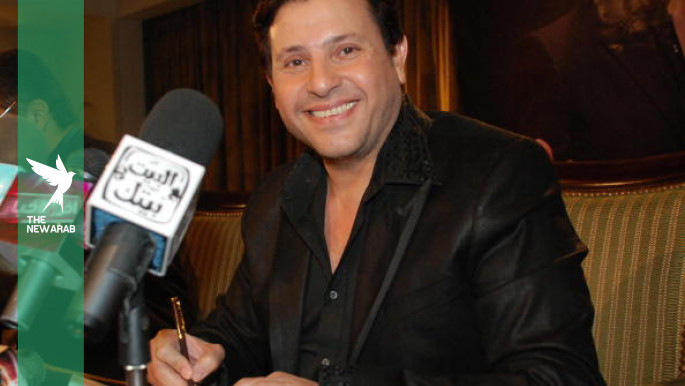
Egyptian pop star Hany Shaker smiles during a press conference after signing in 2008 in Cairo [Getty]
Egyptian singer Hany Shaker, one of the Middle East’s most famed music icons, passed away at 74 on Sunday after battling a long illness.
The musician died at a hospital in Paris where he was undergoing medical treatment. His death followed a rapid deterioration in his condition which saw respiratory complications and severe colon problems, according to Egyptian media.
He had shown relative improvement before suffering a sudden relapse that kept him in intensive care.
His body will be returned to Egypt where he will be buried.
Social media flooded with heartfelt messages of condolences.
Mourning his father on Instagram, Sherif Shaker wrote in a post: “With hearts that accept God’s will and decree, I mourn my father – my friend, my backbone, my support, my beloved, and my brother – Hany Shaker, the Arab world’s ‘Prince of Arabic Song.’
“I have not only lost a father, but my soul and the closest person to my heart. May God have mercy on him, forgive him, and grant him paradise. We belong to God and to Him we shall return.”
Shaker’s daughter, Dina, died in 2011 after battling cancer.
Born in Cairo in December 1952, the singer studied music at the Faculty of Music Education in the city’s Zamalek district. He appeared in a children’s singing show on Egyptian television, one of his earliest appearances where he was first introduced to the wider public.
Emerging in the 1970s as a contemporary of the giants of the ‘Golden Age,’ Shaker established a distinct musical identity through his classical romantic style and extensive discography, gaining his nickname the ‘Prince of Arab Song’.
In addition to his artistic contributions, he served as the head of the Egyptian Musicians’ Syndicate for several years, where he was a key figure in regulating the country’s music industry.
He released around 29 albums, his last being in 2024. His last concert was on 2 April in Cairo.
Shaker leaves behind a vast cultural legacy that remains a cornerstone of modern Arabic music history.