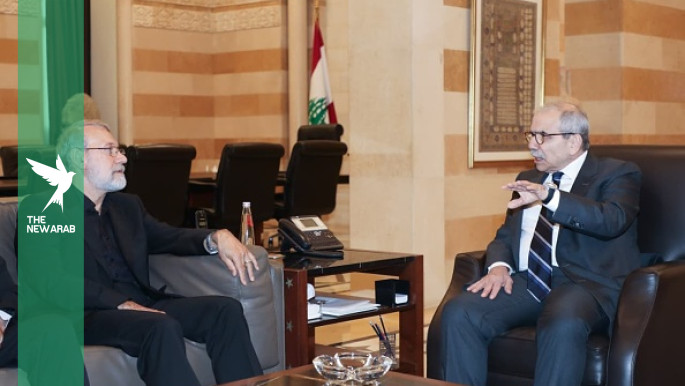
Salam (R) meets with head of Iran’s Supreme National Security Council, Ali Larijani, in Beirut, August 2025 [Getty]
Lebanese Prime Minister Nawaf Salam has called on Hezbollah to prioritise Lebanon’s interests over Iran’s, urging the group to support the government’s negotiation track with Israel under US mediation.
In an interview with Reuters, Salam said Hezbollah should “be faster than us, or at least at the same pace” in backing the upcoming talks between Lebanon and Israel, scheduled to resume on 22 June in Washington.
He stressed that the Lebanese government is negotiating as an independent state, adding that “no one is negotiating on behalf of Lebanon,” while acknowledging that the country is affected by broader regional negotiations involving Iran and the United States.
Salam added that any de-escalation or agreement in the region would have a positive impact on Lebanon.
The premier has repeatedly criticised Iran, alongside President Joseph Aoun, accusing it of interfering in Lebanese internal affairs and using Lebanon as a bargaining chip. Tehran denies this, but says it will continue supporting Hezbollah.
Iran is considered to wield significant influence over Hezbollah, which it has backed for decades.
Hezbollah’s political opponents in Lebanon often accuse it of placing Iran’s interests ahead of Lebanon’s, citing its political and ideological alignment with Tehran.
The group has criticised the Lebanese government for engaging in direct talks with Israel, while also expressing support for linking any ceasefire in Lebanon to US–Iran negotiations being mediated by Pakistan.
Islamabad has said a deal could be signed very soon between the United States and Iran. The agreement is supposed to include a two-month ceasefire in Lebanon. A separate Israel-Hezbollah ceasefire supposed to come into effect since April has failed to materialise.
Hezbollah MP Ali Fayyad said on Saturday that Lebanon should make do with any US-Iran deal that included the country.
A fateful test
Lebanon’s government has insisted that it alone has the mandate to negotiate on behalf of the country, rejecting any linkage between Lebanon’s fate and external negotiations. However, it has welcomed regional diplomatic efforts aimed at ending the conflict.
Lebanese leaders have defended direct talks with Israel as the only viable path to end the decades-long conflict. The US-sponsored negotiations aim to secure a permanent ceasefire, the withdrawal of Israeli troops from southern Lebanon, and possibly a broader peace deal. They also call on disarming non-state actors, namely Hezbollah – a demand the group rejects until Israel withdraws.
Israel has said it will not pull out of Lebanon until Hezbollah is dismantled.
Salam argues that disarming Hezbollah and other armed groups is required under the Lebanese constitution and necessary to strengthen state authority across all territory, regardless of Israeli or US demands.
Aoun said in a statement that Lebanon faces “a fateful test.”
“Either its people unite around a sovereign state that monopolises weapons, upholds the law and protects citizens irrespective of their affiliation or position, or it remains hostage to the logic of militias,” he said.
Since fighting resumed between Hezbollah and Israel on 2 March, Israeli attacks on Lebanon have killed 3,756 people and wounded thousands more.