
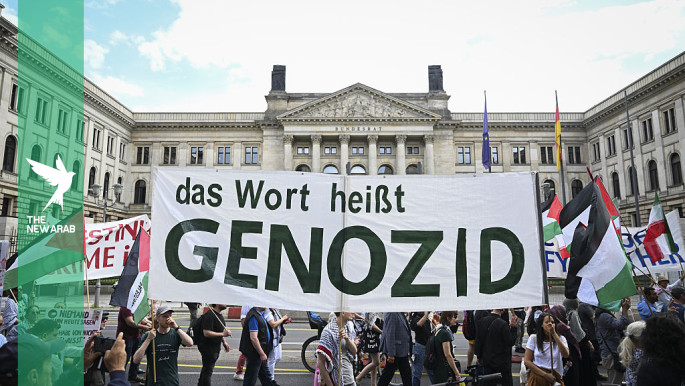
Palestine solidarity groups are taking German intelligence services to court, accusing authorities of escalating surveillance and repression of pro-Palestinian activism [Getty]
German intelligence services are escalating their surveillance of Palestine solidarity activists and organisations in a manner that violates fundamental rights, a legal group challenging the practice in court has told The New Arab.
The European Legal Support Centre (ELSC), which is representing three Palestine solidarity organisations targeted by Germany’s domestic intelligence service, said it was seeking to push back against an “escalating effort” to intimidate and repress activism in support of Palestinians.
“We aim to push back against the escalating effort to intimidate and repress Palestine solidarity and to raise awareness, expose and challenge the massive increase in the deployment of the secret service Verfassungsschutz against civil society and political organisations,” Karim Bohnhoff, spokesperson for the ELSC, told The New Arab.
The comments come as Thawra Hamburg, BDS Berlin and Jewish Voice for a Just Peace in the Middle East challenge surveillance and monitoring measures by Germany’s domestic intelligence service, the Verfassungsschutz.
According to the ELSC, the groups were designated as an “extremist endeavour as corroborated by hard evidence” in intelligence reports and subsequently subjected to extensive monitoring.
Bohnhoff said the ELSC had observed a growing use of intelligence services against Palestine solidarity groups and other political movements in Germany.
“This happens in violation of fundamental human rights such as freedom of expression and political association,” he said.
He warned that being listed in intelligence reports can have serious consequences.
“Being listed in reports by the domestic intelligence services, or being surveilled unknowingly, can lead to severe consequences for people’s citizenship applications, freedom of movement and residency status, cancellation of public events, police raids and criminal cases,” Bohnhoff said.
Jewish group says authorities are trying to portray activists as extremists
One of the groups challenging the surveillance is Jewish Voice for a Just Peace in the Middle East, which has been labelled “extremist” by the intelligence service.
Iris Hefets, a member of the organisation, told The New Arab that she feared the designation could be a precursor to attempts to shut the group down entirely.
“They try to show that we are supporting terrorists,” Hefets said.
German intelligence services have submitted evidence to the courts detailing surveillance of the group and some of its members dating back to 2019.
The organisation has been cited by authorities for activities including commemorating the Nakba, advocating equal rights for all people between the Jordan River and the Mediterranean Sea, and describing Israel’s actions in Gaza as genocidal.
“That’s the logic, that’s what they try to prove by all means, which is really ridiculous,” Hefets said. “Now we are in a situation in which the secret service is allowed to conduct surveillance and to decide that we are extremists.”
Court orders halt to surveillance of Palestine group
In a separate case involving Thawra Hamburg, a court issued an interim order requiring the Hamburg State Office for the Protection of the Constitution to stop surveilling and listing the group.
The ruling followed legal action by ELSC partner lawyer Ammar Bustami.
The court indicated that the surveillance could infringe fundamental constitutional rights and found that authorities had not provided sufficient legal justification for monitoring the group’s political activities.
However, the court noted that procedural limitations prevented it from issuing a final ruling on the substance of the case.
Thawra Hamburg had come under investigation over alleged links to Hamas and its involvement in protests, including a protest camp established at a Holocaust deportation site.
The ELSC said it intends to rely on the court’s findings in future legal challenges should surveillance measures resume.
The organisation is also supporting BDS Berlin in a separate case against Germany’s Federal Office for the Protection of the Constitution.
The legal battles come amid broader concerns among rights groups over Germany’s treatment of Palestine solidarity activism since the start of Israel’s war on Gaza.
In a separate case, five pro-Palestinian activists known as the “Ulm 5” are currently on trial over a break-in at an Elbit Systems weapons facility in the southern German city of Ulm, a case that has drawn further scrutiny of the state’s response to Palestine solidarity activism.