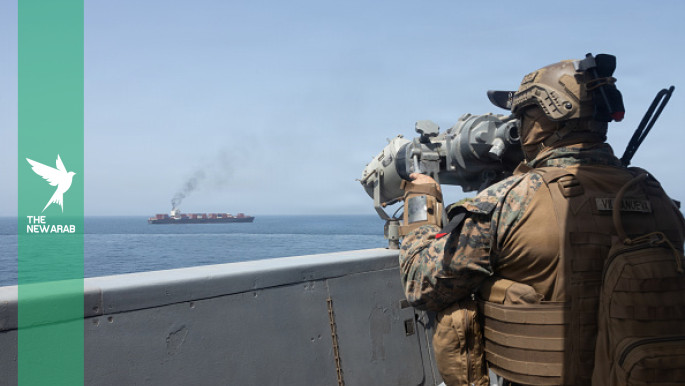
US President Donald Trump said on Sunday that the US Navy would begin helping the thousands of ships trapped in the Gulf pass through the Strait of Hormuz.
Branded ‘Project Freedom’, the move is the US president’s latest gambit to weaken Iran’s control over one of the world’s most critical shipping corridors, whose closure has triggered a historic worldwide energy crisis.
What’s the plan?
In short, it remains unclear.
In a Truth Social post announcing the initiative, Trump said the US Navy would “guide” ships out of the Gulf but stopped short of saying whether they would physically escort them through the strait.
A subsequent statement issued by US Central Command (CENTCOM) was even more ambiguous, saying only that the mission would “support” vessels trying to transit the corridor.
CENTCOM indicated it would be a major operation, announcing that more than 100 aircraft and 15,000 service members would be involved. But it did not specify how many naval ships would be deployed in the effort.
US officials speaking anonymously to Axios downplayed the likelihood of US warships entering the strait, which Iran has declared is under its military control.
One of the officials said the US Navy would instead be “in the vicinity” in case ships come under attack from Iran’s military.
How many ships are trapped in the Gulf?
More than 2,000 ships have been trapped in the Gulf for almost 10 weeks after Iran locked down traffic through the strait following the US-Israel attack on 28 February.
As many as 20,000 crew members are thought to be aboard the stranded vessels.
The humanitarian situation on some of the ships is thought to be dire, with reports back in March revealing growing shortages of food and water.
“There is no precedent for the stranding of so many seafarers in the modern age,” a UN maritime official said in March.
How has Iran responded?
Iran has repeatedly warned the US against deploying its navy to the Gulf and vowed to target them if they tried to break its grip over the strait.
“We warn that any foreign armed force – especially the aggressive US military – if they intend to approach or enter the Strait of Hormuz, will be targeted and attacked,” said Major General Ali Abdollahi, who leads the Iranian military’s central command, on Monday.
Iranian media reported on Monday morning that a US patrol boat navigating near the strait had been forced to turn back after being hit by two Iranian missiles.
Meanwhile, Iran’s deputy foreign minister issued a warning to shipping companies to coordinate with Tehran before trying to transit the strait.
“Ships and shipping companies well know that ensuring their security requires coordination with the competent authorities of the Islamic Republic of Iran,” Esmail Bagheri said in a statement shared by Iran’s semi-official Mehr news agency.
What is the aim?
‘Project Freedom’ is Trump’s latest in a number of attempts to weaken Iran’s control of the strait, all of which have failed to end the ongoing standoff.
Iran has closed the strait to almost all traffic since the start of the war, cutting off vital supplies of oil, gas and fertilisers and triggering a global energy crisis.
Since the ceasefire, it has continued to insist that it retains influence over the strait as part of any settlement to end the war.
Trump has responded by imposing a blockade on Iranian ports in a bid to cripple the country’s oil and gas industry, which he refuses to lift until Iran re-opens the strait.
But three weeks into the blockade, Iran has shown no signs of relenting despite the gathering crisis in its oil sector. Tehran has instead doubled down on its demands and threatened to attack any hostile military that attempts to change the current status quo.