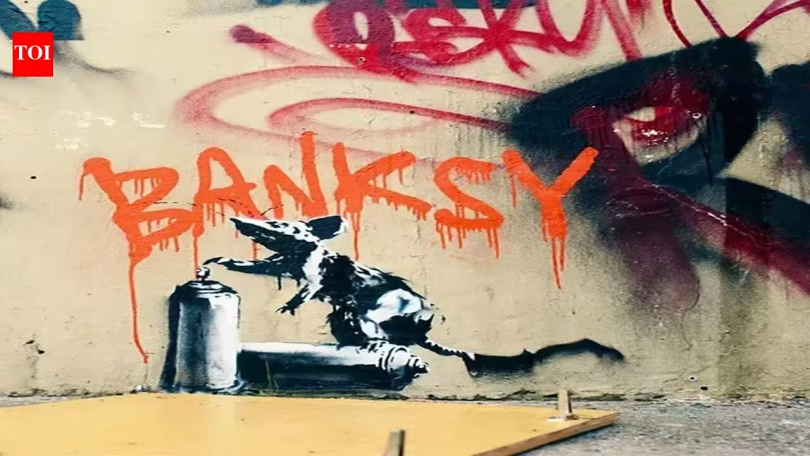
“I don’t know why people are so keen to put the details of their private life in public; they forget that invisibility is a superpower.” — BanksyBanksy is one of the most recognisable modern artists and political activists but ironically, almost nobody knows who Banksy actually is. For more than three decades, the anonymous street artist has built a global reputation without public appearances, interviews or official confirmation of their identity. New works appear overnight on walls, bridges and abandoned buildings, attracting crowds before they are authenticated through Banksy’s social media accounts. The art is instantly recognisable but the artist remains invisible.That paradox gives unusual weight to one of Banksy’s most quoted observations. It is more than a remark about privacy. It is a philosophy that challenges a culture in which visibility is increasingly treated as a measure of success.
The meaning of the quote
At first reading, the quote sounds like a criticism of oversharing. Its deeper message, however, is about choice. In an age where people are encouraged to document holidays, meals, opinions and milestones, sharing can begin to feel less like an option and more like an expectation. Banksy’s quote suggests that privacy is not simply the absence of attention. It is the freedom to decide which parts of life belong to the world and which remain one’s own.Invisibility, in this sense, is not about disappearing. It is about retaining control over your story.There is a solace in knowing that not every achievement needs an announcement, not every opinion requires publication and not every personal moment becomes more meaningful because others witness it. Some experiences derive their value precisely from remaining private.Few public figures have lived this philosophy as consistently as Banksy. Since emerging in Bristol’s underground art scene during the 1990s, Banksy has protected their anonymity despite becoming one of the world’s most influential contemporary artists. Their works have sold for millions of dollars, appeared in museums and sparked international debates on politics, consumerism and war. Yet the conversation almost always returns to the art itself rather than the artist’s personal life.That anonymity has also given Banksy unusual freedom. Without a public persona to maintain, every new artwork arrives without the expectations attached to celebrity. The murals are judged first by what they say rather than by who painted them.It is a reminder that influence and visibility are not always the same thing. Sometimes anonymity allows ideas to speak more loudly than identity.
Privacy in the age of constant sharing
When Banksy first made the remark, social media was still in its infancy. Today, it feels even more relevant. Modern platforms reward visibility, algorithms favour frequent posting. Careers are built on personal branding. Everyday life is increasingly photographed, filmed and shared in real time. For many people, visibility has become intertwined with validation.We have long noted that we share online for many reasons: to stay connected, preserve memories, express identity or seek belonging. None of these motivations is inherently unhealthy. The problem arises when sharing stops being intentional and becomes automatic.Choosing not to post can feel strangely difficult because silence is often interpreted as absence. Yet Banksy’s quote proposes the opposite idea. Remaining unseen, at least sometimes, can be an expression of independence rather than withdrawal.The moments that matter most like a conversation with family, a personal achievement, an act of kindness or a difficult decision do not become more valuable because they receive public attention.The quote does not argue against openness. Sharing stories can build communities, strengthen relationships and inspire others. Banksy himself shares photographs of new artworks through official channels. The distinction lies in deciding what deserves to remain private.Throughout history, many writers, thinkers and artists have guarded large parts of their personal lives while allowing their work to enter the public domain. They recognised that creativity flourishes not only in what is revealed, but also in what is protected.In that sense, privacy is not secrecy. It is a boundary. Like any boundary, it preserves space for reflection, experimentation and authenticity away from public judgement.
Why the quote endures
Banksy’s identity has become one of the art world’s greatest mysteries. Yet perhaps the mystery itself explains why the quote continues to resonate.His anonymity has never diminished his influence. If anything, it has strengthened it. The absence of a public face has encouraged audiences to focus on the message instead of the messenger, proving that recognition does not always require constant exposure.In a world where visibility is increasingly encouraged and personal lives are easily transformed into public content, Banksy’s words offer a different perspective. Freedom is not measured only by the ability to speak. It is also measured by the ability to choose silence.Perhaps that is the real superpower the artist was describing— not invisibility itself, but the freedom to decide what remains unseen.