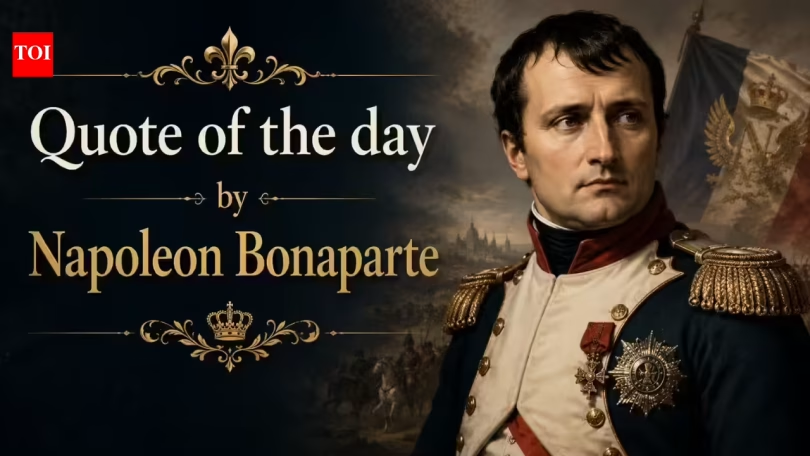
Today’s quote of the day is widely attributed to Napoleon Bonaparte, the French military leader and emperor who reshaped Europe in the early nineteenth century. The line reads, “The world suffers a lot. Not because the violence of bad people. But because of the silence of the good people.” It circulates constantly online, usually without a specific date, speech or letter attached to it, which is common for a lot of quotes tied to historical figures whose words were recorded inconsistently. Whether or not Napoleon spoke these exact words, the sentiment fits a man who spent his career studying how power actually moves, and who understood better than most how much a lack of resistance can shape events just as much as resistance itself.
Quote of the day by Napoleon Bonaparte
“The world suffers a lot, not because of the violence of bad people, but because of the silence of the good people”
A line about inaction, attributed to a man of relentless action
Napoleon rose from a minor Corsican noble family to Emperor of France largely because he moved decisively while others hesitated. He built his early reputation during the chaos of the French Revolution, a period defined by exactly the kind of vacuum this quote describes, where indecision among moderate voices allowed more extreme factions to seize control.That backdrop makes the quote feel consistent with his broader worldview, even without a confirmed original source. Napoleon repeatedly took advantage of moments when others failed to act, whether on the battlefield or in the political manoeuvring that followed the Revolution. An observation about the cost of silence and inaction fits naturally into that pattern, whether or not he ever wrote it down in these precise words.There is also a certain irony worth noting. Napoleon spent his career exploiting the silence and indecision of others to expand his own power, first as a general, then as First Consul, and eventually as Emperor. If he genuinely believed that silence allowed harm to spread, he was also a man who benefited enormously from exactly that dynamic playing out in his favour, again and again, throughout his rise.
The powerful message behind Napoleon Bonaparte’s quote
The quote draws a distinction that is easy to overlook: bad outcomes are not caused only by bad actors. They are also enabled by the inaction of people who knew better but chose not to intervene. Violence, corruption or cruelty rarely operate without some form of surrounding silence, whether that silence comes from fear, convenience, or simply the assumption that someone else will speak up instead.This reframes responsibility in an uncomfortable way. It suggests that watching harm unfold without objecting is not a neutral act. It is a contributing one. The people causing damage are often a small minority. What allows that damage to spread is usually a much larger group who see it happening and stay quiet.This idea also challenges a common excuse people give themselves, which is that staying out of a conflict makes them innocent of it. The quote rejects that logic outright. It treats bystanding as a form of participation, not an escape from it, on the basis that every act of harm requires some measure of surrounding tolerance in order to continue unchecked.
Why this idea keeps resurfacing across history
Versions of this sentiment appear again and again across different eras and different speakers, which is part of why it gets attributed to so many historical figures rather than staying tied to one confirmed source. The idea shows up in discussions of wartime complicity, corporate wrongdoing, and everyday workplace culture, wherever a small group causes harm while a much larger group of onlookers says nothing.That repetition is not really a coincidence. Every generation seems to rediscover the same uncomfortable truth, that silence in the face of wrongdoing tends to function as quiet permission. The specific wording changes depending on who is credited with saying it, but the underlying observation about complicity through inaction has proven durable precisely because it keeps describing real situations, regardless of the century.
How to apply this quote by Napoleon Bonaparte in daily life
Applying this quote does not require confronting large-scale injustice to be useful. It works just as well at a much smaller scale, in a workplace where a colleague is treated unfairly and nobody says anything, or in a friendship where a harmful pattern goes unaddressed because pointing it out feels awkward. The quote is a reminder that staying quiet in these moments is itself a choice, not a neutral absence of one.A practical way to use this idea is to notice the specific excuses that talk you out of speaking up, whether that is not wanting to cause conflict, assuming it is not your place, or believing someone else will handle it. None of those excuses make the silence disappear. They simply explain why it happened. Naming the excuse for what it is can be the first step towards actually saying something the next time it matters.
Other famous quotes by Napoleon Bonaparte
- “Courage isn’t having the strength to go on. It is going on when you don’t have strength.”
- “Ten people who speak make more noise than ten thousand who are silent.”
- “There are but two powers in the world, the sword and the mind. In the long run the sword is always beaten by the mind.”
- “Imagination governs the world.”