
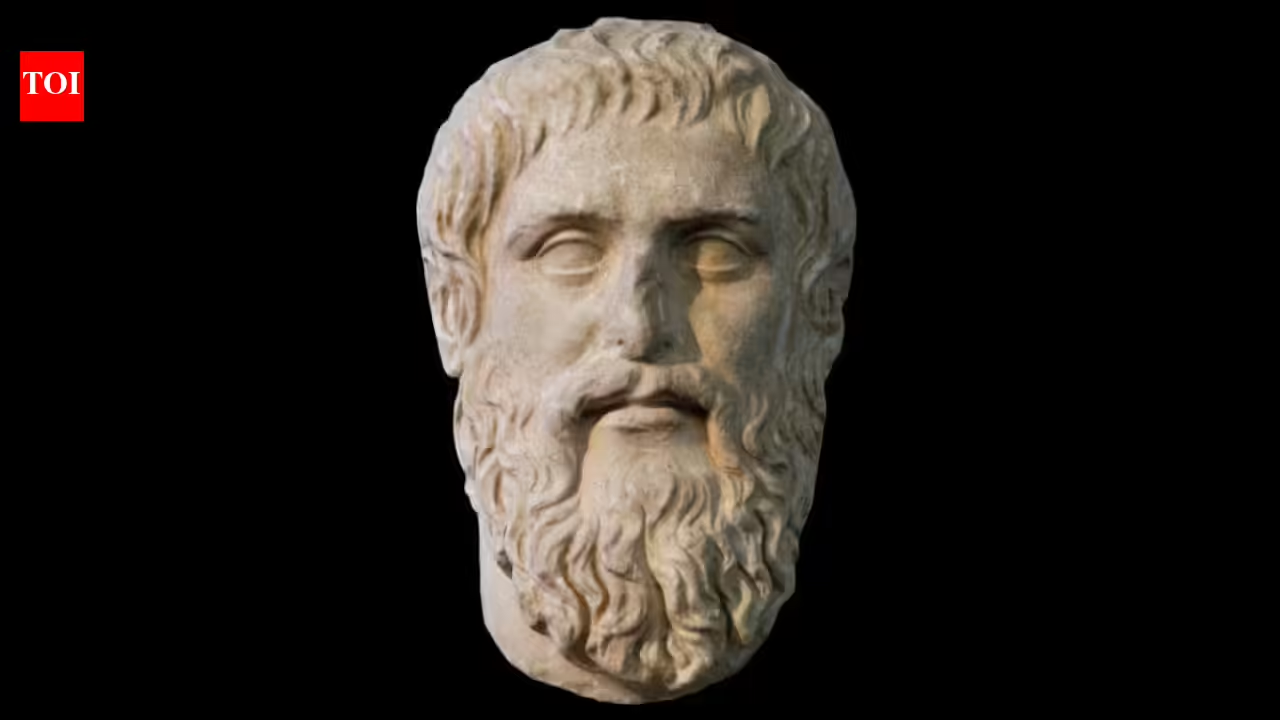
We often think of education as something that happens inside classrooms, ends with a certificate, and is mostly about passing exams. Plato, one of the greatest thinkers who ever lived, saw it very differently, and far more grandly. To him, education was not simply the filling of a young mind with facts. It was the process by which a person becomes fully human, even, in his words, touched by something divine. This quote captures that lofty view in a single line. It says there is nothing more sacred than education, and that it is only through learning that a person truly becomes what they are meant to be. For Plato, an uneducated life is an unfinished one. It is a bold claim worth examining, because it quietly asks us to rethink what education is actually for.
Quote of the day by Plato
“There is nothing more divine than education. It is only through education that one truly becomes man.”
Who was Plato and why education mattered so much to him
Plato was an ancient Greek philosopher who lived in Athens around 2,400 years ago. He was a student of Socrates and the teacher of Aristotle, which places him right at the heart of Western philosophy. He also founded a school called the Academy, often described as one of the first universities in the Western world.Education was one of his deepest concerns. In his most famous work, The Republic, he spent a great deal of time on how people should be taught and why it matters so much, both for the individual and for society. So when Plato talks about education, he is not making an offhand remark. He is touching on something he thought about for his entire life.
What is the meaning of the quote by Plato
At its simplest, the quote makes two claims. First, that nothing is more divine, more elevated or sacred, than education. Second, that it is only through education that a person truly becomes a full human being.Plato is drawing a line between merely existing and truly living as a developed person. A newborn has all the potential of a human, but that potential has to be drawn out and shaped. Education, for Plato, is what does that shaping. It turns raw possibility into wisdom, character and understanding. Without it, he suggests, a person stays unfinished. The word divine matters too. Plato is saying that learning lifts us toward our highest and best selves, closer to what is good and true.
What Plato meant by education
It helps to know that Plato did not mean education quite the way we often do. For him, learning was not about cramming information or collecting qualifications. The Greek idea he worked with, sometimes called paideia, meant the shaping of the whole person: their mind, their character, and their sense of right and wrong.This particular line is a condensed version of an idea he set out more fully in his work the Laws. There he wrote that a human being, given proper instruction and a good nature, becomes the most divine and civilised of all creatures, but a badly educated one can become the most savage. Education decides the direction our nature takes. Left untended, our potential can run wild. Properly cultivated, it can lift us to our finest.
Why this quote is relevant
The idea still lands today, perhaps more than ever. We live surrounded by information, yet information is not the same as education in Plato’s sense. Facts are easy to look up. Wisdom, judgement and character take real cultivation.Plato’s view is a reminder that education is not only job training or a stack of certificates. It is about becoming a more complete and more thoughtful person. It also widens what we count as education in the first place. Formal schooling matters, but so does everything that shapes us afterward, including the books we read, the people we learn from, and the habits of thinking we build over a lifetime.
How to apply this quote in daily life
You do not need to be a philosopher to live by this idea. It is really an invitation to take learning seriously.
- Treat learning as something for life, not just for school. Plato saw education as the shaping of a whole person, which never truly finishes. Keep reading, asking questions and learning long after any classroom.
- Aim for understanding, not just information. It is easy to collect facts. Try to go deeper and grasp why things are as they are, which is closer to what Plato had in mind.
- Work on character, not only knowledge. For Plato, real education shaped how a person lived, not just what they knew. Let your learning make you wiser and kinder.
- Choose your influences with care. We are educated by everything around us, so pick the books, conversations and company that help draw out your best.
Other famous quotes by Plato
Plato had a great deal to say about learning and life. Here are a few of his genuine lines.
- “The direction in which education starts a man will determine his future in life.”
- “Do not train a child to learn by force or harshness, but direct them to it by what amuses their minds.”
- “If a man neglects education, he walks lame to the end of his life.”
- “The beginning is the most important part of the work.”
For Plato, education was nothing less than the path to becoming fully and truly human. It is a far bigger idea than grades or exams, and a far more hopeful one. It means that whatever we start with, we are not fixed in place. Through learning, we can keep growing and keep moving toward our best selves. More than two thousand years later, that is still one of the most encouraging things anyone has said about trying to learn.