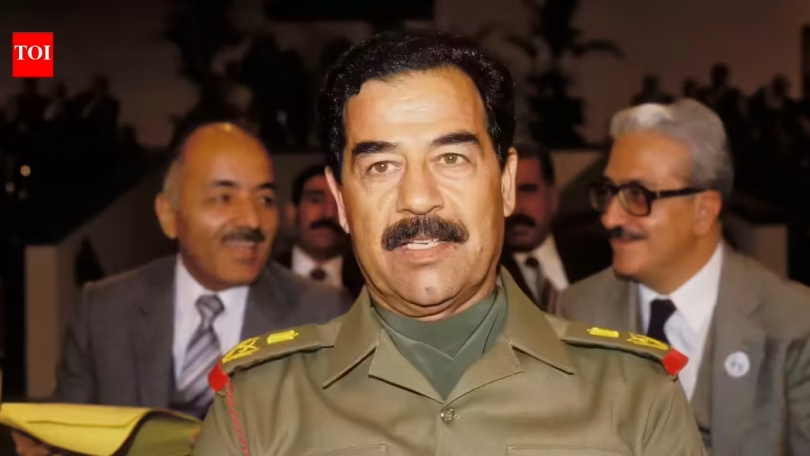
Even after losing power and facing trial for crimes against humanity, Saddam Hussein remained defiant. Sitting inside a Baghdad courtroom in 2006, the former Iraqi president brushed aside jeers from the public gallery with a remark that has since become one of the most widely quoted lines from his trial: “A lion doesn’t care if a monkey in a tree is laughing at him.“The comment was delivered in the middle of a tense courtroom exchange during proceedings against the deposed Iraqi leader. As emotions flared, Hussein urged his half-brother Barzan al-Tikriti to ignore those mocking them, insisting that a lion had no reason to concern itself with the laughter of monkeys. The remark, intended as a display of confidence and superiority, reflected the persona Hussein had cultivated throughout his decades in power.For many of his supporters, the quote symbolised resilience in the face of humiliation. For his critics and the families of thousands of victims, however, it epitomised a ruler who refused to acknowledge responsibility for the violence carried out under his regime. The statement has endured long after Hussein’s execution, frequently resurfacing on social media as a motivational quote, often stripped of the historical circumstances in which it was uttered.
What did Saddam Hussein mean?
The metaphor was straightforward. By comparing himself to a lion and those ridiculing him to monkeys, Hussein suggested that a powerful leader should not be distracted by mockery from people he regarded as insignificant. It was an attempt to project strength at a moment when he was no longer the all-powerful ruler of Iraq but a defendant facing justice.The comment also illustrated Hussein’s refusal to concede defeat. Throughout the proceedings, he repeatedly challenged the legitimacy of the tribunal, declared himself Iraq’s lawful president and clashed with judges and prosecutors. Rather than expressing remorse, he frequently turned court hearings into political statements, insisting that his actions had been lawful and undertaken in defence of the Iraqi state.
Who was Saddam Hussein?
Born in 1937 in the village of al-Awja near Tikrit, Saddam Hussein rose through the ranks of Iraq’s Ba’ath Party before becoming the country’s president in 1979. Over the next 24 years, he established one of the Middle East’s most authoritarian regimes, consolidating power through an extensive security apparatus, political purges and a pervasive cult of personality. Portraits of Hussein dominated public spaces, while dissent was ruthlessly suppressed.His rule was shaped by conflict. Iraq fought an eight-year war with Iran between 1980 and 1988, invaded Kuwait in 1990—triggering the Gulf War—and faced years of international sanctions before the US-led invasion in 2003 brought his government to an end. Captured by American forces near Tikrit in December 2003, Hussein spent the remainder of his life in custody awaiting trial.
The trial that defined Iraq’s post-war justice
Saddam Hussein’s first trial began in October 2005 before the Supreme Iraqi Criminal Tribunal. Prosecutors accused him and seven co-defendants of crimes against humanity over the killing of 148 Shi’ite men and boys from the town of Dujail following an assassination attempt against him in 1982. Hussein pleaded not guilty and consistently rejected the authority of the court.The proceedings were marked by repeated disruptions, security concerns and violence outside the courtroom. Defence lawyers were kidnapped and killed, judges were replaced, and Hussein himself was removed from hearings on several occasions after refusing to comply with courtroom rules. Despite these setbacks, the tribunal continued hearing evidence against the former president and his associates.Alongside the Dujail case, Hussein also faced charges relating to the Anfal campaign against Iraq’s Kurdish population, including allegations of genocide and war crimes. Several senior officials, among them Ali Hassan al-Majid—better known as “Chemical Ali”—were tried alongside him on charges carrying the death penalty.The Dujail trial ultimately resulted in Hussein’s conviction for crimes against humanity. He was sentenced to death and executed on December 30, 2006. The verdict marked the end of one of the most closely watched trials in modern Middle Eastern history, although it also drew scrutiny from legal experts and human rights organisations. Some criticised aspects of the proceedings, arguing that procedural shortcomings and evidentiary gaps undermined parts of the tribunal’s judgment, even while acknowledging the gravity of the crimes committed under Hussein’s rule.
The atrocities that defined his rule
Although Saddam Hussein sought to portray himself as a defender of Iraqi sovereignty, his legacy is overwhelmingly associated with widespread human rights abuses.Among the most infamous episodes was the Dujail massacre, in which 148 Shi’ite men and boys were executed after an assassination attempt against Hussein in 1982. The incident became the basis of the trial that ultimately led to his execution.Another defining chapter was the Anfal campaign against Iraq’s Kurdish population during the late 1980s. Iraqi forces carried out mass killings, forced displacements and village destruction across northern Iraq. The campaign culminated in the Halabja chemical attack in March 1988, when chemical weapons were used against the Kurdish town, killing thousands of civilians and injuring many more. Survivors described choking fumes, blindness and entire families dying as they attempted to flee. The attack remains one of the deadliest chemical assaults against civilians in modern history.Following the Gulf War in 1991, Hussein’s government brutally crushed uprisings in southern Iraq and Kurdish regions. Thousands of suspected opponents disappeared, while mass graves discovered after the fall of his regime revealed the scale of the killings. Families searching burial sites recounted decades of uncertainty before identifying the remains of loved ones.Human rights groups and survivors also documented the systematic use of torture inside Iraqi prisons. Former detainees described beatings, electric shocks, prolonged solitary confinement and psychological abuse. Others recalled witnessing relatives tortured or executed, while athletes and political prisoners alleged they were subjected to brutal punishment for perceived disloyalty. These accounts became part of the broader body of evidence illustrating the climate of fear that existed under Ba’athist rule.The regime’s record extended beyond Iraq’s borders. Hussein’s decision to invade Kuwait in 1990 sparked the Gulf War, while his government’s repeated use of chemical weapons during the Iran-Iraq War attracted widespread international condemnation. Later investigations and historical research also examined the role played by foreign governments and companies in supplying Iraq with materials and technology during that period, adding another layer of complexity to the history surrounding his rule.