By Cecilia Ologunagba/ NAN —
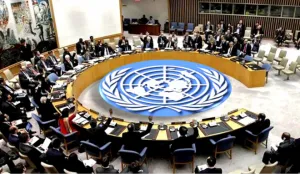
The quest for Africa’s permanent representation in the UN Security Council (UNSC) was accentuated at the General Debate of the 81st session of the UN General Assembly (UNGA).
Born from ..-World War II settlement, the UNSC was created because the older League of Nations had failed to stop the war due to its lack of real enforcement power.
The new council was given the power to issue binding resolutions, impose economic sanctions, and authorise military force.
Under the arrangement, five major powers, China, France, Soviet Union, United Kingdom and United States were given permanent membership.
The arrangement reflected the geopolitical realities of 1945, when the United Nations had 50 members and much of Africa and Asia remained under colonial rule.
The Council originally had 11 members, but was expanded to 15 in 1965, while the five permanent members retained their veto over substantive decisions.
Eight decades later, the United Nations has 193 members, representing a profoundly different international system from that which existed when the Security Council was established.
Africa now has 54 UN member states, making it the largest regional grouping in the organisation, yet the continent has no permanent Security Council representation.
The Council possesses significant authority, including determining threats to international peace, imposing sanctions, authorising peacekeeping operations and, in certain circumstances, approving military action.
Its decisions have frequently concerned African conflicts and security challenges, making Africa a major focus of the Council’s peace and security responsibilities.
Consequently, African countries are often directly affected by decisions taken by a body in which the continent has no permanent voice or veto.
Observers say this creates a representation gap: African states participate in implementing decisions affecting their security, sovereignty and societies, while possessing no permanent seat in making those decisions.
Most African leaders and world leaders, who spoke at the 81st session of UNGA, described the continent’s continued exclusion as indefensible, unjust and unfair.
In his opening address, the UN Secretary-General Antonio Guterres called for Security Council reform, saying that the continued absence of permanent African representation on the body was “unjust and indefensible.”
He said the 15-member Security Council’s composition no longer reflected the current geopolitical realities and repeated his call for reform.
Similarly, the President of the General Assembly’s 81st session, Khalilur Rahman, said the UN’s survival for 80 years was not, by itself, proof of success; hence, the institution must confront painful truths if it hoped to rebuild public trust.
Rahman said the UN had grown from 50 member states in 1945 to 193, but survival alone was not evidence of success.
The assembly president, then, renewed his call for fairer representation at the Security Council.
“Africa remains without a permanent Security Council seat after eight decades, which must change as a matter of fairness, justice and credibility.
“When the Security Council works, the United Nations works.”