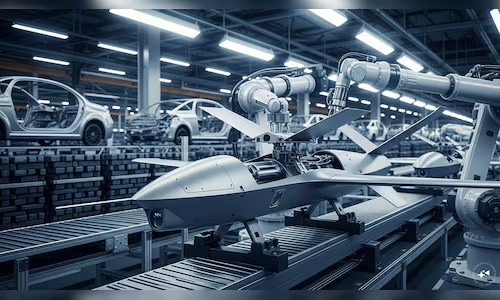
Thales, a defence contractor, and Renault, a company better known for city cars such as the R5 and Clio, said Tuesday they aim to build a “sovereign, agile and competitive drone industry in France, fully aligned with the requirements of the wartime economy.”
The pact, the second defence collaboration announced by the two French companies this week, is for the manufacture of so-called loitering munitions, also known as kamikaze or suicide drones, which are designed to circle above their target before striking. The drones are mostly destined for export, Thales Chief Executive Officer Patrice Caine said during a press event on Tuesday.
The push underscores how Russia’s war in Ukraine is transforming Europe’s industrial base, with governments seeking to produce cheaper weapons at much greater scale and far faster than traditional defence procurement allows.
Carmakers are emerging as a natural partner in that shift, offering the supply chains, factory discipline and mass-production expertise needed to turn drones from specialist military equipment into readily available battlefield commodities.
The project “is important for our sovereignty as almost all components are French or European,” Renault CEO François Provost said at the press conference, held at the Eurosatory 2026 defence and security conference near Paris.
The venture could start output as early as 2027, scaling up to manufacturing capacity of 1,000 units per month from the first year. Renault also is mulling manufacturing ground drones for the battlefield while it has no intention of producing tanks, Provost said during the press event. The group may make some changes to its organisation later this year to better reflect the new defence focus, Provost also said.
Renault is the latest European automaker looking to tap into Europe’s military spending boom. Volkswagen AG has explored defence work at its Osnabrück plant, while Mercedes-Benz Group AG is partnering with Munich-based Tytan Technologies on mobile drone-defence systems.
For Renault, the defence push marks a sharp turn. The French automaker was once among the Western car companies most exposed to Russia through its control of AvtoVAZ, the maker of Lada vehicles, before exiting the country after the Kremlin’s full-scale invasion of Ukraine.
In an internal note in September, Renault had told employees any defence decision would be “aligned with our values, with the interests of the group and taking into account everybody’s security.”
Renault, 15% owned by the French government, also has said it’s working with Turgis Gaillard, a local aeronautics and defence contractor, to manufacture multi-purpose aerial drones at a plant in Le Mans. Like many European manufacturers, the group has a history of contributing to military efforts, including building light tanks during World War I.
In an interview in Brussels this month, Provost denied a Financial Times report that said Renault had set a 5% cap on military revenues. Sales from military material aren’t included in the financial objectives set out in the group’s new business plan, which runs through 2030.
“I don’t know what the sales potential could be,” Provost, who took over in July, said last week in an interview with Bloomberg in Brussels. “But if France and Europe opt in favor for arms of the kind we are seeing on the war grounds in Ukraine, if they decide to go big on the war industry, there Renault will have a big opportunity.”
The spread of relatively cheap drone technology has transformed modern battlefields. That’s forcing militaries to put greater emphasis on low-cost weapons able to target far more expensive equipment, from tanks and ships to higher-end drones.
For carmakers and suppliers struggling with weak demand, high costs and the shift to electric vehicles, that creates a potential new growth market where they can leverage their deep knowledge around scale, supply chains and fast, repeatable production.
Tuesday’s announcement marks one of the biggest defence moves yet for a European car manufacturer, part of a trend that is rippling across the global industry.
Fiat and Peugeot maker Stellantis NV is “in discussions” on defence matters even though the group remains focused on auto manufacturing, CEO Antonio Filosa said in an interview with France’s Le Point this month. In the US, General Motors Co. and Ford Motor Co. are looking at possible defence partnerships.
France is preparing its defence industry for the possibility of a high-intensity conflict by 2030, Alexandre Lahousse, deputy head of the government’s military procurement agency, said last week at the Paris Air Forum.