
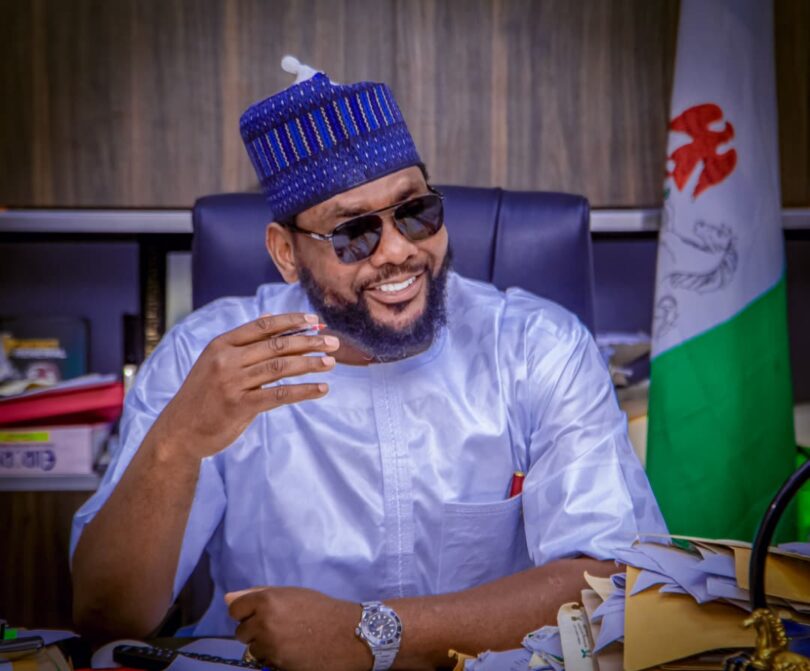
When his name was announced as the Director of Youth Mobilization of the Renewed Hope Ambassadors, it did not come as a surprise to many of us. It was not discombobulating that a man of such pedigree was found worthy of such all-important national task. The leadership saw that he ticked all the boxes, met all the parameters and/or yardsticks for such sensitive responsibility. He is a man known with the youths — he resonates with that demography, being one himself. His marks over the years have remained indelible.
Dr. Mustapha Abdullahi, the Director-General/Chief Executive Officer of the Energy Commission of Nigeria (ECN), stands as a noteworthy exemplar of the contemporary Nigerian technocrat whose professional odyssey traverses the interstices of policy formulation, institutional governance, and developmental strategy. His leadership at the apex energy policy institution situates him within a critical domain where national aspirations for industrialisation, environmental sustainability, and energy security coalesce. In an era marked by the exigencies of global energy transition and domestic infrastructural recalibration, Dr. Abdullahi’s stewardship reflects an engagement with both the theoretical and practical imperatives of sustainable development.
His administrative philosophy appears to be undergirded by a commitment to systemic coherence and policy integration, particularly within a sector historically encumbered by fragmentation and regulatory dissonance. At the ECN, Dr. Abdullahi has been associated with initiatives that seek to recalibrate Nigeria’s energy mix through the promotion of renewable alternatives, enhancement of energy efficiency frameworks, and fostering of collaborative synergies among governmental and non-governmental stakeholders. Such undertakings resonate with broader global discourses on climate responsiveness and energy diversification, thereby situating his leadership within an international context of policy convergence.
Beyond the precincts of technocratic administration, his recent affiliation with the Renewed Hope Ambassadors signals an intriguing extension of his public engagement into the realm of civic participation and socio-political organisation. This platform, which aligns ideationally with the governance philosophy associated with President Bola Ahmed Tinubu, GCFR, represents a structured attempt to galvanise citizen involvement in national developmental narratives.
His appointment as Director of Youth Mobilization within this framework may thus be interpreted as a deliberate convergence of administrative expertise and participatory outreach.
Analytically, such an appointment underscores the increasing premium placed on organisational competence, strategic communication, and adaptive leadership in youth engagement initiatives personified by this Okene-born scion. Nigeria’s demographic configuration, characterised by a preponderance of youthful citizens, necessitates innovative modalities of engagement that transcend conventional political rhetoric. In this regard, Dr. Abdullahi’s institutional background and footprints over time potentially equips him with the requisite skills to design and implement frameworks that emphasise inclusivity, responsiveness, and programmatic coherence in mobilising youth participation.
Furthermore, his trajectory illustrates a broader trend within governance ecosystems wherein technocrats are increasingly called upon to operate within hybrid spaces that intersect policy implementation and civic advocacy. This phenomenon reflects an evolving understanding of governance as a participatory enterprise, one that requires not only the formulation of sound policies but also the cultivation of public trust, engagement, and ownership. Dr. Abdullahi’s role, therefore, may be viewed as emblematic of this paradigm shift toward integrative leadership — one that sees youth as an integral part of national renewal.
It is also pertinent to consider the symbolic dimensions of his appointment. In a socio-political milieu where youth disenchantment and demands for inclusion have become salient, the elevation of individuals with demonstrable administrative competence to roles involving youth engagement carries both representational and functional significance. It signals an attempt to bridge the often-perceived chasm between governance structures and the aspirations of younger demographics, thereby fostering a more dialogic and participatory political culture. Hence, the appointment of Dr. Abdullahi, who himself is a young Nigerian with immense potential.
In a broader developmental context, Abdullahi’s dual engagement — anchored in energy policy leadership and extended into youth-oriented civic structures — offers a compelling narrative of multidimensional public service. It encapsulates the dynamic interplay between sectoral expertise and societal engagement, highlighting the potential for cross-pollination between technical governance and grassroots mobilisation. Such a synthesis, if effectively harnessed, could contribute to more holistic and sustainable development outcomes.
Ultimately, the evolving profile of Dr. Mustapha Abdullahi invites scholarly reflection on the nature of leadership in contemporary Nigeria. His career trajectory, marked by both institutional stewardship and expanded civic involvement, exemplifies the fluidity and complexity of modern governance roles. As Nigeria continues to navigate the challenges of development, demographic transformation, and political participation, figures such as Abdullahi provide a lens through which the possibilities and limitations of integrative leadership can be critically examined.
To a friend and brother, therefore, I say congratulations are in order.
OMOGBOLAHAN L.A BABAWALE
Convener/Lead Resource Person
The Think-Tinubu Initiative (3TI)
officialczar2@gmail.com