Nobel Laureate, Prof. Wole Soyinka, has called on President Bola Tinubu to revisit the files of unresolved assassinations and extra-judicial killings across Nigeria, insisting that justice must be served regardless of where such crimes occurred. The elder statesman also renewed his call for justice for Deborah Samuel, the Sokoto student……
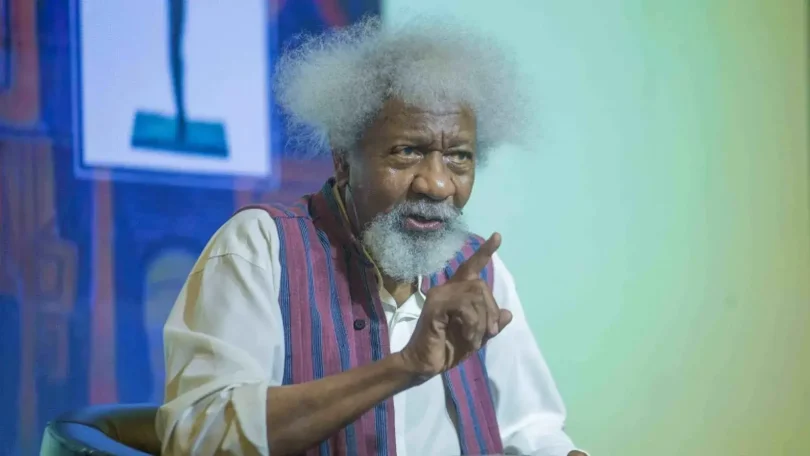
Nobel Laureate, Prof. Wole Soyinka, has called on President Bola Tinubu to revisit the files of unresolved assassinations and extra-judicial killings across Nigeria, insisting that justice must be served regardless of where such crimes occurred.
The elder statesman also renewed his call for justice for Deborah Samuel, the Sokoto student lynched over allegations of blasphemy, and Mene Ogidi, the 28-year-old reportedly shot dead by a police officer in Delta State, warning against what he described as selective justice and a culture of impunity.
According to Guardian Nigeria, Soyinka spoke at the 28th Wole Soyinka Lecture Series and National Association of Seadogs (Pirates Confraternity) Martyrs Day held in Port Harcourt.
The lecture, themed “Reclaiming the Nigerian State through Accountability, Justice and Civic Courage,” was chaired by former Managing Director of the Niger Delta Development Commission (NDDC), Chief Timi Alaibe.
The Nobel Laureate said Nigeria must not remain silent while perpetrators of brutal crimes evade justice, stressing that the country’s justice system must treat every human life with equal value.
Reflecting on the killing of Deborah Samuel, Soyinka said it remained disturbing that one of those allegedly involved publicly displayed the match used to set her ablaze without facing justice.
“It’s dedicated to individuals, the youths, like Deborah, who was killed, who was butchered by her own classmate, hunted through the city, necklaced and set on fire. But that is not the crime. That really is not the crime.
“The crime is the silence of the rest of us, that such a thing is possible, and that the killers of that girl can actually go on television, hold up a match, and say this is the match with which I set her on fire. And there the system of justice fails us completely. Try and imagine that policeman who shot that young person, then going on television and saying this is the gun with which I killed him. It’s impossible.”
Soyinka contrasted the swift arrest of the police officer accused of killing Mene Ogidi with the handling of Deborah’s case, saying justice should not depend on geography or circumstance.
“But because that happened in another part of the nation, those killers got away with it. Now when I say this, which I have done of course, then I hear cries like, oh yes he wants to start a religious war, people are starving, he doesn’t talk about that, people are stealing, he doesn’t talk about that. I think such people are insane.”
He urged Nigerians to remain vigilant and ensure that the ongoing prosecution of the police officer accused of killing Ogidi is not compromised.
“And that is why sessions like this are important, to remind us that the human unit is the basic, the less common denominator, and thus ironically the most important of what you call the human community. And I want you all to keep watch with me, to follow what happens to that policeman, to make sure, like judiciary doesn’t fail us again, that the system of justice doesn’t fail us, to set a pattern of impunity which allows such individuals, whoever they are, to be terminated just like that.”
Soyinka also reminded the audience of President Tinubu’s earlier pledge to investigate unresolved killings and urged the President to fulfil that commitment.
“Watch with me so that we can force the government to bring up all the files. When there was a government retreat, you remember? The incoming president said, I want all the files of all the unsolved assassinations, killings, extrajudicial killings. What has happened to those files?
“I want you to join me in asking President Tinubu to say, we want you to dig up those files. We want to know what happened, why it happened, who is of value as a human being, and who is there for casual disposition.”
According to him, the lecture was dedicated to victims of injustice across the country, including the six policemen killed in Apo, Abuja, and other Nigerians who lost their lives through what he described as failures of the state and society.
“That is the essence that I understand from this lecture. That is why I took the trouble, as a seadog, This was a duty, and this is a message to the nation, to you as citizens, as human beings, to put an end to this casual butchery, no matter what the causes are.”
Delivering the keynote address, former Minister of Aviation, Chief Osita Chidoka, said justice begins long before cases reach the courtroom, stressing that the conduct of law enforcement agencies often determines whether citizens receive fair treatment.
He lamented the large number of awaiting-trial inmates in Nigerian correctional facilities, saying prolonged detention without conviction amounted to injustice.
“Each of these 50,000 is a life in suspension, a job lost, a family destabilised, someone’s health failing. When the state causes that delay, and the citizens pay for it in lost liberty. The delay is not inefficiency, It is a form of violence carried out by the state itself,” Chidoka said.
He maintained that justice must apply equally to every citizen, regardless of status or political affiliation.
“A citizen who defeats the government in court must not face a second battle to compel obedience. Justice is also tested by how society treats those it dislikes. The law is not established when it protects only our friends.
“Justice must defend the accused, the unpopular, the political opponent, and the minority, because citizenship does not depend on agreement. Where justice is negotiable, citizenship becomes hierarchical,” he added.