
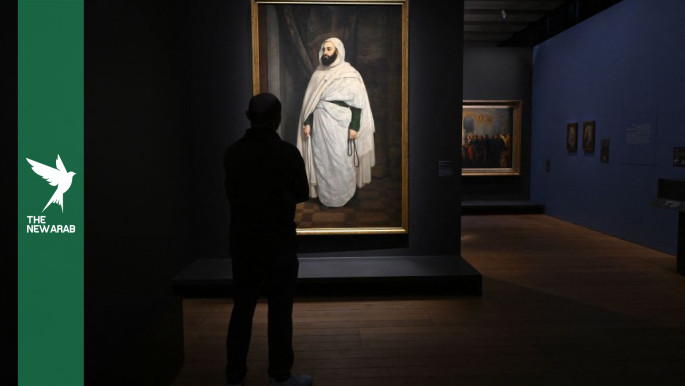
Contested items include the personal effects of legendary Algerian leader Emir Abdelkader, who led his people’s resistance against the French up until 1847, writes Nabila Ramdani. [GETTY]
Raising questions about colonialism makes many people groan. They make out that Western nations, including France and Britain, gave up their empires long ago, and that we should all move on.
To understand how wrong they are, you only have to look at the never-ending arguments over the return of looted treasure. Billions of euros-worth of art and artefacts were taken by occupying powers over hundreds of years, and much of it remains with the thieves.
This is not a leftist complaint. It is a basic one about justice, and – more than that – a perfect example of how the decolonisation process is far from over. Old prejudices linger, and there are far too many ultra nationalist bigots who still treat former Imperial subjects as lesser beings.
Ancient hatreds certainly manifest themselves in the latest French parliamentary bill aimed at returning missing items. The legislation deals with ones taken between June 1815 – the time of the Battle of Waterloo – right up until April 1972, when a referendum saw French voters approve Britain’s entry into the European Economic Community, the forerunner of the EU.
It was also just a decade after the war in which Algerian nationalists defeated France in one of the bloodiest conflicts in history. Millions of Algerians were killed over the course of 132 years, as the French imposed their military might on what is now the largest country in Africa. Everything from gas chambers to napalm – the incendiary chemical mixture dropped from the air over entire villages, cities and towns to burn victims alive – were used to subjugate the indigenous population of Arabs and Berbers.
By the by, Algerian towns and villages were also plundered, along with some of the richest archaeological sites in the world.
You would think that anything taken under such circumstances – be it jewels or ancient pottery – would have to be returned, but no. Algeria was considered the jewel in the crown of the Gallic Empire, and many French people remain furious that it was lost. Handing it back represented lost honour and a betrayal of all the colonialists who had ethnically cleansed and then settled on land that never belonged to them.
Many of the Algeria nostalgists are members of the National Rally (RN), the far-right party which was founded as the Front National (FN) by men who had fought in Algeria during the Independence War between 1954 and 1962, as well as some who had taken up arms on behalf of the Nazis when France was part of the Third Reich. The FN’s long-term leader, Jean-Marie Le Pen, was implicated in torture while serving as a lieutenant in a French Army intelligence unit. He was an abject racist who – like many of his RN colleagues – never made any secret of abhorring Algeria’s Muslim majority.
Le Pen died last year but, shortly afterwards, the RN won a poisonous parliamentary resolution attacking the Évian Accords – terms at the end of the Independence War which, among other matters, regulated the movement of people between Algeria and France in the post-war period. Algerians naturally had extremely strong links with France, and it was entirely right that they should be given relatively easy travel and immigration rights to a country that had dominated their lives for so long.
During the colonial era, Algeria was considered part of the French mainland, to the extent that it had its own MPs in the Paris National Assembly. In turn, the French imported tens of thousands of Algerian labourers to their major cities and towns to help rebuild them after the devastation caused by the Second World War.
Yet despite this history, the xenophobic RN is still interested in settling scores with the Algerian authorities, and indeed with the millions of Franco-Algerians who live in France today. Hence the RN suggesting that the new bill concerning the return of stolen treasure should only apply to countries with which France has good relations.
This, by any objective measure, would not include Algeria at the moment, not least of all because of its constant appeals for a full and fair settlement following all those years of barbaric occupation. In December, for example, the Algiers parliament unanimously passed a law declaring French colonisation a crime and demanding an apology and reparations.
President Emmanuel Macron officially agreed with the Algerian view while campaigning before coming to power in 2017, stating unequivocally that what happened to Algeria was “a crime against humanity”. However – as is so typical of a politician who has a different opinion for every occasion, and for whoever he is speaking to – he said his commitment to justice has changed.
Outrageously, the bill that he is backing even offers war as a reason for annulling restitution. In short, if an artefact is in any way connected with armed conflict, then it will no longer be returnable.
Such a caveat would include Baba Merzoug, Algeria’s 16th-century bronze cannon, which is currently a military trophy kept at the French naval base in Brest, Brittany. It was stolen following the capture of Algiers in 1830, and multiple requests for its return have been denied.
Other contested items include the personal effects of legendary Algerian leader Emir Abdelkader, who led his people’s resistance against the French up until 1847. They include a ceremonial cloak and the sword of a still much-admired figure, who was acclaimed as a “Prince among Saints”. Beyond using outstanding tactics against one of the most technologically sophisticated armies in the world, Abdelkader was known for respecting human rights, at a time when they were barely thought about by many fighting forces, least of all France’s.
National conscience is built around heroes such as Abdelkader, yet many French people still deny it.
There is nothing new in the weaselly manner by which former colonial powers try to hang on to their booty. France retains tens of thousands of objects looted from sub-Saharan Africa, and has offered all kinds of reasons to keep them. This can be contrasted with the way France moved its finest art works out of Paris during the Nazi Occupation. Even the Mona Lisa was taken out of the Louvre and hidden away. Despite this, some have even suggested that taking art away from its intended setting is a “creative act” in itself.
In fact, creativity is all the former colonisers have left as they desperately continue to defy the march of history. They should return the treasures, apologise profusely, and offer appropriate reparations to the proud peoples they exploited for so long.
Nabila Ramdani is a French-Algerian Journalist, Broadcaster, Academic, and Author of Fixing France: How to Repair a Broken Republic (PublicAffairs/Hurst).
Follow Nabila on X: @NabilaRamdani
Have questions or comments? Email us at: editorial-english@newarab.com
Opinions expressed in this article remain those of the author and do not necessarily represent those of The New Arab, its editorial board or staff.