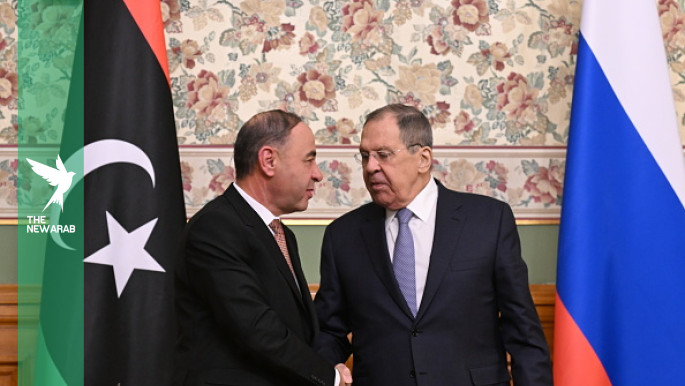
Al-Baour (L) and Lavrov shake hands during a joint press conference following talks in Moscow [Getty]
The Russian-Libyan intergovernmental commission will resume its work after roughly 15 years of disruption, opening the way for Russian companies to return to Libya, Moscow’s top diplomat announced on Tuesday.
Foreign Minister Sergey Lavrov made the announcement after meeting Taher al-Baour, acting minister of foreign affairs and international cooperation in Libya’s Government of National Unity (GNU), during talks in Moscow.
Libyan Transport Minister Mohamed al-Shahoubi, who heads the Libyan side of the joint commission, also attended the meeting, alongside Russian Energy Minister Sergey Tsivilev, who chairs the body for Moscow.
A statement by the Russian foreign ministry said the two sides “held a substantive exchange of perspectives on the evolving situation within and around Libya”.
It added that significant attention was given to expanding Russian-Libyan relations across a range of sectors.
“Both parties acknowledged the urgency of promptly resuming the activities of the Russian-Libyan Intergovernmental Commission on Trade, Economic, Scientific, and Technical Cooperation, which is anticipated to serve as the principal coordinating mechanism for bilateral collaboration in the trade and economic domains,” the ministry said.
The Libyan government said the meeting focused on preparations to restart the commission’s sessions after years of suspension, including identifying programmes and proposed projects in several vital sectors to be presented at an upcoming session.
The two sides also discussed expanding economic cooperation, increasing trade volumes, and the return of Russian companies to contribute to reconstruction projects, as well as cooperation in the oil and gas sectors.
The commission was first established in 1974 as a high-level framework to organise and develop economic and technical ties between Libya and the Soviet Union, now Russia.
Its work largely stalled in the early 1990s following the collapse of the Soviet Union and the imposition of international sanctions on Libya over the Lockerbie bombing.
It was revived in 2008 following a visit by President Vladimir Putin to Libya, when major agreements were signed in oil, gas and civilian nuclear energy.
The commission was suspended again in 2011 after the uprising that toppled longtime ruler Muammar Gaddafi and the instability that followed.
Attempts to fully revive the body in recent years have struggled due to Libya’s political divisions and security tensions.
Lavrov said in October 2025 that Libya’s “internal political instability” remained the main obstacle to deeper cooperation.
Libya holds Africa’s largest proven oil reserves, with hydrocarbons accounting for nearly all export revenues, and political disputes have repeatedly disrupted production and exports.
“We will seek opportunities to help our companies return or enter the Libyan economy anew via the mechanism of the intergovernmental commission, which will resume its work,” Lavrov told a news conference after meeting the Libyan ministers.
“We have agreed on this today. This is one of the concrete results of our friends’ visit.”
Since Gaddafi was overthrown in 2011, Libya has remained split between rival administrations. The internationally recognised GNU is based in Tripoli, while warlord Khalifa Haftar’s Libyan National Army controls the east.
Russia has maintained ties with both camps, though particularly with Haftar.
It has deployed Wagner mercenaries, fighter jets and advisers to Haftar’s forces since 2018.
Following the fall of Moscow ally Bashar al-Assad in Syria in December 2024, US officials said Russia had moved sophisticated weaponry from bases in Syria to facilities in eastern Libya.
Several regional powers also maintain close military and economic links with Haftar.
The GNU, led by Abdul Hamid Dbeibeh, was intended to be an interim administration, but failed elections, militia backing and foreign support have helped keep it in power despite its expired mandate.