
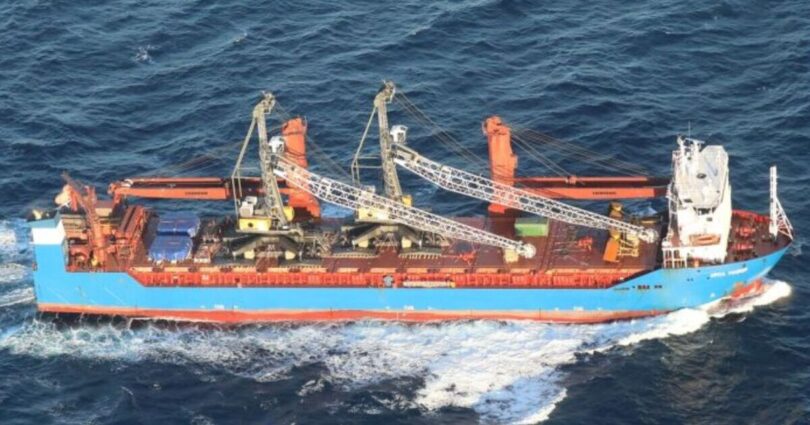
The ship has reportedly gone missing (Image: PA)
A Russian ship possibly carrying nuclear reactors to North Korea mysteriously exploded and sank 60 miles off the coast of Spain. The Ursa Major went down in the Mediterranean Sea on December 23, 2024, after suffering three explosions on its starboard side, according to a CNN investigation citing Spanish authorities and sources familiar with the probe.
CNN reported the vessel may have been transporting components for two submarine nuclear reactors to the North Korean port of Rason. The incident came just months after Kim Jong Un sent troops to support Russia’s war effort in Ukraine. Spain’s government later confirmed the Russian captain told investigators the cargo included “components for two nuclear reactors similar to those used in submarines”. According to CNN, the captain initially described the cargo as “manhole covers” before allegedly admitting their true nature under questioning. The vessel had departed from St Petersburg on December 11 with a public manifest listing two large cranes, 129 empty containers and two oversized “manhole covers”. The ship was officially bound for Vladivostok in Russia’s Far East.

The Russian cargo ship Ursa Major is pictured during a monitoring operation (Image: Portuguese Navy/AFP via Getty Im)
Read more: Russia sends horror WW3 threat to attack UK as world on brink
Read more: Panic in Russia as worrying sign Putin is ‘using a body double’ spotted
Investigators reportedly questioned why Russia would transport such limited cargo by sea across the globe when it could have used its own rail network.
The ship was escorted through European waters by two Russian military vessels, including the Ivan Gren and the Aleksandr Otrakovsky.
Portuguese naval aircraft tracked the convoy before losing contact shortly before the explosions.
CNN reported the Ursa Major suddenly slowed in Spanish waters on December 22, but the crew initially denied being in distress.
Around 24 hours later, the Ursa Major sharply veered off course before issuing a distress call at 11:53am UTC on December 23.
Investigators said the ship had suffered three explosions on its starboard side, believed to be near the engine room, killing two crew members and leaving the vessel immobile and heavily listing.

Yantar reportedly returned to the wreck site of the Ursa Major days after the sinking (Image: MOD/AFP via Getty Images)
Two crew members were killed in the blasts, while 14 survivors escaped in a lifeboat and were rescued by Spanish authorities.
Footage seen by CNN showed a Spanish rescuer attempting to enter the ship’s engine room, only to find it sealed shut.
The rescuer also searched the living quarters and inspected containers onboard, with two reportedly filled with rubbish, fishing nets and equipment.
A subsequent investigation reportedly found a 50cm by 50cm hole in the vessel’s hull, with metal bent inward.
Spanish investigators are said to be examining whether the damage could have been caused by a high-speed “supercavitating” torpedo or explosive device.
Only the US, Russia, Iran and a handful of NATO allies are believed to possess the high-speed torpedoes, which use air bubbles to reduce water resistance and punch through a ship’s hull at extreme speed.
Four further explosions were later detected after the Ivan Gren reportedly fired red flares over the scene, CNN said.
Russia’s state-linked ship owner Oboronlogistics later described the sinking as a “targeted terrorist attack”
The Russian owners of the ship, Oboronlogistics, along with the Russian, Spanish and British militaries, did not respond to requests for comment, while the Pentagon declined to comment.
CNN said several Western intelligence and security officials described the incident as “strange” and questioned parts of the Spanish investigation, but offered no alternative explanation for the blasts or Russia’s response.
The mystery deepened after a suspected Russian spy ship, the Yantar, returned to the wreck site for five days.
Four further explosions were later detected, possibly aimed at the wreckage on the seabed.
Our community members are treated to special offers, promotions, and adverts from us and our partners. You can check out at any time. Read our Privacy Policy
CNN also reported that rare US WC135-R “nuke sniffer” aircraft flew over the wreck area twice following the sinking.
The aircraft are normally used to detect radioactive material and monitor nuclear activity.