Gaza, Lebanon, Iran… Our daily newsfeeds are constantly updated with horrifying reports from conflict zones across the Middle East, yet only fragments of information reach us from Yemen.
Since 2014, Yemen has been devastated by civil war, fought mainly between the Iran-backed Houthis, who control much of the north, and the Yemeni government, supported by a Saudi-led coalition, leaving fertile lands turned into battlefields and once-thriving cities in ruins.
The country has also suffered one of the world’s worst humanitarian crises, with more than half the population still requiring aid. Although these striking details are available across information channels, they remain largely outside the spotlight and away from the mainstream news cycle.
In this context of media eclipse, Sara Ishaq’s debut feature, inspired by real-life experiences, The Station — a multinational co-production between Yemen, Jordan, France, Germany, the Netherlands, Norway and Qatar, and currently competing in the Critics’ Week strand of the 78th Cannes Film Festival — feels like a timely corrective to the widespread ignorance surrounding the subject.
However, the film does not delve directly into the political context, nor does it zoom in on the front lines. Rather, it captures the war’s resonance in society and portrays a tragic reality through the minimalist story of two sisters and their little brother, who somehow carry on with their lives despite the circumstances, set within small female communities.
“As men vanish into the battlefields, women are left to hold society together,” opens the film’s opening line, before inviting viewers into a world “caught in an endless cycle of fighting”, but also into a clandestine, parallel and ultimately hopeful realm with alternative rules, shaped by inventive mechanisms of survival, where destructive male logic is replaced by the female impulse to create, nurture and preserve.
It is a curious and mysterious world that draws us into its orbit, making us want to know more about this culture and place and to explore the real events surrounding it further.
In this sense, The Station fulfils its purpose best not by merely expanding viewers’ knowledge, but by awakening curiosity after first seducing the eye and the senses.
Sisters at odds
At the centre of this unusual universe stands Layal, who runs the proudly titled Queen of Sheba women-only petrol station somewhere in the Yemeni desert; a sanctuary governed by a few uncompromising rules: no men, no weapons, no politics.
Besides petrol, which is constantly running out anyway, Layal has also set up a small bar serving tea and sweets, cultivating a cosy atmosphere that invites lively conversation. Her customers exchange ointments and jewellery, and even contraceptives can be found under the counter, despite loudspeakers encouraging childbirth and condemning birth control.
In a country fractured by violence and ideological division, the station functions as a fragile enclave of solidarity and mutual care, where women carve out a temporary refuge from the chaos beyond its borders.
Nevertheless, the outside world inevitably seeps in when Layal’s younger brother, Laith, faces forced enlistment, mandatory for all boys who have turned 12, and she is compelled to reunite with her estranged sister, Shams, in an attempt to save the one life still within their reach.
Through this deceptively simple premise, Sara further constructs a dynamic, multilayered and gripping story that moves between intimacy and allegory, balancing the political context and the daily absurdities with a deeply humanist message.
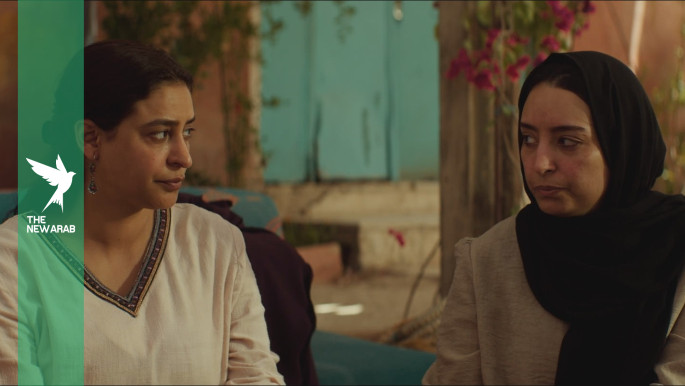
The two sisters make for an intriguing duo, skilfully embodying strong personalities and two distinct approaches to survival.
While Shams has chosen to take an active role — collecting donations for soldiers at the frontline and bravely moving through a male-dominated world with quiet determination beneath her mandatory hijab — Layal prefers to avoid direct confrontation with it, instead tending flowers in the middle of the desert and caring for her brother and the female community, all without giving up life’s small everyday pleasures.
Abeer Mohammed and Manal Al-Mulaiki’s performances are emotionally nuanced, oscillating between initial mutual hostility and tenderness, rivalry and acceptance, while Rashad Khaled, as Laith, appears to be the film’s brightest ray of pure joy, portrayed as carefree a child as circumstances allow.
As Sara explains in an interview for the festival strand’s page, shooting in Yemen was not feasible due to security concerns and the limitations the team would have faced during production.
Jordan emerged as the most viable alternative, offering experienced crews, landscapes resembling Yemen’s terrain, and well-established Yemeni refugee and diaspora communities that became essential for casting.
Fragile utopias amid chaos
The film’s atmosphere — at once playful, quietly melancholic, and tense amid the surrounding chaos — reflects Sara’s own vision of Yemen, shaped by both personal memory and political rupture.
Born to a Yemeni father and Scottish mother, the filmmaker first gained international recognition with her Oscar and Bafta-nominated short documentary Karama Has No Walls (2012), made in the aftermath of the Yemeni revolution, followed by The Mulberry House (2013), an intimate documentary portrait of her family during the uprising.
Since then, Sara has remained deeply engaged with the realities of filmmaking in Yemen, training local filmmakers. The Station marks her transition into fiction, but it retains the same urgency and emotional proximity to lived experience that characterised her earlier work.
Imagining this parallel reality, which distils what she cherishes about Yemeni society into “a fragile utopia, constantly shadowed by turmoil beyond its walls,” as noted in her director’s statement, Sara underscores the film’s tension between fragility and perseverance that runs through every frame.
Even amid anxiety and loss, she foregrounds gestures of warmth, affection, humour and collective resilience, offering an ode to the people of Yemen and their capacity to endure destruction while maintaining their dignity.
Mariana Hristova is a freelance film critic, cultural journalist, and programmer. She contributes to national and international outlets and has curated programs for Filmoteca de Catalunya, Arxiu Xènctric, and goEast Wiesbaden, among others. Her professional interests include cinema from the European peripheries and archival and amateur films