
KUCHING – For 23-year-old Nur Huda Al Thaqifah Narzaruddin, enrolling in I-CATS University College on April 6 to study software engineering was a relief she did not take for granted.
She is among the first cohort of students under Sarawak’s ambitious free tertiary education scheme, which offers places in private universities to about 10,000 Sarawakian youths annually from 2026.
“If I had to pay for the course myself, it would cost around RM30,000 to RM40,000,” Ms Nur Huda told The Straits Times. The fees are about S$9,700 to S$13,000.
As the third of seven children, with four younger siblings, she has long been concerned about the family’s finances.
“(The free education) really helps me focus more on my studies without worrying too much about money,” she said.
The scheme has created a buzz in Malaysia, where access to quality university education has long been constrained by racial quotas at public universities and high fees that put it out of reach for many lower-income families.
This comes as oil-rich Sarawak is betting on renewable energy, hydrogen and the digital sector as it aims to achieve high-income status by 2030. At the centre of that shift is the free education plan, aimed at building the local talent needed to power the new industries.
“We gave an allocation of RM260 million for 10,000 students registered at our own universities,” Sarawak Premier Abang Johari Tun Openg said at the ruling Gabungan Parti Sarawak (GPS) coalition’s convention in Kuching on April 19.
“We are export-oriented, that is why we are giving free education. That is why we are emphasising on STEM (Science, Technology, Engineering and Mathematics).”
The scheme focuses on 64 approved STEM courses at four universities in the state: Australia-linked Swinburne University of Technology Sarawak and Curtin University Malaysia, as well as state-linked University of Technology Sarawak (UTS) and I-CATS University College.
In addition to tuition fees, the state gives up to RM5,000 a year for housing and RM10,000 for living expenses to students from lower-income households. The scheme does not require students to serve in government agencies or remain in Sarawak after graduation, unlike scholarships.
Early signs suggest that the scheme is gaining traction. Professor Lau Hieng Ho, the pro vice-chancellor of Swinburne University in Kuching, told ST that while the main intake is in September after the STPM exams – equivalent of A-levels – the university has already seen positive signs.
“There has been a noticeable increase in applications and inquiries as the first semester of the year opened in March,” Prof Lau said.
The university has been working closely with the government to align its courses with the state’s aspirations.
“Since last year, we added two new courses: cybersecurity and data science. In the future, we plan to offer Bachelor of Arts in AI, which is central to Sarawak’s plan,” Prof Lau said.
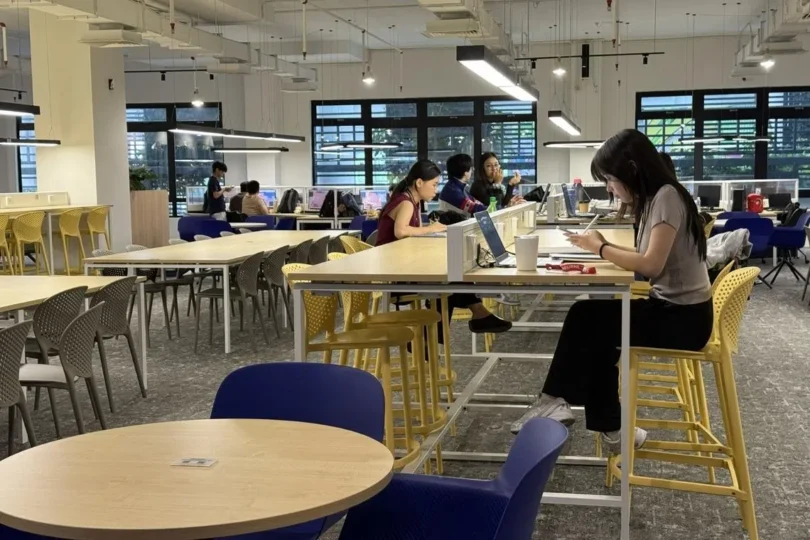
The Sarawak campus of Australia’s Swinburne University of Technology in Kuching
ST PHOTO: HADI AZMI
The scheme reflects the more assertive path Sarawak has charted under Mr Abang Johari since 2018, when local parties formed GPS after splitting from the national Barisan Nasional coalition, placing greater emphasis on state control over resources and development. At the April 19 convention, chants of “Sarawak First” rang out as banners around the hall carried the same message.
Since 2018, the state has expanded its economic footprint, including through its own oil company Petros, taking a controlling stake in Affin Bank, and acquiring MASwings from Malaysia Airlines to be rebranded as Air Borneo.
For residents like Ms Lina Lai, 36, whose children are still years away from university, the policy offers “a real sense of reassurance” that more young people will have access to higher education.
“This reflects a strong commitment to investing in its people and the state’s long-term development,” she said. “I do hope that this plan continues to uphold high academic standards, so it can truly benefit students and contribute to a better future for Sarawak.”
Economist Geoffrey Williams of Williams Business Consultancy said the scheme could help Sarawak retain talent and reduce brain drain. Like other parts of Malaysia, the state has seen young people leave for better opportunities in Kuala Lumpur and Singapore.
“Keeping talent and educational investment in the state will boost development, enterprise and job opportunities and attract investment,” he said.
But critics believe the scheme’s reach may be limited. Ms Ida Thien, an Atlantic Fellow for Social and Economic Equity at the London School of Economics, cautioned that its focus on just four private universities could restrict who actually benefits.
“For many from challenging or rural backgrounds, private universities simply don’t feature in their calculus, as they are not the institutions that tend to shape their attitudes or aspirations,” she told ST.
“Tuition coverage may increase representation, but there’s a valid concern the scheme may default back to middle- and upper-middle-income students, who are private universities’ core market anyway.”
She noted that rather than a fundamental overhaul of higher education funding, the scheme currently resembles a form of state-sponsored scholarships.
“With careful implementation, it could still meaningfully raise socio-economic diversity in private universities, but remains a far cry from a promise of free higher education for all,” said Ms Thien.
Sign up for our weekly Asian Insider Malaysia Edition newsletter to make sense of the big stories in Malaysia.