
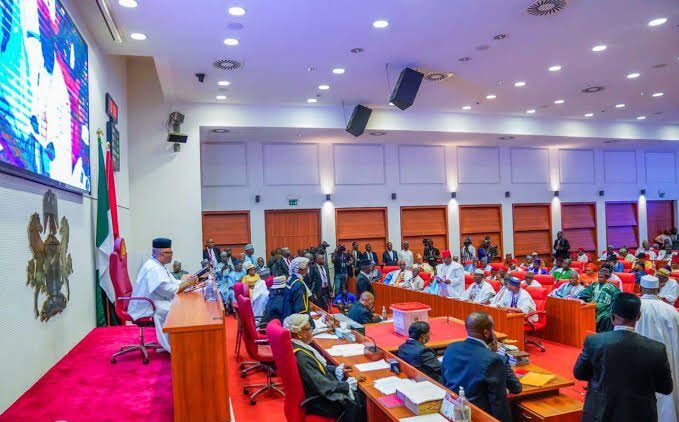
The Senate has approved a N50 million donation for the families of two teachers and three soldiers who lost their lives during the abduction of pupils and teachers from schools in Oriire Local Government Area of Oyo State.
The donation was announced by Senate President Godswill Akpabio during Wednesday’s plenary, according to the News Agency of Nigeria (NAN).
Under the approval, each of the five bereaved families will receive N10 million in recognition of the sacrifices made by the deceased during the tragic incident, which ended with the successful rescue of the abducted pupils and teachers after 56 days in captivity.
What they are saying
Announcing the donation during plenary, Akpabio described the deaths of the teachers and soldiers as painful sacrifices in Nigeria’s fight against insecurity.
He also commended the Nigerian Armed Forces and other security agencies for successfully rescuing the abducted pupils and teachers after 56 days in captivity.
- “The Senate has approved a donation of N50 million to families of five persons who lost their lives during the abduction of pupils and teachers from schools in Oriire Local Government Area of Oyo State.”
- “The donation is intended to support the grieving families while recognising the ultimate sacrifices made by the deceased,” the NAN report read in part.
The beneficiaries include the families of teachers Michael Oyedokun and John Olaleye, as well as soldiers Lieutenant F.A. Isaac, Private Silas Musa and Sergeant Abena John Jerome.
According to the school principal, Oyedokun was beheaded by his abductors while in captivity, while Olaleye was shot during the attack on the school.
The three soldiers died during the military operation to rescue the abducted pupils and teachers, who were kidnapped from two schools in Oriire Local Government Area on May 15.
Backstory
The Presidency last Friday announced the rescue of all the pupils and teachers abducted in Oriire Local Government Area of Oyo State. Special Adviser to the President on Information and Strategy, Bayo Onanuga, confirmed that security agencies successfully rescued the victims.
Onanuga said there was no quid pro quo in securing the victims’ release.
He disclosed that although the kidnappers demanded the release of one of their kingpins, the suspect remains in custody and is being prosecuted for alleged crimes.
The victims were abducted on May 15, 2026, after armed men attacked three schools in the Ahoro Esiele/Esiele and Yawota communities of Oriire Local Government Area.
The affected schools were Community Grammar School, Baptist Nursery and Primary School, and L.A. Primary School.
The rescue operation ended the victims’ 56-day captivity but came at the cost of the lives of the three soldiers who participated in the mission.
What you should know
School abductions remain one of Nigeria’s biggest education security challenges, with thousands of learners affected by attacks on educational institutions in recent years.
Save the Children International says at least 1,683 learners were abducted across Nigeria between 2014 and 2022.
- UNICEF estimates that insecurity forced the closure of 11,536 schools during the 2020/2021 academic session, disrupting learning for about 1.3 million children.
- Attacks have continued in recent years, with gunmen targeting schools in Kebbi and Niger states in late 2025, while criminal groups have also attacked rural communities and places of worship.
- Nairametrics previously reported, citing SBM Intelligence, that Nigeria’s kidnap-for-ransom crisis generated at least N2.57 billion for criminal groups between July 2024 and June 2025, while ransom demands were estimated at N48 billion during the period.
The latest Senate donation highlights the human cost of insecurity and comes as the Federal Government continues efforts to strengthen security operations and protect schools from future attacks.
This version aligns with Nairametrics’ style by sharpening the lead, improving grammar and flow, removing redundancy, maintaining the inverted-pyramid structure, and keeping the article within the preferred 500–600-word range.