Nigeria’s policy of rehabilitating and reintegrating repentant terrorists has remained one of the country’s most controversial counterterrorism strategies.
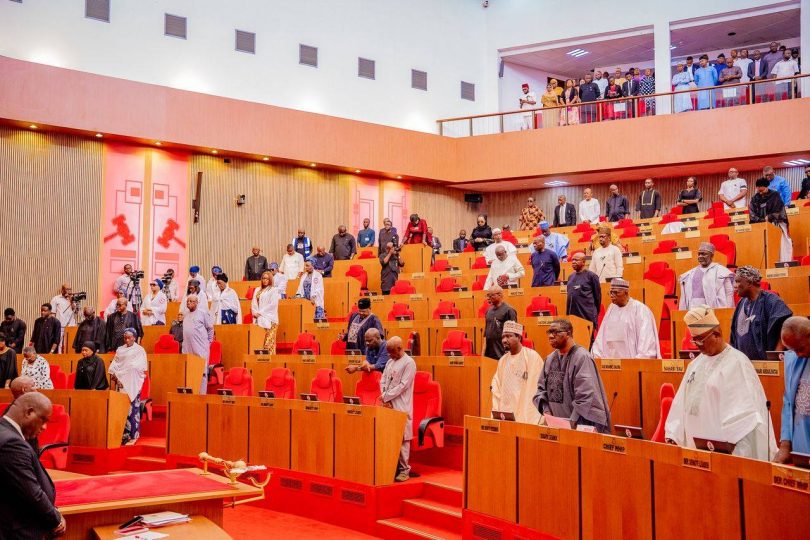
The Senate on Tuesday urged the federal government to end the practice of pardoning and rehabilitating repentant members of the Boko Haram sect into society.
The upper chamber made the resolution after the majority of the lawmakers supported it through voice votes during the plenary while considering a motion on the abduction and killing of a retired major general, Rabe Abubakar, and other military officers by bandits.
The motion was sponsored by Abdulaziz Yar’Adua, the senator representing Katsina Central Senatorial District.
During the debate, the senator representing Edo Central, Joseph Ikpea, proposed an additional prayer calling for the abolition of the rehabilitation programme for repentant Boko Haram members.
The senator representing Edo North, Adams Oshiomhole, supported the proposal, arguing that the practice of pardoning and rehabilitating criminals “does not make common sense.”
Mr Oshiomhole, a former governor of Edo State and member of the ruling All Progressives Congress (APC), urged the Senate to consider legislation that would abolish the rehabilitation of repentant Boko Haram terrorists.
The Deputy Senate President, Barau Jibrin, who presided over the session, put the proposal to a voice vote, and a majority of senators adopted it.
The Senate’s resolution is not legally binding on the executive, as motions have no force of law. It represents the opinion of the upper chamber and will be communicated to the Presidency for consideration. Any decision to abolish or significantly alter the rehabilitation programme would require executive action and, depending on the approach adopted, could also involve legislative amendments to existing laws or policies governing Nigeria’s counterterrorism framework.
Nigeria’s policy of rehabilitating and reintegrating repentant terrorists has remained one of the country’s most controversial counterterrorism strategies.
The programme gained prominence in 2016 after the military began recording increasing numbers of insurgents surrendering, particularly in the North-east, following sustained offensives against Boko Haram and later its splinter faction, the Islamic State West Africa Province (ISWAP). The policy was further expanded in 2021 when thousands of fighters and their families surrendered after violent clashes between the two extremist groups, including the death of Boko Haram leader, Abubakar Shekau.
The federal government institutionalised the initiative through Operation Safe Corridor (OPSC), a non-kinetic deradicalisation, rehabilitation and reintegration programme established in 2016. The programme is coordinated by the Defence Headquarters and involves the military, security agencies, and several ministries, departments, and agencies, including the ministries of justice, education, health, women’s affairs, and humanitarian affairs, as well as the National Orientation Agency.
Under the programme, screened former fighters who are assessed as not having committed serious crimes undergo psychological counselling, religious reorientation, vocational training, literacy education, and civic instruction at a rehabilitation centre in Gombe State. Upon completing the programme, participants are handed over to their state governments for reintegration into their communities.
Several North-east states, including Borno, Adamawa and Yobe, have received rehabilitated ex-combatants under the programme. Borno State, where the insurgency has been most intense, has also implemented its own reintegration initiatives, with state authorities saying that encouraging defections weakens insurgent groups and provides valuable intelligence for military operations.
However, the policy has generated widespread criticism from victims’ groups, civil society organisations and some security experts. Critics argue that many communities remain traumatised by years of violence and are unwilling to accept former insurgents, especially where victims have received little compensation or justice. Concerns have also been raised about the adequacy of the screening process and the possibility that some rehabilitated fighters could return to insurgency.
Supporters of the programme, including military authorities and some international partners, maintain that rehabilitation is consistent with global Disarmament, Demobilisation and Reintegration (DDR) principles. They argue that military force alone cannot end the insurgency and that providing a pathway for defections encourages more fighters to surrender, thereby reducing the strength of terrorist groups.
Despite these arguments, the programme has remained politically contentious with repeated calls from lawmakers and sections of the public for its review or outright suspension.
The Senate Minority Leader, Abba Moro, also proposed an additional prayer urging the Senate leadership to constitute a delegation to interface with President Bola Tinubu on the country’s worsening security situation.
The deputy senate president put the prayer to a voice vote, and the majority of senators adopted it.
Presenting the motion, Mr Yar’Adua, a retired colonel, expressed concern over Nigeria’s worsening security challenges, particularly terrorism and banditry.
He said terrorist networks had become more sophisticated and emboldened, extending their attacks from communities to the coordinated abduction of military personnel.
The senator condemned the abduction and killing of Mr Abubakar and several other military officers who have fallen victim to bandits in recent times.
He urged the Senate leadership to constitute a delegation to pay condolence visits to the family of the late military spokesperson, the Katsina State Government and the Nigerian Army.
Mr Yar’Adua also called on the Senate to urge the federal government to accelerate the deployment of modern security technologies, including unmanned aerial systems, geospatial intelligence capabilities, integrated command-and-control platforms, advanced communication systems and other force-multiplying technologies needed to combat terrorism, banditry and kidnapping.