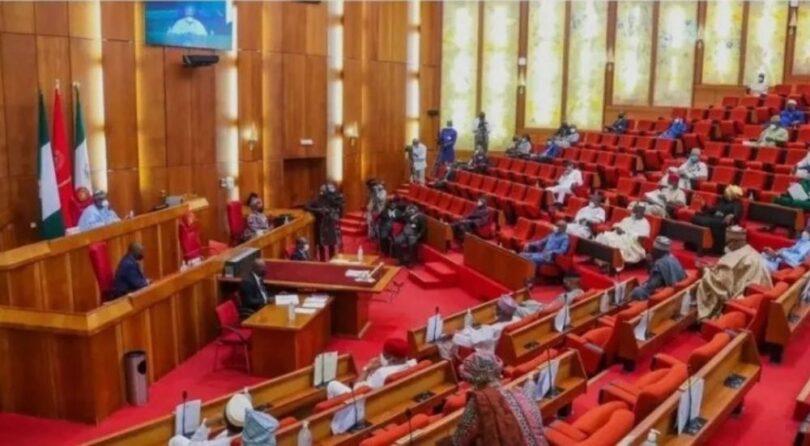
The Senate on Thursday tinkered with its earlier decision amending portions of its Standing Orders relating to the election of the Senate President and Deputy Senate President.
The upper chamber, during plenary, reversed amendments made on Tuesday, May 5, 2026, to Order 2(2) and Order 3(1) of the Senate Standing Orders, 2026, following concerns that the changes could conflict with constitutional provisions.
The controversial amendment had sought to alter the procedure for the inauguration of a new Senate by allowing senators-elect to be sworn in before the election of principal officers.
Under the existing arrangement, the Clerk to the National Assembly presides over the election of the Senate President and Deputy Senate President before the newly elected Senate President administers the oath on other senators-elect.
However, the Senate retained another amendment which reserved the offices of Senate President and other principal officers exclusively for members of the 10th Senate.
That provision had sparked tension in the chamber on Tuesday, particularly during a heated exchange between Senate President Godswill Akpabio and Senator Adams Oshiomhole (Edo North).
The motion titled, “Rescission and Re-Committal of Order 2(2) and Order 3(1) of the Senate Standing Orders, 2023, as amended,” was sponsored by Senate Leader Opeyemi Bamidele (Ekiti Central).
In its resolution, the Senate said: “Upon further legislative and constitutional review, certain provisions introduced under Order 2(2) and Order 3(1) may give rise to constitutional inconsistencies and unintended tensions with the provisions of the Constitution of the Federal Republic of Nigeria, 1999 (as amended), particularly Section 52 thereof.”
The Senate further noted that “it is necessary to ensure that the Standing Orders of the Senate remain fully consistent with constitutional provisions, established parliamentary conventions, and legislative practice.”
It also stressed that the chamber possesses “the inherent parliamentary authority to revisit, rescind, and recommit any matter previously decided upon in order to preserve the integrity of its proceedings and legislative framework.”
Shortly after the Senate reversed the amendment, Oshiomhole urged his colleagues to allow proper debate before taking critical decisions, blaming the controversy on the hurried manner in which the amendment was passed on Tuesday.
His comments, however, drew sharp reactions from the Senate Leader, who raised a point of order to fault the former Edo State governor.
Bamidele said senators were all present during Tuesday’s proceedings and witnessed what he described as unnecessary drama.
He said, “We were all in the chamber and witnessed the kind of drama that went on even though it was totally unnecessary.”
“But the unfortunate thing about that drama was that regardless of what was done in this hallowed chamber yesterday, what became the news was that unnecessary drama. We are not going to allow this to continue.”
Citing Order 52(6) of the Senate rules, Bamidele explained that matters already decided by the Senate could only be revisited through a substantive motion for rescission.
According to him, “If the Senate has come to the conclusion that the distinguished Senator Adams Oshiomhole had any problem with the decisions that were taken with respect to the amendment two days ago, what he was expected to do was to bring a substantive motion for rescission to be debated on the floor of this parliament.
“We cannot allow this kind of drama to go on every time on the floor of this Senate. We must put a stop to it. As the leader of this Senate, I had an issue with what was passed. We discussed it at the leadership level and I was going to bring the motion for rescission, which we just considered.
“Senator Adams Oshiomhole could have done that regarding any other aspect of this amendment if he had a problem with it. This drama must stop because it is not helping the image of this institution. This is the Senate of the Federal Republic of Nigeria.”
The Deputy Senate President, Barau Jibrin, who presided over the plenary at that point, subsequently sustained the point of order raised by the Senate Leader.