Senegal’s 2026 World Cup campaign has become engulfed in controversy after a series of off-field disputes threatened to overshadow the team’s bid to reach the knockout stages.
The Lions of Teranga arrived at the tournament with high expectations, hoping to surpass the achievement of the country’s celebrated 2002 squad, which reached the quarter-finals on Senegal’s World Cup debut.
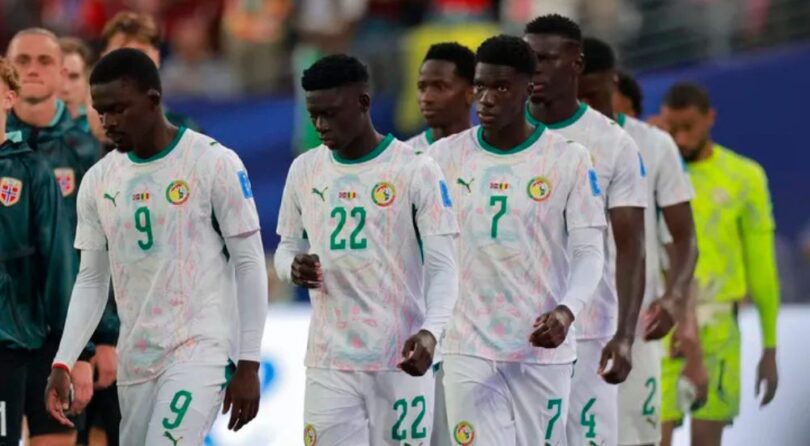
Instead, back-to-back defeats against France and Norway have left the West African nation without a point and facing a must-win encounter against Iraq to keep their hopes alive.
As pressure mounts on the pitch, a succession of issues behind the scenes has drawn widespread attention, including disputes over bonuses, concerns about camp arrangements, complaints from members of the delegation, a prolonged contract standoff involving head coach Pape Thiaw, and protests from supporters over ticket allocations.
Much of the controversy has centred on Senegal’s World Cup base in the United States. Players and coaching staff are staying at the Hyatt Regency in New Brunswick, New Jersey, close to the team’s training facilities at Rutgers University.
Reports circulated that members of the delegation were unhappy with accommodation and food arrangements. The concerns intensified after the team’s long-serving chef, who had worked with Senegal at previous tournaments and was responsible for preparing meal plans months in advance, left the camp for personal reasons shortly before the World Cup began.
A replacement chef was brought in, but according to sources close to the team, the players themselves have not raised concerns about the quality of the catering.
Instead, dissatisfaction reportedly came from members of the wider delegation, some of whom were disappointed by the limited availability of traditional Senegalese dishes and occasionally sought meals outside the official hotel.
The presence of relatives of federation officials and family members staying near the team base also generated discussion within the camp.
While player families were accommodated separately with support from the federation, some observers questioned whether the proximity of non-essential personnel risked becoming a distraction during a major tournament.
Another issue that surfaced involved unpaid bonuses owed to players and staff. Reports suggested frustrations had been growing within the camp over delays in receiving agreed payments. The matter was eventually resolved after the Senegalese government released the funds shortly before the team’s crucial group-stage fixtures.
Speaking publicly, Thiaw acknowledged that operational issues had occurred but insisted the squad remained focused on football.
“There are some malfunctions,” he admitted, while stressing that players, coaches and federation officials were concentrating on the task ahead.
Former Senegal international El Hadji Diouf also weighed in on the situation, arguing that the players did not need additional distractions during such an important competition.
The most significant controversy surrounding Senegal’s World Cup preparations involved the future of head coach Pape Thiaw. Thiaw, a member of Senegal’s historic 2002 World Cup squad, assumed charge of the national team in 2024.
After leading the country to the Africa Cup of Nations final in 2025, his standing within Senegalese football rose considerably, strengthening his position during negotiations over a new contract.
However, talks over an extension became increasingly complicated after his previous deal expired following the continental tournament. Under Senegal’s system, national team coaches negotiate with the football federation, but contracts and salary payments require approval from government authorities.
Political upheaval in the country, including changes within government leadership and ministerial restructuring, contributed to delays in finalizing the agreement.
As negotiations dragged on, concerns grew that the dispute could affect Senegal’s World Cup preparations.
Reports emerged suggesting individuals close to the coach had warned he might refuse to travel to the United States unless the situation was resolved.
The issue eventually escalated to the highest levels of government, prompting direct intervention from President Bassirou Diomaye Faye. The president reportedly contacted Thiaw personally and assured him that efforts were underway to settle the matter.
Following further discussions involving Sports Minister Djireye Clotilde Coly, an agreement was finally reached. Thiaw signed a new contract reportedly worth £480,000 per year, along with an annual bonus package.
Despite the prolonged negotiations, the coach rejected suggestions that financial demands were the driving force behind the dispute. “It’s true it took too long, but it was never a money issue,” Thiaw said. “It was more a principles and respect issue, but it’s been resolved.”
He added that patriotism remained his primary motivation and insisted that all contract-related matters were now firmly in the past.
While headlines have been dominated by events away from the field, players have attempted to project unity and professionalism.
Goalkeeper Mory Diaw dismissed suggestions that internal disagreements would undermine the team’s World Cup campaign, describing the issues as matters resolved internally.
Veteran observers of Senegalese football have also urged caution before assuming the controversies will directly affect performances. Journalist Babacar Diarra noted that while bonus disputes and organizational challenges have surfaced before, such matters rarely became public knowledge to the extent witnessed during this tournament.
The controversy has extended beyond the team’s internal affairs. A separate dispute emerged over the allocation of match tickets to Senegalese supporters living in North America.
Traditionally, the Senegalese state assists organized supporter groups by covering travel and ticket costs for major international tournaments.
However, restrictions affecting supporter travel meant many traditional fan groups were unable to attend the World Cup. Members of the Senegalese diaspora in the United States and Canada expected to receive a larger allocation of tickets in their place.
Instead, only around 400 tickets were distributed, triggering complaints about transparency and fairness. Dissatisfied supporters organized a protest outside the team hotel, demanding greater clarity over how tickets had been allocated.
The demonstration added another layer of controversy at a time when the national team was already battling growing scrutiny.
With defeats to France and Norway leaving Senegal at the bottom of their group, attention now turns to a decisive clash against Iraq.
Victory is essential if the Lions of Teranga are to retain any realistic chance of progressing to the knockout rounds.
Failure to win would result in an early exit and intensify questions about whether the off-field turmoil contributed to a disappointing campaign.