… Senate Panel Urges NNPC, Telecom Firms To List On Stock Exchange
… Nigeria Needs Strong Capital Market To Achieve $1tn Economy — Oyedele
..SEC Launches National Savings Scheme To Deepen Retail Investment
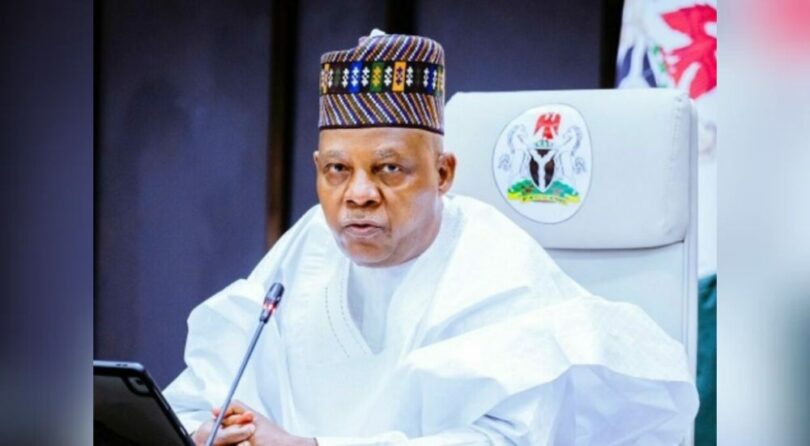
Vice President Kashim Shettima has unveiled the Nigerian Capital Market Master Plan 2.0, a 10-year roadmap designed to expand the country’s capital market to N750tn by 2036 and mobilise long-term financing for infrastructure and economic development.
Shettima, while speaking at the National Capital Market Conference 2026 in Abuja on Monday, said the capital market had become a critical instrument of national economic policy and a major channel for financing Nigeria’s future.
The plan, developed by the Securities and Exchange Commission (SEC), targets growth from a baseline of about N250tn to N750tn over the next decade.
This is just as the SEC Director-General, Dr Emomotimi Agama, said the Nigerian Capital Market Master Plan 2026–2036 was designed to deepen market participation, expand investment products and strengthen the integrity and infrastructure of the capital market.
He said the initiative would position the market as a major source of financing for the Federal Government’s ambition of building a $1tn economy.
Shettima said Nigeria’s capital market had recorded significant growth since the Tinubu administration assumed office in May 2023.
According to him, the Nigerian Exchange All-Share Index rose from about 55,000 points in May 2023 to more than 260,000 points, while the value of listed equities increased from approximately N30tn to nearly N160tn in January 2026.
He added that the combined value of the equities and bond markets had exceeded N217tn, reflecting increased investor participation and the impact of economic reforms.
The Vice President attributed the growth to reforms undertaken by the Federal Government, including the removal of petrol subsidy, unification of the foreign exchange market, tax reforms, bank recapitalisation and the enactment of the Investments and Securities Act 2025.
He said the reforms, despite their short-term costs, had helped strengthen investor confidence by improving the policy framework and regulatory environment.
Shettima said the master plan would place the capital market at the centre of infrastructure financing, enabling governments to fund long-term projects through domestic savings rather than relying excessively on short-term or foreign borrowing.
He said the plan would also strengthen the bond market for state and subnational governments, broaden retail participation through technology and investor education, and provide opportunities for businesses in agriculture, solid minerals and other sectors to raise capital locally.
The Vice President, who chairs the National Economic Council, said he would work with state governors to encourage responsible use of the capital market through properly structured bonds, credible project pipelines and greater transparency.
According to him, access to capital market financing could promote fiscal discipline and strengthen accountability in public spending.
Shettima urged market operators and regulators to sustain the momentum, warning that policy reversals could undermine investor confidence and erode the gains recorded in recent years.
He said the success of the 10-year plan would depend on consistent policies, effective regulation and the ability of market participants to protect investors while expanding investment opportunities across the country.
As part of efforts to expand participation in the capital market, the SEC also announced plans to launch the National Savings Scheme to provide Nigerians with a formal avenue to save and invest.
Agama said the scheme was designed to encourage savings among different segments of the population, including traders, farmers and young graduates, while connecting domestic savings to productive investments.
He said the scheme had legal backing under the Investments and Securities Act 2025, with funds to be managed by professional fund managers registered with the Commission.
According to him, a memorandum of understanding involving the SEC, the Nigeria Revenue Service and FSD Africa would support the initiative through tax incentives aimed at encouraging savings.
Agama said the Commission would establish implementation structures to ensure that the master plan delivered measurable results.
He disclosed that the Project Steering Committee and the Capital Market Master Plan Implementation Committee would be inaugurated at the conference to oversee implementation.
“Every commitment in NCMMP 2.0 will have an owner, a timeline and a scorecard, and we will report progress openly to this nation,” he said.
The SEC boss said Nigeria’s capital market had recorded significant growth, with equities market capitalisation crossing N100tn for the first time in January and rising above N160tn in September.
He added that the All-Share Index gained about 60 per cent in 2026, following a 51 per cent return in 2025.
Agama also cited Nigeria’s reinstatement into the FTSE Russell Frontier Market Index on September 21 as evidence of growing international confidence in the country’s market reforms.
However, he warned that the market’s growth in value had not been matched by sufficient participation among Nigerians.
According to him, too few Nigerians own shares, bonds or units in collective investment schemes, while many businesses, infrastructure projects and state governments continue to rely heavily on bank financing or foreign sources of capital.
“The strength of any capital market rests on the savings of its people. Ours must rest on the savings of all of us,” he said.
He added that the UK Government, through the Foreign, Commonwealth and Development Office, and FSD Africa had provided technical and financial support for the master plan and the savings initiative.
Agama stressed that the success of the capital market should ultimately be measured not only by market indices and capitalisation, but also by the number of Nigerians who participate in it, the businesses it finances and the economic opportunities it creates.
Meanwhile, the Chairman of the Senate Committee on Capital Market, Osita Izunaso, has urged the Federal Government to encourage more companies, particularly the Nigerian National Petroleum Company Limited (NNPC) and telecommunications firms, to list on the Nigerian Exchange.