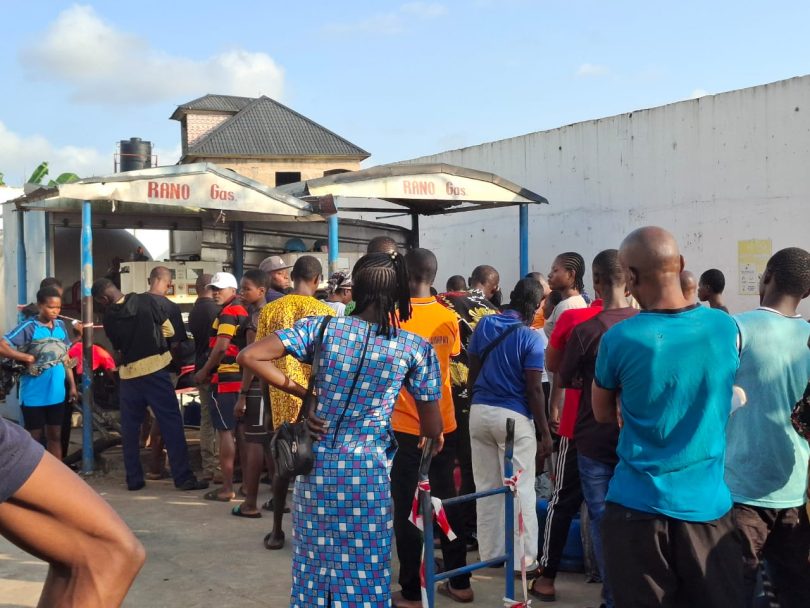
A PREMIUM TIMES nationwide survey shows how global supply disruptions and longstanding domestic bottlenecks combined to drive up the cost of Liquefied Petroleum Gas (LPG), leaving consumers and businesses under severe pressure.
By: Abdulkareem Mojeed, Ekemini Simon, Chuwang Dungs, Famrah Bagudu, Fortune Eronmonsele, Oluwakemi Adelagun, Abubakar Ahmadu Maishanu, Auwal Umar, Ogalah Dunamis, Afolabi Joseph, Manasseh Mbachii, Emmanuel Agbo, Abubakar Abdulrasheed, Oluwole Josiah, Falmata Daniel, Folashade Ogunrinde, Idowu Omotoyosi, and Chinagorom Ugwu
“The price is ridiculous. You still spend money on transportation to the gas station, and the gas may not even serve you for a week,” she told PREMIUM TIMES in July.
Ms Fayemi’s experience mirrors that of millions of Nigerians after the price of Liquefied Petroleum Gas (LPG), popularly known as cooking gas, increased following supply disruptions triggered by the war involving Iran, the United States and Israel.
Energy experts and players across the supply chain said the increase was compounded by longstanding domestic challenges, including inadequate infrastructure, inconsistent government policies and Nigeria’s dependence on imported LPG.
Although PREMIUM TIMES’ survey in July showed that prices have begun to ease after peaking in late June, consumers say the relief has been modest, with cooking gas still selling well above levels recorded just two months ago.
A PREMIUM TIMES survey across Nigeria’s six geopolitical zones found that LPG prices rose from about ₦1,100–₦1,350 per kilogramme in April and May to between ₦1,700 and ₦2,200 in late June, with some outlets charging as much as ₦2,500.
By the first week of July, prices had eased to between ₦1,250 and ₦1,800 per kilogramme, but many households continue to buy smaller quantities, postpone refills or return to traditional means of cooking with the use of firewood and charcoal.
Retailers in Lagos attributed the price spike to shortages at coastal depots and uncertainty in international energy markets during the recent Middle East tensions.
Lateef Badmus, manager of Al-Moruff Gas Plant along LASU-Iba Road, said retail prices largely reflected wholesale costs.
“When there is scarcity and demand is high, prices increase because consumers have little choice,” he said.
Damilola Adeyoriju, administrator at Casco Gas, described the period as a “man-know-man” market, where access to supplies depended largely on personal relationships.
“The few marketers that had products sold mainly to people they knew. Getting even one truck became difficult,” she said.
Across Lagos, however, prices have begun to moderate.
At Al-Moruff Gas in Kosofe, cooking gas sold for about ₦1,450 per kilogramme, down from around ₦2,000 at the peak of the supply crisis. Starco Filling Station in Orile reduced its price to ₦1,800 from over ₦2,000, while NIPCO outlets in Jakande Estate sold between ₦1,500 and ₦1,550 per kilogramme after previously charging as much as ₦1,700.
Consumers said the temporary spike significantly increased household expenses.
Enomfon Okure, an oncology nurse, said she paid ₦2,100 per kilogramme in June compared to about ₦1,700 in May.
“The hike affects everything because cooking gas is our only reliable means of cooking. We don’t have regular electricity, so we simply adjust and pay,” she said.
Another resident, Ajura Oseme, said the increase forced her to temporarily return to charcoal before prices started easing.
Prices followed a similar pattern in Akure, the capital of Ondo State, rising from about ₦1,300 per kilogramme in April to around ₦1,700 in late June before easing to about ₦1,400 in early July.
The increase forced many residents to reduce usage and embrace traditional cooking methods.
Jo Uanzekin, a resident of Oda, said although he took his 12.5kg cylinder for a refill, he could afford only 5kg.
“I am managing that one for now while supporting it with firewood from my farm,” he said.
Joshua Nambur, who buys cooking gas at a NIPCO station in Akure, said he now purchases only one to one-and-a-half kilograms at a time.
Marketers also reported declining patronage.
Shuaibu Aminu, operations manager at Shaffa Filling Station, said the station sold LPG for about ₦1,350 per kilogramme in May before prices rose to ₦1,600 and later eased to around ₦1,400.
Rotimi Adamolekun, manager of SCAAB Gas, said the recent drop in wholesale prices left many marketers selling at a loss.
“My last purchase was ₦28 million for 20 tonnes. Now the same quantity sells for ₦22 million, so we have to sell at a loss,” he said.
In many rural communities of Ondo state, households reverted to firewood and charcoal, while some urban residents with relatively stable electricity increasingly relied on electric cookers.
A similar trend emerged in Oyo and Osun states, where cooking gas prices fell after peaking at ₦1,700 and ₦2,000 per kilogramme during the supply crisis.