A closed clinic in a Benue IDP camp has left pregnant women and children facing serious barriers to healthcare.
In April 2026, Anaor Saawuan laid her eight-month-old granddaughter on a thin mattress inside their makeshift shelter at the Anyiin Internally Displaced Persons (IDP) camp in Logo Local Government Area of Benue State, Central Nigeria.
But when the vomiting and diarrhoea returned, she took the child to a hospital outside the camp, where health workers said she needed a blood transfusion.
“I had no money,” she said. “And there was nobody to help me.”
She resorted to a traditional remedy. However, at about 9 p.m. on 2 May, the child died. She believes the child might have survived if the nearby clinic within the camp had still been operational.
“There used to be a clinic here,” Mrs Saawuan said, pointing towards a building inside the camp. “Medicines were available, and treatment was free, until everything stopped.”
Her case illustrates the healthcare crisis at settlements for people displaced by conflicts in Benue State, where clinics are closed or poorly equipped, medicines are in short supply, referral systems are weak, and many families cannot afford healthcare costs.
Mrs Saawuan also has a young grandson, who was diagnosed with an inguinal hernia and referred for surgery at a general hospital. “We barely feed,” she said. “How can I pay for an operation?”
Mrs Saawuan has again resorted to herbs to manage his condition.
A few shelters away in the same camp lives a pregnant 32-year-old woman, Naomi Teryen.
Her previous pregnancies were difficult, she said, involving prolonged labour and Caesarean sections.
But five months into her current pregnancy, she has little money for regular antenatal care at a health centre outside the camp and has not had an ultrasound scan.
“I don’t have a job, and there is no proper healthcare service in this camp,” she told PREMIUM TIMES.
Mrs Teryen said she previously relied on the health facility in the camp.
“When the hospital was available, we used to get medicine free of charge there,” she said. “But now that the hospital has been closed, when we go to the health centre, we pay for medicine.”
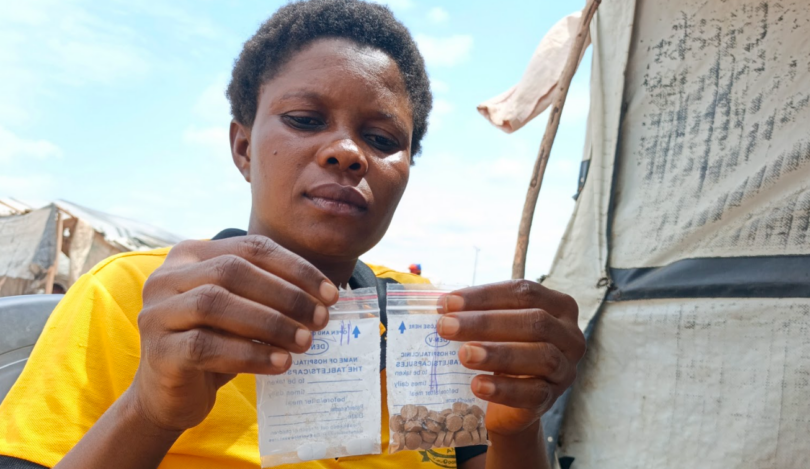
Mrs Teryen showed PREMIUM TIMES the medicines she received during an antenatal visit. They consisted of paracetamol and Multiple Micronutrient Supplements (MMS), which contain vitamins and minerals intended to prevent micronutrient deficiencies and improve maternal and birth outcomes.
The MMS supplements are distributed through Nigeria’s public health system with support from the government and development partners, including UNICEF.
They are intended to be dispensed free of charge. But Mrs Teryen alleged pregnant women from the camp are charged for medicines, including MMS, during antenatal visits to the health centre outside the camp.
She said that an antenatal visit to the European Economic Community Health Clinic (CHC) in Anyiin, a government-owned primary healthcare facility in the community, typically costs her about ₦3,000. She recalled an occasion when she arrived at the centre with only ₦1,000. “They told me to go back,” she said.
Mrs Teryen’s husband makes wooden crafts inside the camp. But he often sells nothing.
“Every time she gives birth, it is difficult. Sometimes we spend more than a week in the hospital,” he said.
Terrence Akighir, a medical doctor and UNICEF consultant, told PREMIUM TIMES the supplements should not be sold to patients.
“MMS is supposed to be free,” he said. “If somebody is taking advantage of that to sell the medicine, it should be looked into and stopped. These women do not have money. If they are paying for medicines that should be free, how will they meet their other healthcare needs?”
A UNICEF humanitarian report corroborates Mr Akighir’s claims amid the humanitarian crisis.
In its Humanitarian Situation Report No. 3, published on 18 March 2026 and covering January to December 2025, the agency said that 8.8 million people, including 4.9 million children, required humanitarian assistance, while 2.9 million people were internally displaced.
UNICEF reported that, under its First 1,000 Days Initiative, 489 pregnant women in Benue IDPs received free MMS between June and December 2025.
PREMIUM TIMES contacted the European Economic Community Health Clinic in Anyiin for a response to the allegation. An official on duty said she was not authorised to comment on whether MMS were being sold to patients and declined to provide further information before walking away.
The healthcare crisis at the Anyiin IDP camp did not begin this year. It followed the closure of a health facility inside the camp that had once provided basic medical care to displaced residents.
Helen Tsavwua, a former worker at the facility, said the clinic was established by Médecins Sans Frontières (MSF), which provided medical services to displaced communities in Anyiin IDP at the height of the displacement crisis in 2018.
“When MSF was leaving, Victim Support Fund (VSF) took over until January 2021,” she said. “When they left, the hospital was closed down.”