
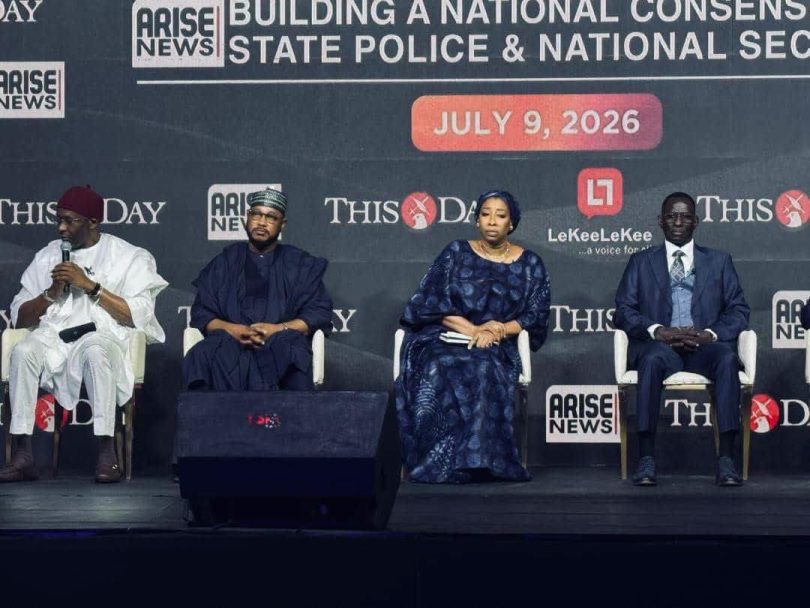
The Governor of Zamfara State, Dr. Dauda Lawal, has declared that the proposed State Police framework will finally strip away the long-standing illusion of governors as “Chief Security Officers” without real power, transforming them into fully accountable leaders with direct control over security in their states.
Lawal made this assertion on Thursday, July 9, 2026, while speaking at the Arise News Town Hall meeting themed “Building a National Consensus for State Police and National Security,” held at the ThisDay Dome in Abuja.
In a blunt assessment of Nigeria’s current security structure, the governor exposed what he described as a constitutional contradiction—where governors bear the title of Chief Security Officers but lack operational authority over security agencies.
“The chain of command and control structure is not under the governors,” Lawal stated. “By the time we have state police, we can then truly bear the title of Chief Security Officers of our respective states.”
He argued that the establishment of state police would not only empower governors but also eliminate excuses, forcing them to take full responsibility for security outcomes within their jurisdictions.
According to him, the reform introduces a new era of accountability where state leaders can no longer deflect blame to federal authorities when security fails.
Addressing fears that state police could be weaponised for political repression, Lawal dismissed such concerns as overstated, pointing to existing state-backed security outfits that have operated without being used to target opposition figures.
“Almost all states have one or more security apparatus in place, and none have been used to oppress the opposition or cause mayhem,” he said.
The governor highlighted Zamfara’s local security initiative as a working model, noting that it draws personnel from communities across local government areas—individuals with deep knowledge of the terrain and immediate response capability.
“They are always the first line of defence during any attack,” he added.
While conceding that no system is entirely immune to abuse, Lawal maintained that effective legislation, institutional safeguards, and evolving checks and balances would mitigate the risks of misuse by state authorities.
He described the anticipated passage and signing of the State Police Bill by President Bola Ahmed Tinubu and the National Assembly as a “critical turning point” in Nigeria’s fight against insecurity.
“I strongly believe that state police will go a long way in solving many of the security challenges we face today,” Lawal said.
The push for state policing has gained renewed urgency amid worsening insecurity across parts of the country, with advocates insisting that decentralising security control is no longer optional but necessary for national stability.