
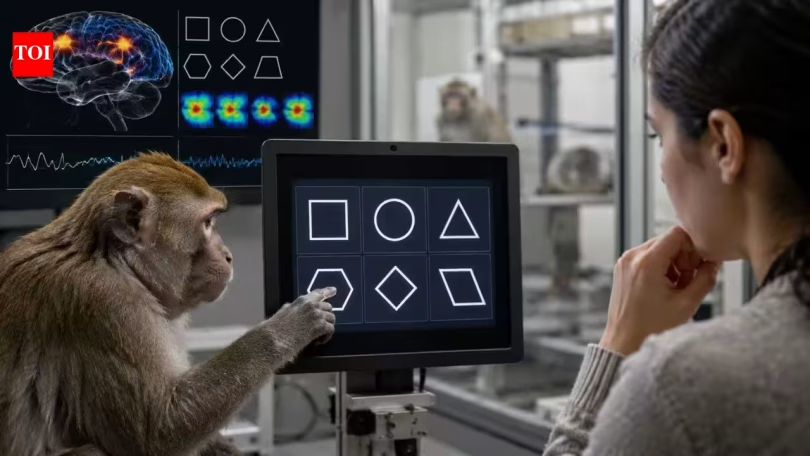
For decades, one idea has shaped discussions about human intelligence: our ability to recognise geometric patterns was thought to set us apart from other primates. People naturally notice features such as symmetry, parallel sides and right angles, and many researchers have argued that this reflects a uniquely human way of thinking.A new study was published in Proceedings of the National Academy of Sciences of the United States of America, titled “Continuity in geometric intuition between humans and monkeys”, states that the researchers found that both species appear to process geometric shapes using related mental representations. The difference is less about possessing entirely different abilities and more about how strongly those abilities develop. The work suggests that the foundations of geometric intuition may have evolved long before modern humans appeared.
How researchers tested geometric intuition in monkeys and humans
To investigate the question, the research team compared the performance of monkeys, preschool children and adults using a shape-matching task. Participants first viewed one geometric figure before choosing which of two options matched it. The experiments included both familiar orientations and versions where the shapes had been rotated, making recognition more demanding.According to the researchers, they were interested in discovering whether monkeys relied only on simple visual appearance or whether they also used more abstract information about a shape’s structure. They compared participants’ responses with several computer models designed to represent different ways of processing visual information, ranging from low-level image features to higher-level geometric representations.Rather than supporting the long-standing idea that only humans employ symbolic geometric reasoning, the results showed that monkeys also made use of higher-level representations. Adult humans generally performed with greater precision, yet the overall pattern suggested shared cognitive mechanisms rather than completely separate systems.
Rotated shapes helped uncover abstract geometric reasoning in monkeys
One part of the study focused on what happens when the same shape is presented from a different angle. Recognising that two rotated figures are still the same requires the brain to ignore orientation and focus on the underlying structure.This ability may explain much of what has previously been described as uniquely human symbolic thinking. When monkeys were tested with rotated shapes, their reliance on abstract geometric information increased substantially. Preschool children also showed a similar shift, suggesting that recognising shapes across different orientations plays a major role in developing more sophisticated geometric reasoning.The researchers argue that this finding raises the possibility that what appears to be symbolic reasoning may often emerge from increasingly flexible visual representations rather than from a separate, exclusively human system for encoding geometry.
Study suggests human geometric intuition evolved from shared primate abilities
The evidence fits an evolutionary continuity model rather than a strict human-versus-monkey divide. Statistical analyses found considerable overlap in the way monkeys, preschool children and adults represented geometric shapes, with differences appearing gradual instead of categorical. Rotation placed greater demands on participants than species differences themselves.In the discussion, the researchers argue that adult humans still demonstrate the strongest abstract geometric abilities, but these seem to build upon mental processes already present in other primates. They suggest that human experience, learning and culture may strengthen these shared systems over time instead of creating an entirely new form of reasoning.The roots of geometric intuition may stretch much deeper into primate evolution than previously assumed. Rather than viewing geometry as an ability that suddenly appeared in humans alone, the findings suggest it developed gradually from cognitive foundations that humans continue to share with monkeys.