
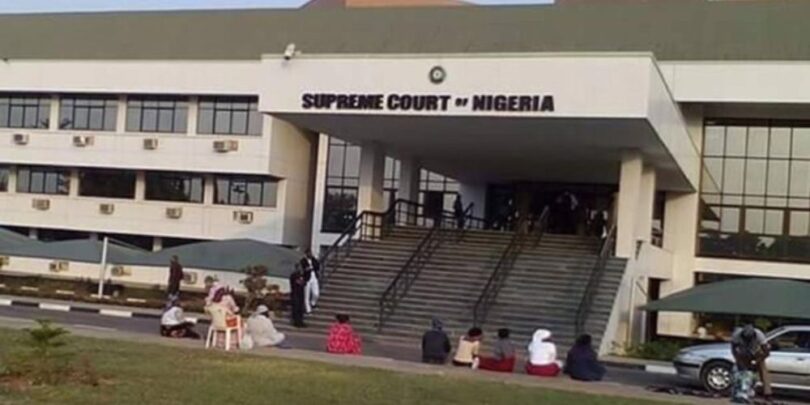
The Supreme Court of Nigeria has affirmed the conviction and five-year jail sentence of three officials of the Non-Academic Staff Union (NASU) of Tai Solarin College of Education, Omu-Ijebu, Ogun State, over the diversion of N68m belonging to the union.
The judgment, delivered on April 17, marked the end of a protracted legal battle spanning over 11 years, with the apex court unanimously dismissing the appeal filed by one of the convicts for lacking merit.
The Independent Corrupt Practices and Other Related Offences Commission (ICPC), which prosecuted the case, described the ruling as a landmark victory in its anti-corruption drive in a statement issued on Monday by Okor Odey
Head, Media and Public Communications of ICPC.
The convicts – Yusuf Temilade, Adeyemi Alaba Samuel, and Amuludun Tosin – were non-academic staff of the institution and members of the NASU executive committee, where they served as Chairman, Secretary, and Acting Treasurer, respectively.
They were entrusted with the management of union funds, including a loan facility of about N68m secured in 2011 from a commercial bank for disbursement to approximately 120 staff members.
According to the ICPC, the disbursement process required strict oversight and approval by key officials of the institution, including the Provost and the Registrar.
However, investigations revealed that the trio abused their positions by diverting funds for personal use, withdrawing amounts in excess of approved limits, and facilitating payments to individuals who were not staff of the college.
Following a petition, the ICPC charged the defendants before the Ogun State High Court sitting in Abeokuta on a seven-count charge bordering on conspiracy and abuse of office by conferring corrupt advantage on themselves and others, contrary to Section 19 of the Corrupt Practices and Other Related Offences Act, 2000.
During the trial, the prosecution presented witnesses and documentary evidence linking the defendants to the fraudulent disbursement of the loan.
In its judgment delivered on June 13, 2017, the trial court found the defendants guilty on counts 1, 2, 3, 5, and 7, and sentenced them to five years imprisonment, with the sentences to run concurrently.
Dissatisfied with the ruling, the convicts approached the Court of Appeal, Ibadan Division, which, on December 6, 2019, upheld the trial court’s judgment in a majority decision and dismissed the appeal.
Still aggrieved, one of the defendants further appealed to the Supreme Court. After hearing arguments from both parties on January 22, 2026, the apex court, in a unanimous decision, affirmed the concurrent judgments of the lower courts and dismissed the appeal in its entirety.
In its ruling, the Supreme Court made a significant pronouncement on the interpretation of who qualifies as a public officer under the ICPC Act.
The court held that individuals cannot evade accountability by operating under the guise of union or cooperative society leadership, warning that accepting such a defence would effectively legitimise corrupt practices by public officials who exploit such platforms to siphon funds meant for collective benefit.
Reacting to the judgment, the ICPC reiterated its commitment to promoting transparency, accountability, and integrity in the management of public resources.
The Commission also commended its prosecution team, led by Deputy Director of Legal Services, Enosa Omoghibo, for what it described as diligence and professionalism in securing the conviction.