
National

TETFund Grant: OOPOLY Urges Lecturers To Focus On Problem-Solving Research

The management of Ogbonnaya Onu Polytechnic, Aba, has commenced efforts to position its academic staff to participate in the TETFund National Research Fund through a one-day workshop on concept note writing organised by the Directorate of Research and Development.

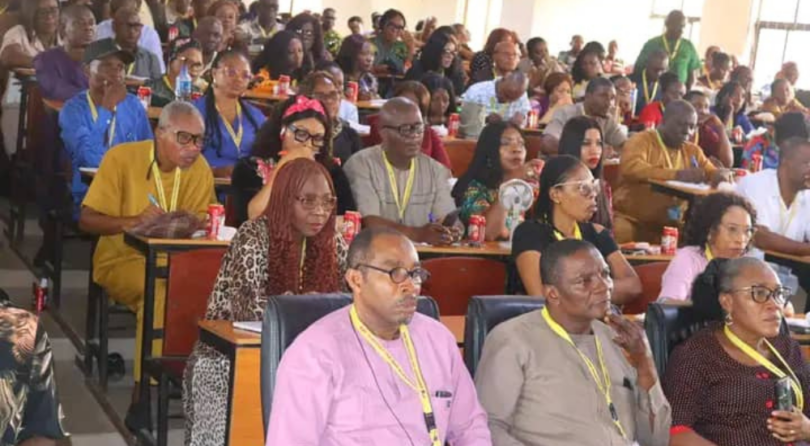
The workshop, held at the Polytechnic’s ICT Auditorium, brought together academic staff from the institution’s six schools and focused on equipping participants with the skills required to develop research concept notes that meet TETFund’s funding requirements.

The training also marked the assumption of office of the newly appointed Director of Research and Development, Dr. Lovinah C. Emelogu, who was appointed on August 18, 2026, and succeeded Dr. Ezechi Onyerionwu.

Speaking on the purpose of the workshop, Emelogu said it was organised in response to TETFund’s call for the submission of concept notes for the National Research Fund, with October 15, 2026, set as the submission deadline.

She said the training was designed to give academic staff a better understanding of the requirements for developing fundable concept notes, particularly the need to structure research proposals around clearly identified problems and practical solutions.

The resource person, Prof. Philip Asuquo, Director, TETFund Centre of Excellence in Computational Intelligence Research, University of Uyo, urged participants to approach research from a problem-solving perspective.

He stressed that every research proposal should clearly demonstrate how the proposed study would address an existing problem and deliver practical outcomes.

Asuquo also emphasised the importance of proper topic selection, measurable objectives and the use of active verbs when stating research objectives.

He advised researchers to clearly define their targets and expected outputs while ensuring that the scope of their proposed research remained realistic and achievable.

The professor further encouraged academic staff to adopt interdisciplinary approaches where necessary, noting that some research problems require contributions from experts in different fields.

He also stressed the importance of technical reporting, adherence to application guidelines and strict compliance with funding requirements.

According to him, concept note writing for research funding should not be approached in the same manner as conventional academic writing, but should focus on the practical application and potential impact of the proposed research.

Asuquo cautioned participants against excessive reliance on Artificial Intelligence tools, noting that AI-generated proposals could contain ideas that may be difficult to implement if they are not critically evaluated by the researcher.

He advised researchers to subject their proposals to internal vetting before submission and pay close attention to details, adding that the rejection of a proposal did not necessarily mean that the research itself lacked quality.

He also urged prospective researchers to carefully select competent members when constituting research teams, particularly for multidisciplinary projects.

The Rector of the Polytechnic, Dr. Christopher Okoro Kalu, who served as Chief Host of the workshop, was represented by the Deputy Rector, Dr. Chizaram Ogbuji.

Also present was Dr. Anthony U. Chimezie, Desk Officer, TETFund Diaspora.

.

National

TETFund Grant: OOPOLY Urges Lecturers To Focus On Problem-Solving Research

The management of Ogbonnaya Onu Polytechnic, Aba, has commenced efforts to position its academic staff to participate in the TETFund National Research Fund through a one-day workshop on concept note writing organised by the Directorate of Research and Development.

The workshop, held at the Polytechnic’s ICT Auditorium, brought together academic staff from the institution’s six schools and focused on equipping participants with the skills required to develop research concept notes that meet TETFund’s funding requirements.

The training also marked the assumption of office of the newly appointed Director of Research and Development, Dr. Lovinah C. Emelogu, who was appointed on August 18, 2026, and succeeded Dr. Ezechi Onyerionwu.

Speaking on the purpose of the workshop, Emelogu said it was organised in response to TETFund’s call for the submission of concept notes for the National Research Fund, with October 15, 2026, set as the submission deadline.

She said the training was designed to give academic staff a better understanding of the requirements for developing fundable concept notes, particularly the need to structure research proposals around clearly identified problems and practical solutions.

The resource person, Prof. Philip Asuquo, Director, TETFund Centre of Excellence in Computational Intelligence Research, University of Uyo, urged participants to approach research from a problem-solving perspective.

He stressed that every research proposal should clearly demonstrate how the proposed study would address an existing problem and deliver practical outcomes.

Asuquo also emphasised the importance of proper topic selection, measurable objectives and the use of active verbs when stating research objectives.

He advised researchers to clearly define their targets and expected outputs while ensuring that the scope of their proposed research remained realistic and achievable.

The professor further encouraged academic staff to adopt interdisciplinary approaches where necessary, noting that some research problems require contributions from experts in different fields.

He also stressed the importance of technical reporting, adherence to application guidelines and strict compliance with funding requirements.

According to him, concept note writing for research funding should not be approached in the same manner as conventional academic writing, but should focus on the practical application and potential impact of the proposed research.

Asuquo cautioned participants against excessive reliance on Artificial Intelligence tools, noting that AI-generated proposals could contain ideas that may be difficult to implement if they are not critically evaluated by the researcher.

He advised researchers to subject their proposals to internal vetting before submission and pay close attention to details, adding that the rejection of a proposal did not necessarily mean that the research itself lacked quality.

He also urged prospective researchers to carefully select competent members when constituting research teams, particularly for multidisciplinary projects.

The Rector of the Polytechnic, Dr. Christopher Okoro Kalu, who served as Chief Host of the workshop, was represented by the Deputy Rector, Dr. Chizaram Ogbuji.

Also present was Dr. Anthony U. Chimezie, Desk Officer, TETFund Diaspora.

.