Marine scientists in Thailand are placing young seagrass shoots inside 3D-printed bioplastic shelters because strong waves and hungry sea creatures keep destroying new transplants before they can grow roots.The trial is taking place in the waters surrounding Koh Lidi, two small islands inside Mu Ko Phetra National Park in Satun Province. Seagrass meadows in the area are vanishing under heavy environmental pressure. That loss has hit local fishing communities that rely on the meadows as a nursery for shrimp, crabs and fish. It has also devastated Thailand’s declining dugong population, which depends on seagrass as its main food source. Unprecedented numbers of dugongs have washed up dead along the Andaman Coast in recent years.
Shielding shoots on the seabed
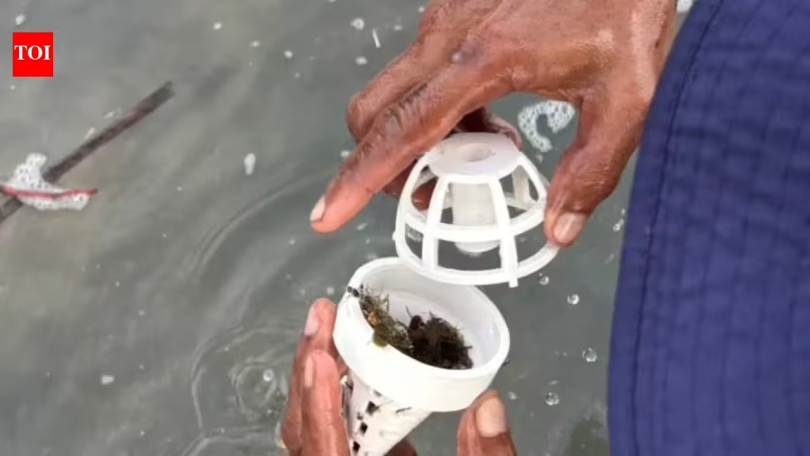
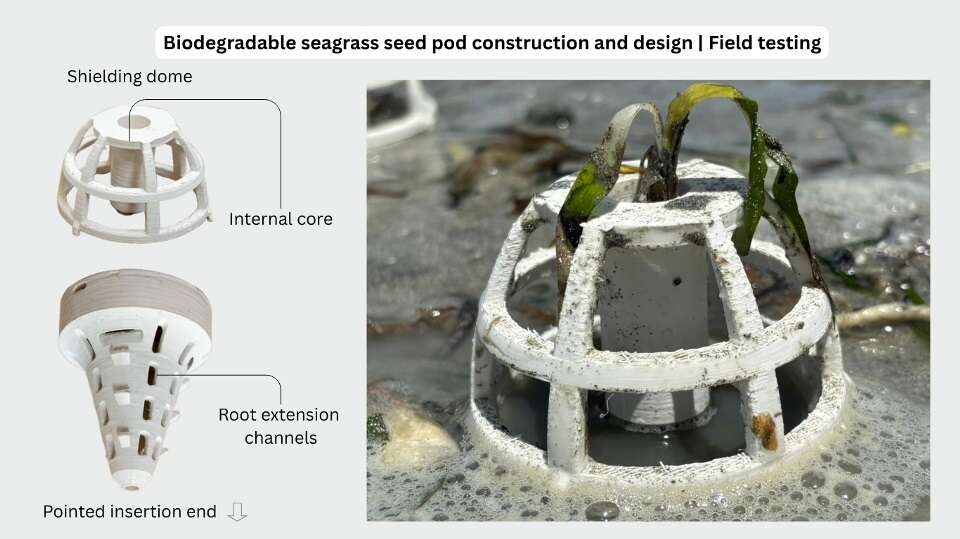
Past attempts to plant new seagrass have struggled. Young shoots are easily swept away by ocean currents, buried in moving seabed sediment, or eaten by marine life before their roots anchor into the seafloor.To solve this problem, researchers from Walailak University in Thailand and Murdoch University in Australia have designed a protective 3D-printed pod. Shaped like a small dome with an anchor, the unit is pushed directly into the seabed with a seagrass shoot tucked safely inside.The dome features open slots along its sides, allowing roots to spread outward into the sand while keeping crabs, fish and turtles away from the tender shoot.
Bioplastic engineered to break down
The pods are made from polyhydroxyalkanoate (PHA), a fully biodegradable plastic produced through bacterial fermentation using local microbial strains in Western Australia.“The bioplastic is produced through bacterial fermentation using locally sourced microbial strains in Western Australia,” said Dr Alexandra Gulizia from Murdoch University’s Bioplastics Innovation Hub. “By tailoring the material’s properties, we can create a pod that’s durable enough to withstand marine conditions while remaining fully biodegradable.”Once the seagrass establishes a strong root system, the PHA dome naturally breaks down without leaving plastic waste behind.The material can be produced at Murdoch University’s Bioplastics Innovation Hub and at the Joint Laboratory of Waste and the Circular Economy at Naresuan University in Thailand.
The bioplastic is produced through bacterial fermentation using locally sourced microbial strains
Cross-border institutional backing
The collaborative project is led by Walailak University PhD candidates Patsakorn Jeenchuay and Leoniel Jude Giray. They are supervised by Professor Mullica Jaroensutasinee and Professor Krisanadej Jaroensutasinee, directors of the university’s Centre of Excellence for Ecoinformatics.The Thai team is working alongside Dr Gulizia, Professor Andrew Macrae and Dr Samantha Vijjoen from Murdoch University’s Bioplastics Innovation Hub. Financial support for the research comes jointly from the National Research Council of Thailand and Murdoch’s Bioplastics Innovation Hub, supported by the Commonwealth Scientific and Industrial Research Organisation (CSIRO).Professor Macrae, deputy director of the Bioplastics Innovation Hub, spent more than twenty years working on mangrove restoration in Brazil before joining this project.“One of the biggest challenges in seagrass restoration is helping young plants survive long enough to establish roots,” Professor Macrae said. “These biodegradable pods are designed to protect transplants from waves, sediment movement, and grazing animals during those critical early stages.”
Testing before field deployment
Researchers from Murdoch University recently visited Koh Lidi to survey the underwater site and meet the local research team.The 3D-printed pods remain in the prototype phase. Scientists are running safety checks and packaging tests before starting physical field trials in the ocean around Satun Province.Professor Jennifer Verduin, a leading seagrass expert and Pro Vice-Chancellor for the College of Environmental and Life Sciences at Murdoch University, is providing mentorship for the project.“If successful, this technology could provide a scalable and environmentally friendly solution for restoring seagrass ecosystems across Southeast Asia and other coastal regions facing similar challenges,” Professor Verduin said.
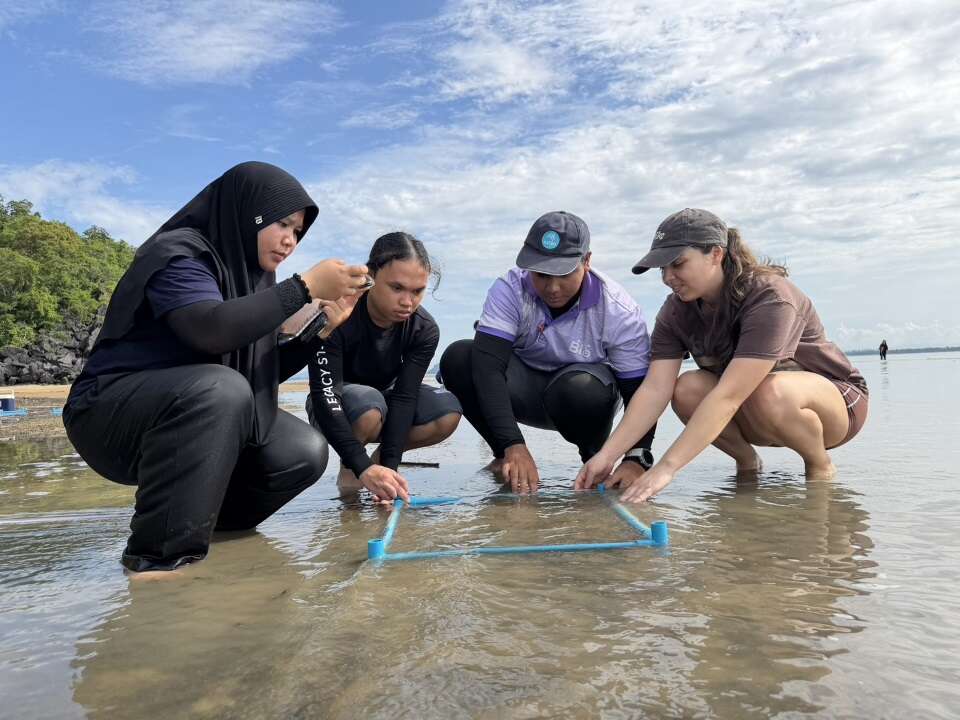
Leading seagrass expert, Jennifer Verduin, will provide expert guidance and mentorship throughout the project.
Regional conservation efforts
The initiative around Koh Lidi aligns with broader conservation strategies launched across Thailand to address accelerating coastal habitat loss. In response to rising dugong mortality along the Andaman Coast, the Thai Department of Marine and Coastal Resources, alongside environmental organizations, has expanded satellite mapping and aerial drone surveys to monitor surviving dugong populations and map historic seagrass loss. These high-resolution mapping projects allow researchers to identify high-priority zones where active replanting efforts stand the highest chance of success.The choice of polyhydroxyalkanoate (PHA) for the 3D-printed pods is rooted in its performance in marine environments. Unlike traditional bio-based plastics such as polylactic acid (PLA), which require industrial composting conditions to break down, PHA is naturally consumed by ocean-dwelling microbes. In tropical waters like the Andaman Sea, PHA marine half-lives range from two months to under a year, depending on structural thickness and surface area. Microorganisms break down the polymer into carbon dioxide, water, and natural biomass. This ensures that once the pod completes its physical duty of anchoring the shoot and preventing grazing, it vanishes completely from the ecosystem without leaving synthetic microplastic residues behind.