
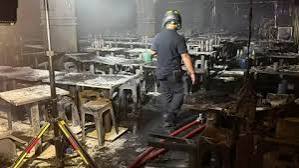
(Bangkok’s bar fire. Photo by BBC)
A sudden burst of flame swept through a packed bar, sending panicked patrons scrambling toward a single narrow exit as thick, toxic smoke overwhelmed them, with the bodies of those who didn’t survive blocking the escape route for others. Reader discretion is advised.
This scene played out not only at the Rong Beer Na Ladprao pub in Bangkok last Sunday night, where 32 deaths have now been confirmed, but also at another club, Mountain B, in the coastal town of Sattahip four years earlier, where 26 people died in a strikingly similar blaze.
Both incidents echo an earlier tragedy at the Santika Club in Bangkok during a 2009 New Year celebration, which claimed 67 lives.
Each disaster prompted calls for reform to prevent recurrence one of them from Worsak Kanok-Nukulchai of the Asian Institute of Technology, who spoke out after the Mountain B fire and now finds himself repeating the same warnings.
He observed that despite occurring in different places, at different times, and likely for different causes, all three fires followed a similar pattern: mass casualties in overcrowded venues, rapid fire spread through stage areas or ceilings, thick smoke that cut visibility and blocked people from locating exits, and deaths caused mainly by smoke inhalation rather than the fire itself.
He believes the Bangkok fire may have started from an electrical fault and spread through flammable sound insulation material.
The intense flames seen shooting out of the front entrance were likely fuelled by fresh oxygen once the door was opened to let people escape.
That surge of fire near the entrance may have pushed some patrons toward the rear of the pub, where the two exits were reportedly partially obstructed and difficult to locate once the power failed an area where many of the victims were later found.
Professor Worsak stressed that the more pressing question isn’t merely what ignites these fires, but why a single spark so often escalates into mass casualties.
The devastating toll from the 2009 Santika Club fire did prompt tighter safety regulations for nightclubs.
From 2012, venues were required to use fire-resistant sound insulation materials, install wider exits that open outward, maintain backup power systems to keep exit signs lit, and, for venues holding more than 500 people, install sprinkler systems.
However, these stricter rules only apply to venues located within designated entertainment zones, of which Bangkok has just three.
Most pubs operate outside these zones and are instead classified as restaurants offering live music, a category exempt from the regulations regardless of capacity. Both Rong Beer Na Ladprao and Mountain B fell into this loophole.
Bangkok Governor Chadchart Sittipunt has since acknowledged this dangerous regulatory gap.
The Rong Beer Na Ladprao pub had reportedly been inspected just three months prior and cleared as safe.
In response, he has directed city officials to begin conducting unannounced spot checks on so-called restaurants that are actually operating as pubs or clubs, stating that stricter standards will now be applied to such venues.
He acknowledged that authorities may lack full legal power to enforce compliance but said they would push for changes and seek ways to shut down venues found to pose a risk.
Still, with thousands of such establishments across Bangkok, it remains unclear whether the Bangkok Metropolitan Administration has the manpower to carry out inspections at that scale, and any effort to close down non-compliant venues, likely the majority, would probably face significant pushback.
Corruption among local officials and police remains a longstanding issue in Thailand, with it being widely understood that many entertainment venues make informal payments to police to continue operating.
Even if stricter rules are extended to pubs outside official entertainment zones, enforcement remains doubtful.
Following the Mountain B fire, five police officers were suspended over suspicions they may have overlooked a restaurant functioning as a club, but no further updates on their case have emerged.
The venue’s owner and three others were convicted on various charges by a lower court and sentenced to up to 10 years in prison, though they remain free on bail as their appeal proceeds, a process that can take years in Thailand.
In the Santika Club case, the owner and the person responsible for the indoor fireworks blamed for sparking the fire were each sentenced to three years in prison, but remained free on appeal for six years before the Supreme Court upheld the sentence.
No other officials are known to have faced prosecution over either disaster.
Safety failures remain widespread across Thailand more broadly. Road fatalities per capita are ten times higher than in Britain. In October 2024, a bus fire caused by illegally installed gas canisters killed 23 people, including 20 schoolchildren.
In January this year, 32 passengers died when a construction crane collapsed onto a train, and earlier this month, 10 monks were killed by a pickup truck driven by an 11-year-old boy.
Each of these tragedies has been met with promises of official action, yet the pattern continues to repeat itself.