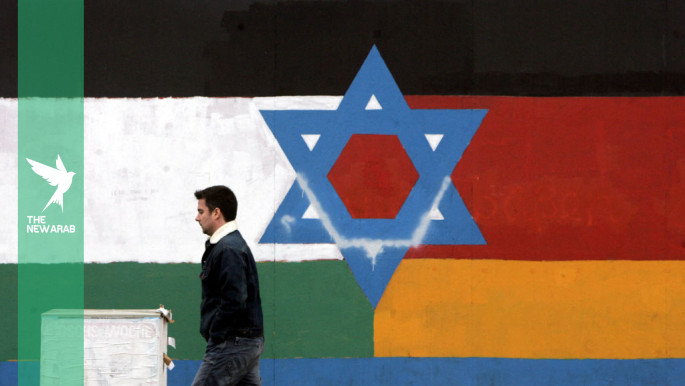
As Palestinians in Gaza were slaughtered on a mass scale, the German government resisted sanctions on Israel, opposed South Africa’s ICJ genocide case against Tel Aviv, and maintained arms supplies to the Israeli military, write Emad Moussa. [GETTY]
June did not bring the long-awaited summer to much of Europe. And for Germany, the forecast was particularly grim.
Earlier this month, Germany failed for the first time to secure a non-permanent seat on the United Nations Security Council, after decades of routinely holding this position. The event generated competing narratives that sought to provide coherent explanations for what happened.
Perhaps Berlin had grown too confident that it forewent sufficient campaigning for the position. Or, the country’s reduction in funding for parts of the UN amounted to a quiet political cost, mainly borne by the Global South.
Or perhaps Germany’s failure was driven by Russia in response to Berlin’s support for Ukraine. Portugal and Austria, both supporters of Ukraine, secured seats on the UNSC.
That said, it is in such moments that alternative readings begin to form to explain the turn of events. One such reading is Germany’s position on Israel, especially since October 2023.
The suggestion was voiced by Foreign Minister Johann Wadephul, who stated: “[T]he fact that Germany must always assume a special responsibility for Israel in the Middle East conflict may also have cost votes.” Craig Mokhiber, former director of the OHCHR’s New York Office, also pointed to this possibility.
What stands out in Wadephul’s remarks, however, is neither a declaration of causality nor a dismissal of it. It is rather a position closer to an admission that a long-standing moral orientation may now sit differently within a changing diplomatic environment. That, and what appeared as ‘a German martyr complex’, linking “moral self-image” to “being punished for embracing it”.
Most of this worldview is rooted in Germany’s collective memory and what’s perceived a confrontation with its own historical crimes. Particularly after the reunification of East and West Germany in 1990, Shoah remembrance became deeply institutionalised beyond commemorative practices and embedded as part of state identity. Yet once memory becomes super-institutionalised, it begins to organise attention unevenly.
The centrality of the Shoah coexists with other histories of violence that remain less integrated into the symbolic core of German public remembrance. Germany’s genocide in Namibia, for instance, between 1904 and 1908 occupies significantly less density within the moral imagination of the state. The same applies to approximately 27 million Soviet citizens who died during the Nazi invasion of the Soviet Union from 1941 to 1945.
Within this architecture, Israel became embedded within Germany’s post-war self-understanding as a continuation of historical responsibility, not merely as a foreign policy. Over time, this created an indissociable proximity between identity and policy.
This configuration, nonetheless, did not emerge cleanly in the post-war worldview. In the early decades after 1945, German society remained marked by uneven confrontation with its past. Public acknowledgement of collective responsibility for the Jewish genocide was limited. “… I’m yet to find a German who will admit to being a Nazi,” said American photojournalist Margaret Bourke-White, who toured Germany after the war and recorded her observations in a 1946 article titled ‘Dear fatherland, rest quietly’.
Think also of the fact that in the early 1950s, survey data in West Germany showed only a small minority of citizens explicitly accepted responsibility for the fate of European Jews, while a significant proportion blamed the Jews themselves.
Against this backdrop, the 1952 reparations agreement between Germany and Israel, negotiated under Chancellor Konrad Adenauer, was not only a moral gesture but also a strategic act of reintegration into a Western order. This mechanism allowed Nazism to be imagined as external to Europe’s historical continuity, rather than something structurally embedded within it, a move that also enabled Arab leaders opposed to Israel to be framed through fascist analogies. Nasser, for instance, was labelled “Hitler on the Nile”.
A similar logic persists today within German debates on antisemitism. Public discourse often places disproportionate emphasis on immigrant communities, particularly from the Middle East. Despite consistent findings that far-right actors account for the majority of antisemitic crimes.
The result is not only empirical imbalance but a shaping of perception, in which support for Israel becomes entangled with the performance of democratic self-legitimation. And, for a long period, this configuration produced limited external friction.
However, that “equilibrium” has begun to shift since October 2023, and Berlin has found itself face-to-face with a changing international environment.
The answer, or rather the attempt to adapt, came weak and half-hearted. Berlin repeatedly emphasised humanitarian concerns and calls for restraint, in Palestine or Lebanon, without a meaningful shift in its perception of Israel.
And as Palestinians in Gaza were slaughtered on a mass scale, the German government resisted sanctions on Israel, opposed South Africa’s ICJ genocide case against Tel Aviv, and maintained arms supplies to the Israeli military for much of the period in question.
Domestically, this has coincided with restrictive practices around Palestine-related activism, occasionally comparable in their severity to those in Israel against Palestinians or their supporters. The justification for these measures was/is often framed through historical responsibility and the imperative to prevent antisemitism from re-emerging in any form.
Yet the more significant shift is external rather than internal. It lies in the changing way Israel is now seen within parts of the international system. Even in areas where Israel previously held a stable and influential place, such as the United States, it has maintained a historical lifeline.
American public opinion, particularly among younger generations, has moved noticeably away from older alignments, according to a Pew poll in April 2026. This is the country where the word “Palestine” was once “politically fraught”, as Edward Said explained.
Meanwhile, several states have begun to revisit questions of recognition of Palestinian statehood, which Germany continues to adamantly refuse to recognise.
Within Israel itself, these developments are increasingly visible, albeit often interpreted differently and primarily through the lens of anti-Semitism.
Concerns about diplomatic isolation, boycotts, and long-term external pressure have entered public discourse. References to economic self-sufficiency and strategic adaptation, including comparisons to Sparta, according to Netanyahu, reflect not confidence but rather an awareness of the narrowing of external space.
Germany, however, continues to operate within a moral framework shaped in an earlier historical moment rather than through the evolving language of international political perception. It is a type of self-perceived coherence within a memory structure that does not guarantee resonance within a changing international order.
What emerges, as a result, is not rupture but drift: a gradual divergence between moral self-description and external readability.
And it is within this rift that the Security Council result acquires its suggestive weight. Not as cause or definitive proof, but as a moment in which misalignment becomes a visible marker of a state’s tension between external reality and internal self-image.
This increasingly registers as a loss of international credibility for Germany, exposing its growing inability to keep pace with the shifting global perceptions and expectations.
Dr Emad Moussa is a Palestinian-British researcher and writer specialising in the political psychology of intergroup and conflict dynamics, focusing on MENA with a special interest in Israel/Palestine. He has a background in human rights and journalism, and is currently a frequent contributor to multiple academic and media outlets, in addition to being a consultant for a US-based think tank.
Follow him on Twitter: @emadmoussa
Have questions or comments? Email us at: editorial-english@newarab.com
Opinions expressed in this article remain those of the author and do not necessarily represent those of The New Arab, its editorial board or staff.