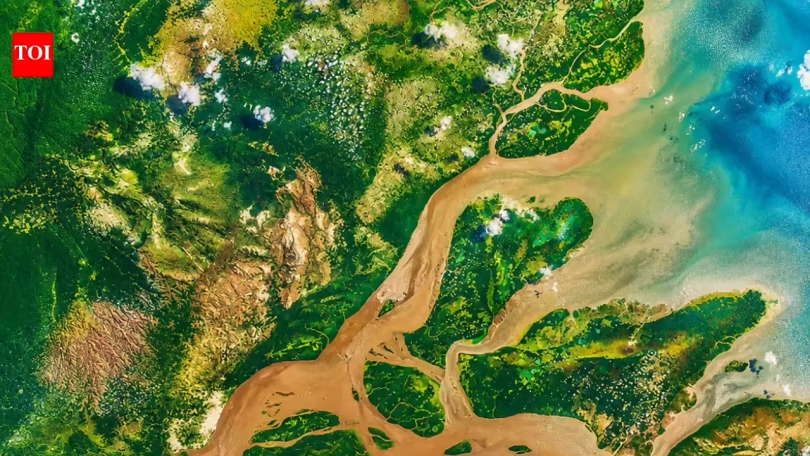
Stretching across the heart of South America, the Amazon River is the largest river on Earth by water discharge and one of the planet’s most extraordinary natural systems. It flows through vast tropical rainforests, supports unrivalled biodiversity and sustains millions of people. Yet despite spanning more than 6,400 kilometres (4,000 miles), one remarkable fact continues to astonish travellers and engineers alike: there is no bridge crossing the Amazon River’s main channel. Unlike the Thames, the Nile or the Mississippi, the Amazon remains entirely bridge-free along its principal course. The absence of bridges is not an engineering oversight but the result of geography, hydrology, economics and environmental conservation. Together, these factors explain why boats, not bridges, continue to define travel across the world’s most powerful river.
Why no bridges cross the Amazon River despite modern engineering
At first glance, constructing a bridge across the Amazon might appear to be an achievable engineering challenge. However, the river presents conditions unlike almost any other on Earth.Walter Kaufmann, chair of Structural Engineering (Concrete Structures and Bridge Design) at the Swiss Federal Institute of Technology in Zurich, told Live Science, “Of course, there are also technical and logistical difficulties.”According to the World Wide Fund for Nature (WWF), the Amazon’s width changes dramatically throughout the year. During the rainy season, floodwaters spread across extensive floodplains, causing the river and its surrounding wetlands to expand to tens of kilometres wide in many locations rather than remaining confined to a single channel. As the seasons change, so does the river. During the dry season, the width of the Amazon River can be 4 km to 5 km in places and in the wet season, this can increase to 50 km! At the height of the wet season, the current can reach a speed of 7 km/hr.The Amazon Basin also contains unstable sediments, shifting sandbanks and constantly changing river channels. Bridge foundations would need to withstand not only immense water volumes but also continual movement of the riverbed.Nasa notes that the Amazon carries approximately 219,000 cubic meters (7,740,000 cubic feet) of water; roughly the equivalent of 88 Olympic-size swimming pools, flowing from the river into the Atlantic Ocean every second. , more than any other river on Earth. This enormous discharge creates powerful hydraulic forces that significantly complicate large-scale bridge construction.Seasonal flooding adds another obstacle. Water levels can rise by more than 10 metres in parts of the basin, requiring exceptionally tall bridge approaches that would extend for many kilometres across floodplains rather than simply crossing the main river channel.
Remote rainforest, low traffic and conservation make bridges unnecessary
Engineering is only part of the story. Unlike many major rivers that connect densely populated cities, much of the Amazon’s main course passes through sparsely populated rainforest with relatively little road infrastructure.Many Amazonian communities remain connected primarily by rivers rather than highways. Boats function as everyday transport for passengers, food, fuel, construction materials and medical supplies. But the World Bank points out that of Brazil’s 63,000 km of rivers, only about 20,000 km are navigable, and just 6,500 km are used for regular commercial shipping.Building an expensive bridge where few roads exist on either side would provide limited economic benefit.Environmental considerations are equally important. The United Nations Educational, Scientific and Cultural Organization (UNESCO) describes the Amazon as one of Earth’s most biologically diverse ecosystems, supporting millions of species and regulating regional and global climate.Large bridge projects would require extensive road construction through intact rainforest, increasing the risk of deforestation, habitat fragmentation and illegal logging. Numerous scientific studies have shown that new roads often become gateways for forest clearing, making infrastructure planning especially sensitive within the Amazon Basin.For these reasons, governments frequently prioritise maintaining river transport instead of expanding road networks into remote forest regions.
Could the Amazon River ever have bridges in the future?
While no bridge spans the Amazon River’s main channel today, bridges do cross several of its major tributaries, including the Rio Negro, where the Manaus-Iranduba Bridge connects important urban centres.Engineers agree that constructing a bridge across the Amazon itself is technically possible with modern technology. The question is not whether it can be built, but whether it should be.Future decisions will depend on balancing transportation needs with environmental protection, economic feasibility and the rights of Indigenous communities whose territories lie within the basin.Safeguarding the Amazon remains essential because the rainforest plays a critical role in global biodiversity, freshwater systems and climate regulation. For now, ferries, cargo vessels and riverboats remain the most practical, and sustainable, way to travel across the world’s largest river.
A river that continues to shape life without bridges
The Amazon River demonstrates that not every geographical challenge demands a concrete solution. Its immense size, dynamic floodplains, shifting sediments and ecological importance have combined to make bridges both impractical and, in many places, unnecessary. Instead of roads spanning its waters, the river itself remains the region’s primary transport corridor, just as it has for centuries. In an era of expanding infrastructure, the Amazon stands as a rare reminder that preserving natural systems can sometimes be more valuable than transforming them.