
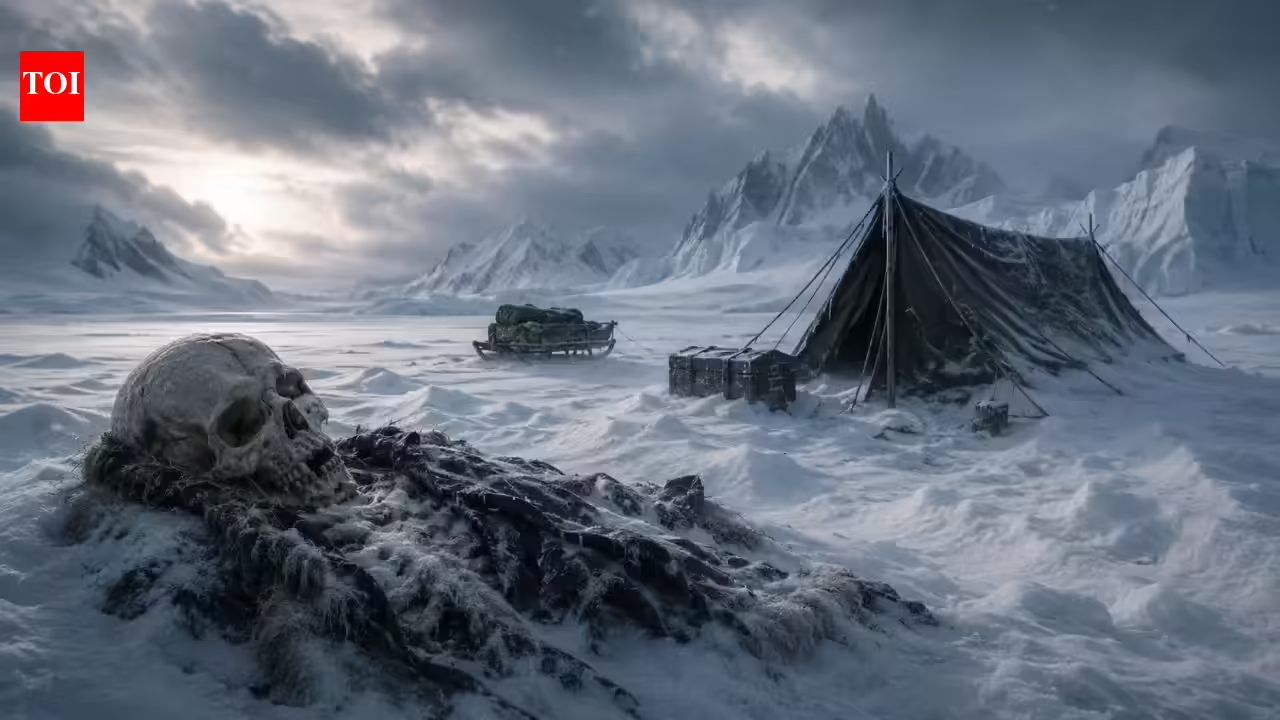
Antarctica tends to be described in numbers first. Temperatures that fall far below what most instruments are built for, wind that can strip visibility down to nothing, distances that flatten judgment. It is also a place where people still go to work, to measure ice, to run stations, to move supplies across blank stretches of white that look unchanged for weeks at a time. Over the decades, some of those journeys have not ended in the way they were planned. A few deaths are documented carefully, others only partly understood, and some remain without clear closure. The records left behind are uneven, often fragmentary, shaped by weather, isolation, and the simple difficulty of getting anything out once conditions turn.
Unexplained remains of a young Chilean woman on Livingston Island and the gaps in Antarctic history
The oldest human remains linked to the Antarctic region were not found in any scientific camp or expedition base. They were discovered much later, lying near a beach on Livingston Island in the South Shetlands, after having been exposed by shifting ice and weather over time.What puzzled archaeologists was not just the age of the bones, but the identity behind them. The individual was a young woman from southern Chile, far from any recorded early sealing route that reached that far south. There are gaps in how she might have travelled, and even the most careful reconstruction only circles possibilities. Sealing ships, informal exchanges along the South American coast, the rough and often undocumented movement of crews in the early nineteenth century. Nothing fits cleanly.There is no diary entry, no confirmed logbook reference. Just the remains, and a coastline that would have looked nothing like the place it is now.
The final march of Scott’s expedition: A journey where survival slowly ran out of reach
The British polar expedition led by Robert Falcon Scott reached the South Pole only to find another team had already been there. The return journey is where the surviving accounts grow heavier, written in short entries that thin out as exhaustion took hold.Men dropped away one by one across the ice. One officer stepped out of the tent and did not come back, a moment later turned into one of the more quoted fragments of polar history. Others followed as the distance to their final depot shrank but remained out of reach for days.By the time a search party arrived months later, the last camp was still there, half buried, with bodies inside. They were left where they lay, covered over in snow, as there was little else to do in that environment. The notes recovered from Scott’s journal read like someone writing while the margins of survival were closing in.
Hidden hazard of Antarctic traverses
Mid-winter traverses inland from Antarctic stations relied on heavy tracked vehicles and sledges, often moving blind across surfaces that looked stable but were not. In October 1965, a party travelling near the Heimefront Mountains crossed a stretch of ice that had been softened and disguised by drifting snow.A crevasse opened beneath them without warning. The machine went down almost vertically, taking three men with it. The sled behind stopped short, leaving one man above ground, shouting into a gap that led straight into deep ice.There was contact for a short time, voices carried up from below. Then it faded. Attempts to climb down were made, abandoned, then tried again. At some point the responses stopped entirely.Crevasses in that region can run deep enough that recovery becomes unrealistic even with heavy equipment. Afterward, reports focused less on the fall itself and more on visibility, training, and how little warning the surface sometimes gives.
Storms, ice failure, and a vanished supply link in Antarctica
As reported by The BBC, in the early 1980s, three men were stationed on Petermann Island during a period of winter travel and sea ice instability. They had crossed over safely and settled near a hut that was already in use by previous expeditions.What changed was not inside the hut but outside it. Storm systems moved through and reshaped the sea ice, breaking the connection back to the mainland. At first, it was treated as a delay. Supplies were present, radio contact still worked in short bursts, and the conditions did not appear unusual for the region.Then the ice failed to reform in the way it normally does. Communication windows narrowed as batteries weakened. The weather shifted again, and the island became separated for longer than expected.From the base, observers could see movement at times, shapes near the hut, but no clear resolution ever came. When the final scheduled radio check was missed, there was little immediate clarity. Search attempts followed when conditions allowed, but the island had already changed again. The sea ice was gone by then.
What the continent keeps and what it gives back
Across different decades, the same patterns appear in reports from Antarctic stations. Accidents involving vehicles disappearing into hidden gaps, teams stranded by sudden weather shifts, and smaller incidents that become serious simply because help is far away.Even when recovery is possible, it is often delayed. Bodies may be buried temporarily in snow or ice, sometimes never found again if the surface moves. In other cases, colleagues are left with only partial accounts of what happened, pieced together from radio fragments or written notes.Grief in that environment has its own limitations. There is no immediate return, no familiar setting for rituals that normally follow a death. Work continues around it because stopping is rarely an option in such isolated conditions.