
Forecasts for the tropical Pacific have shifted noticeably over the past month, with climate scientists now placing greater confidence in the arrival of a particularly powerful El Niño later this year. While these events are part of a natural climate cycle, their effects rarely stay confined to the Pacific Ocean. Changes in ocean temperatures can alter rainfall, drought patterns, storms and heat across large parts of the world, sometimes affecting harvests, water supplies and public health at the same time. The latest outlook suggests the coming event could rank among the strongest observed in modern records, prompting governments, aid organisations and climate experts to pay close attention.Although the exact outcome will depend on how conditions evolve over the coming months, expectations have shifted enough for many forecasters to begin preparing for impacts that could stretch well beyond individual weather events.
A strong El Niño could emerge by late 2026, forecasters say
The latest seasonal outlook from the US National Oceanic and Atmospheric Administration’s Climate Prediction Center indicates that El Niño is increasingly likely to develop during the coming weeks before strengthening through the second half of the year.Current projections give an 82% chance that El Niño conditions will become established between now and July. Looking further ahead, forecasters now estimate a 65% probability that the event will reach either a strong or very strong category between October 2026 and February 2027, as reported by the National Weather Service Climate Prediction Centre.A very strong El Niño is generally associated with sea surface temperatures in the central and eastern tropical Pacific rising at least 2°C above long-term averages. Events reaching that level are uncommon, and only a handful have been recorded since reliable observations began.
El Niño’s return could bring droughts, floods and shifting weather
El Niño forms as part of the El Niño-Southern Oscillation, a naturally recurring pattern that alternates between warmer and cooler conditions in the tropical Pacific every few years.When ocean waters warm significantly, the atmosphere responds. Rainfall patterns shift, jet streams move and weather systems develop differently across continents. Some regions experience prolonged drought, while others receive unusually heavy rainfall. The consequences often appear in agriculture, fisheries, water management and disaster response rather than simply in temperature records.The world is currently moving out of neutral ENSO conditions, with ocean observations suggesting the transition is already under way.
Scientists warn the next El Niño may amplify human-caused warming
The last El Niño, which lasted from mid-2023 until early 2024, added to the background warming caused by greenhouse gas emissions and contributed to exceptionally high global temperatures.Climate analysts expect the same combination could unfold again if the coming event strengthens as forecast. Because El Niño releases additional heat from the Pacific into the atmosphere, global average temperatures often peak during or shortly after major episodes.That raises the possibility that 2027 could surpass previous global temperature records if the event reaches the upper end of current projections. Scientists point out that the natural climate cycle is now operating in a world that is already considerably warmer than it was during past El Niño episodes, making extreme heat more likely.
Experts say the next El Niño could match the infamous 1877 event
Some atmospheric scientists believe the developing event has the potential to rival the largest El Niño episodes documented since the late nineteenth century.The benchmark often mentioned is the powerful 1877 El Niño, which coincided with widespread droughts and crop failures across several regions. Those conditions contributed to the global famine of 1876 to 1878, one of the deadliest humanitarian disasters in recorded history.Modern societies have very different infrastructure, transport systems and food distribution networks, making direct comparisons difficult. Even so, climate specialists caution that severe disruptions to agriculture and water supplies remain possible where communities are already facing economic or political pressures.
El Niño’s biggest impacts may be felt in farms, food and water.
Not all countries will be equally affected by an El Niño phenomenon, but in general, this natural phenomenon poses a threat to the process of food production. For example, some places lack sufficient rainfalls during the growing period of crops, whereas others are subjected to flooding.All the above-listed issues may have an impact on global food markets, especially if multiple countries fail to harvest their crop yield. In case of high food prices, those countries that are already experiencing food shortages and are affected by armed conflicts will suffer from them the most.The experts researching climate changes have raised the issue of water scarcity and the health of people who live in the area experiencing abnormal weather conditions.
Wildfires, storms and wider economic costs
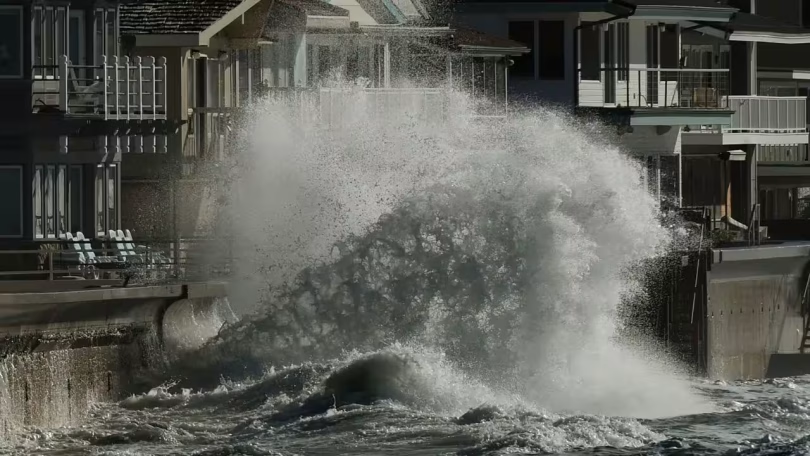
The influence of El Niño extends beyond agriculture. Different parts of the world often see increased wildfire danger, shifts in tropical cyclone activity and changes in marine ecosystems that support commercial fisheries.The economic consequences can be substantial. A strong El Niño during 1997 and 1998 was associated with global losses estimated between tens of billions of dollars, reflecting damage from floods, droughts, storms and disruptions to industries dependent on stable weather.Scientists stress that individual disasters cannot be attributed solely to El Niño, but the climate pattern increases the likelihood of certain extremes developing in regions already prone to them.