
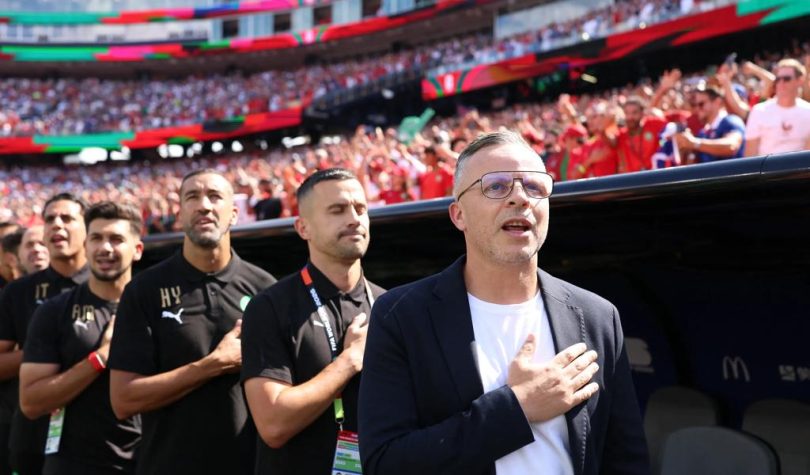
Despite the defeat, Ouahbi admitted his side had come up against one of the strongest teams in international football.
Morocco’s dream of another FIFA World Cup semi-final appearance came to an end on Thursday. Still, head coach Mohamed Ouahbi believes the Atlas Lions have laid the foundations for even greater success after becoming the first African nation to reach the quarter-finals in back-to-back World Cups.
Having reached the last four in Qatar, Morocco returned four years later to establish themselves among the world’s elite once again, achieving a feat no other African nation has managed.
Despite the defeat, Ouahbi admitted his side had come up against one of the strongest teams in international football.
France arrived in the quarter-finals as one of the favourites to lift the FIFA World Cup 2026 title, having won the tournament in Russia in 2018 before finishing runners-up in Qatar four years later.
Reflecting on the contest, the Morocco coach acknowledged that Les Bleus gave his players very little opportunity to impose their style of play.
“We have to acknowledge that we were up against a very difficult opponent,” Ouahbi said.
“We struggled a great deal in the first half, but Bounou’s penalty save kept us in the game.”
“In the second half, we defended better and were calmer in possession. We started the second half well, but their goal came from a rather strange sequence—a scramble, really—and Mbappe’s individual brilliance was what ultimately led to the goal.”
Ouahbi only took charge of the Moroccan national team in March, less than three months before the start of the World Cup.
Despite the short preparation period, he guided the Atlas Lions to another memorable campaign and believes the experience will serve as a springboard for future success.
The coach, who also led Morocco to glory at the FIFA U-20 World Cup Chile 2025, insisted the focus must now shift towards strengthening the squad and developing greater depth.
“It was difficult in the end, but we have to keep believing and keep working,” Ouahbi said.
“We need to work on the fundamentals so that when injuries strike, or when players aren’t at their best, we have a wider range of options on the bench that we can rely on.”
“We will carry on. We won’t stop here. We’re disappointed because we wanted more, but we have to accept what happened today.”
Looking beyond the disappointment, the Moroccan tactician expressed confidence that the country’s golden generation still has plenty to offer.
“The future looks bright for Morocco if we continue on this path. We have a strong group of players and some outstanding young talent.”
“We’ll remain confident, and we won’t allow this defeat to discourage us.”
Bouaddi embraces the lessons.
One of Morocco’s standout performers at the 2026 FIFA World Cup, Ayyoub Bouaddi, echoed his coach’s sentiments after the defeat.
The young midfielder admitted the Atlas Lions had hoped to control possession and dictate the rhythm of the game, but found themselves up against a French side whose quality made that task extremely difficult.
“We wanted to play our usual game, and we’d worked on certain aspects of that with the coach in training, but football isn’t an exact science, and things didn’t go the way we’d planned,” Bouaddi said.
“We have to adapt. Our opponents played well, and we have to accept that.”
The youngster also praised his teammates’ commitment, insisting the players left everything on the pitch despite the result.
“Before the match, we knew we were facing a very strong French team. We knew it would be difficult and that we’d have to put in a huge effort, and that’s exactly what the players did.”
“Everyone gave 100%. But that’s football: You can’t win every match.”
For Bouaddi, the quarter-final defeat will serve as an important lesson for a squad that continues to grow with every major tournament.
The midfielder believes the experience of facing one of the world’s strongest teams has highlighted the fine margins required to compete for football’s biggest prize.
“This match will help us develop for future tournaments because it showed us what we’re missing and what small details we need to address if we want to go even further.”
Although Morocco’s journey ended at the quarter-final stage, the Atlas Lions leave North America with another piece of history after becoming the first African nation to reach the last eight at consecutive FIFA World Cups.