Relentless Israeli airstrikes and a ground invasion of southern Lebanon, which began on 2 March, have forced more than one million people – roughly one-fifth of the population – to flee their homes, destroying entire villages, levelling infrastructure, and leaving hundreds of thousands without shelter.
Many have fled to Beirut in search of relative safety, though a rapid 100-strike assault in ten minutes on 8 April, which killed over 350 people, showed that even the capital is not immune from Israeli attacks.
Even amidst this destruction, displaced families are struggling to survive in harsh conditions. On the Beirut waterfront alone, about 400 families have pitched tents, living without proper access to running water or adequate sanitation. Across Lebanon, some 138,532 people are living in 678 collective shelters.
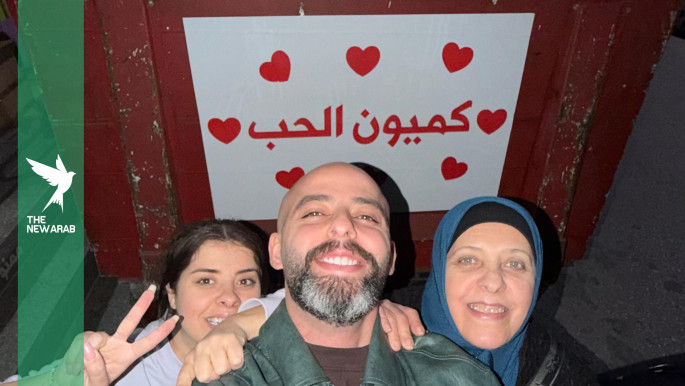
It was against this backdrop of war and displacement that Lebanese influencer Hasan Raad, a content creator with over 700,000 Instagram followers, and his family stepped in to support the masses of displaced people arriving in the capital.
On the morning of 2 March, as Lebanese families fled their homes, temperatures dropped to 10 degrees Celsius.
Hasan recalled that his family bought fabric in bulk, cut it up, and distributed makeshift blankets to those left on the cold streets.
The next day, they wanted to do more. To be of maximum use, they went out and assessed exactly what displaced families needed. The husband of Hasan’s sister, Zeina, owned a red truck that could be used to shuttle aid around. They realised they could fill it with different cargo each day and cruise around, quickly distributing items to those in need. And so, the Love Truck was born.
“We are a family you can count on the fingers of one hand, yet we offer love and aid to an unlimited number of people,” said Raji Qabbout, 43, who provided the truck for the initiative.
He now divides his time between work in the mornings and volunteering with the Love Truck in the afternoons. “Our pain and suffering are one, as children of a single homeland,” he added.
Daily acts of care
Day and night, the red flatbed tours the city, filled with everything from toys to tents. A placard attached to it reads: ‘The Return of Love’.
Though the largest share of items is offloaded in Beirut, the truck also travels outside the capital, east into the Bekaa Valley and northward to Tripoli.
Its aid cargo changes daily. Sometimes it functions as a bakery, distributing bread and pastries to the displaced. Other times, it acts as a grocer, handing out fresh fruit and vegetables. Clothing, shoes, medicines, diapers, sanitary pads – even mattresses and tents – are also provided, depending on the available aid.
During Eid al-Fitr in March this year, the truck distributed toys to displaced children in Biel, a moment Hasan described as particularly heartwarming.
“The children’s joy was indescribable,” Hasan told The New Arb.
“I saw their eyes light up, and I felt that I had given them a moment of Eid amidst the war, fear, and anxiety surrounding them.”
Hasan’s family is closely involved in the initiative, with his mother cooking meals for the displaced and his sister Zeina helping manage logistics.
“People need love more than they need aid in difficult circumstances, which is why the Love Truck exists,” said 37-year-old Zeina, whose experience in emergency relief during Lebanon’s last war with Israel has helped her organise its work.
The truck’s popularity has attracted support from a range of donors, both within Lebanon and from the diaspora, some contributing goods, others offering cash.
As Hasan has got to know the displaced community up close, he has been able to tailor the items to their needs.
“The Love Truck is an initiative that’s meant to benefit the community with love and giving,” he said.
He added, “At the start, we faced difficulties identifying those most in need and ensuring that aid reached them properly, without compromising the dignity of the displaced.”
Love and dignity on wheels
Even amidst bruising economic hardship, the Lebanese have given what little they have to support the displaced.
After a young woman donated five dollars, she admitted to Hasan that it was half the money she had. “This is the meaning of the Love Truck,” he said.
Lebanon’s economy has been in crisis since at least 2019, facing a sovereign debt crisis, a currency collapse in which the Lebanese pound lost over 95% of its value, and soaring inflation.
Some 82% of families face multidimensional poverty, according to UN figures, meaning they have insufficient access to health, education and public utilities.
While it is impossible to quantify precisely how many individuals have benefited from the Love Truck, Hasan estimates that over 10,000 displaced people have received help.
For him, it demonstrates that, despite the country’s infamous sectarian and political divisions, the Lebanese ultimately stand together when it counts.
For those displaced, the truck represents more than aid. Zeina Al-Ahmad*, a woman in her thirties from a southern suburb of Beirut, sat in a tent no larger than a few square metres. She was recently displaced, along with her parents, to the Biel area on the Beirut waterfront.
“We were never accustomed to asking for help or waiting for it, and we were too ashamed to ask, but the Love Truck distributed love and dignity to us before it distributed aid,” she told The New Arab.
Even if the war ended today, Lebanon’s displacement crisis is likely to be long-term.
More than 150,000 people will probably have no home to return to when the war ends, a figure that is likely to increase, according to the Ministry of Social Affairs.
Mohamed Daghman, 62, arrived at the makeshift Biel encampment early in the crisis.
“The Love Truck brought joy and smiles to the hearts of the displaced without discrimination. Everyone here shares the same suffering, including Syrian families who were displaced from the southern suburbs and the south – we share our bread with them,” said Mohamed.
“The Love Truck eased our pain because they are different – they provide aid without condescension or humiliation,” he added.
When the war ends, Hasan and his family hope to use the truck for another altruistic purpose: helping return the belongings of the displaced to their homes.
Initially, Hasan wanted the truck to deliver aid to the south as well, but conditions have been too unsafe. Still, he hopes the truck can serve the Lebanese in the hard-hit south.
“They will return to the south aboard the Love Truck, with dignity, pride, and love,” said Hasan.
*A pseudonym is used to protect privacy
Safaa Sallal is a Syrian journalist focusing on humanitarian, social, and developmental issues
This article was published in collaboration with Egab