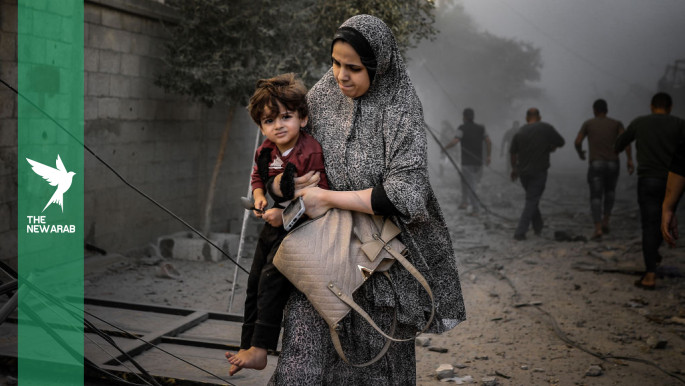
In Gaza, the issue of missing children has become one of the most painful and alarming humanitarian crises facing thousands of Gazan families.
Made worse since the outbreak of Israel’s genocide in Gaza in October 2023, the situation has been further compounded by the inability to carry out search operations or determine the fate of those who have disappeared, while the scale of destruction, ongoing shelling, and restrictions on the entry of heavy machinery have prevented rescue teams from recovering bodies or carrying out full search operations.
As a result, the number of children whose fate remains unknown in Gaza is currently estimated at more than 2,900.
According to estimates published by the Palestinian Centre for the Missing and Forcibly Disappeared, around 2,700 of these children are believed to remain under the rubble of buildings destroyed by intensive Israeli bombardment. Many are also thought to still be trapped in areas that rescuers have been unable to access.
For others, they are classified as disappeared or missing under unclear circumstances, leaving their families trapped in a distressing cycle of waiting, caught between hope and despair.
Estimates of thousands still unaccounted for
Speaking to The New Arab, Nada Nabil, director of the Palestinian Centre for the Missing and Forcibly Disappeared, said the number of missing Palestinians “ranges between 7,000 and 8,000. This includes approximately 2,700 children believed to remain under the rubble. A further 200 children are reported missing under various circumstances, including in aid waiting areas, near zones adjacent to Israeli army positions, and along displacement corridors.”
She added that the “famine sweeping the Gaza Strip forced many children to take on family responsibilities, such as securing firewood and basic food supplies, primarily flour. This led them to areas where aid convoys were located, resulting in many children going missing.”
Nada also explained that “under international humanitarian law, enforced disappearance is considered a crime against humanity and is strictly prohibited. It obliges parties accused of such crimes to disclose the whereabouts of the disappeared and release them.”
She further stated that “international law underscores the right of every family to know the fate of their child. Meanwhile, those under the rubble are considered missing until they are recovered by their families, death certificates are issued, and they are buried in a manner that preserves human dignity, whether during or after the conflict.”
Waiting amid the ruins
As it stands, the sites of destroyed homes have turned into mass graves.
A lack of technical and logistical capacity to reach victims’ remains means bodies have stayed under the ruins for long periods, in what many describe as a flagrant violation of human dignity.
This, in turn, deepens the suffering of relatives who are left without the opportunity to say goodbye or provide a proper burial.
Among those affected is Majdal Saadallah, who sits before a pile of stones that was once her home in Gaza City.
Staring into the distance, she told The New Arab, in a trembling voice: “The last time I saw my son, he was laughing, holding his toy. He asked me when he would go back to sleep in his room.”
Recalling the circumstances of the attack, she said: “The house that collapsed on the body of my eight-year-old son, Ahmed, belonged to my husband’s relatives. They had been forced to flee their own home in western Gaza City, which was destroyed after successive Israeli evacuation orders. The house was bombed suddenly, without warning. Rescue teams have been unable to reach my child’s body or those of several others until now.”
Turning to the aftermath, Majdal added that rescue teams eventually managed to pull her and her husband from the rubble after hours of searching, but said her “heart’s joy” remains buried.
“I have returned to the site more than once, trying to find any trace of my child, but I found nothing but silence and dust,” she said.
Her account, she added, reflects the reality of hundreds of mothers across Gaza, caught between hope and loss, still waiting for answers that have not come.
Families searching without answers
Other testimonies indicate that many families have spent months searching for their missing children without receiving any information.
In many cases, their traces have vanished completely across different parts of the Strip, amid indications that they may have been subjected to enforced disappearance or direct targeting, resulting in the loss of their bodies or making them impossible to reach.
In addition, multiple reports suggest that some of these children were last seen near aid distribution points or in areas under military control before disappearing entirely, with no official information provided about their fate.
One such case is Ibrahim Abu Zaher, a 15-year-old from the Tal al-Zaatar neighbourhood in Jabalia camp, who went missing on 17 July 2025. He had headed to the Zikim area near the border and Israeli military positions, where aid was being transferred during the famine affecting around two million people in Gaza.
According to his family, contact with him was maintained until late that evening, after which it was completely cut off.
Eyewitness accounts suggest that an Israeli special unit surrounded dozens of civilians at the site and took them to a military location. It is believed that Ibrahim was among those detained.
Subsequent information suggested he was seen inside the Sde Teiman detention centre in December 2025, although no details regarding his detention have been confirmed.
Because there is no official acknowledgement or inclusion of his name on detainee lists, he is still classified as missing.
This ongoing silence has fuelled fears of secret detention and enforced disappearance, while the possibility that he may have been caught up in military operations in the area cannot be ruled out.
Another case is that of Mohammed Abu al-Ula, a 17-year-old who went missing on 7 October 2023 after going out to follow events east of Khuza’a, in eastern Khan Younis.
Contact with him was lost completely, and his family has been unable to obtain any information about his whereabouts or fate, despite an unverified report that he had been taken to a hospital, where no trace of him was found.
In response, the Abu al-Ula family began an extensive search across hospitals and mortuaries, alongside appeals to human rights and media organisations, but with no results.
The family continues to live in a state of anxiety and anticipation, in the absence of any clear evidence. Mohammed’s fate remains unknown, amid continued calls to clarify what happened to him and end the uncertainty surrounding his disappearance.
Taken together, these cases reflect how daily life for Gaza’s children has become an increasingly perilous environment.
Loss is no longer linked only to bombardment, but also to the struggle for survival itself, whether searching for food or firewood, or returning to destroyed homes to salvage what remains.
In this context, disappearance or undocumented death has become a constant risk.
Ultimately, the continued absence of so many children, without effective investigations or clear mechanisms to determine their fate, is worsening an already severe humanitarian crisis.
It leaves families in a state of prolonged, painful uncertainty, where the passage of time brings no answers or resolution.
Article translated from Arabic by Afrah Almatwari. To read the original, click here.