The US war against Iran is spiraling out of control. Over the past week, the conflict has expanded across the Middle East, with attacks and counterattacks in at least five other countries. Instead of a quick war that sought to topple Iran’s regime, Donald Trump has started a regional conflict that risks severely disrupting energy supplies and prices – and triggering a global recession.
After a few days of relative calm, the conflict resumed with the Pentagon carrying out almost nightly strikes against Iran, and Tehran retaliating against US military bases in the region. The conflict also extended to attacks in Saudi Arabia, Iraq, Yemen, Jordan and Egypt. And there’s little sign that peace negotiations between the US and Iran, which are being brokered by Pakistan and Qatar, are making much progress.
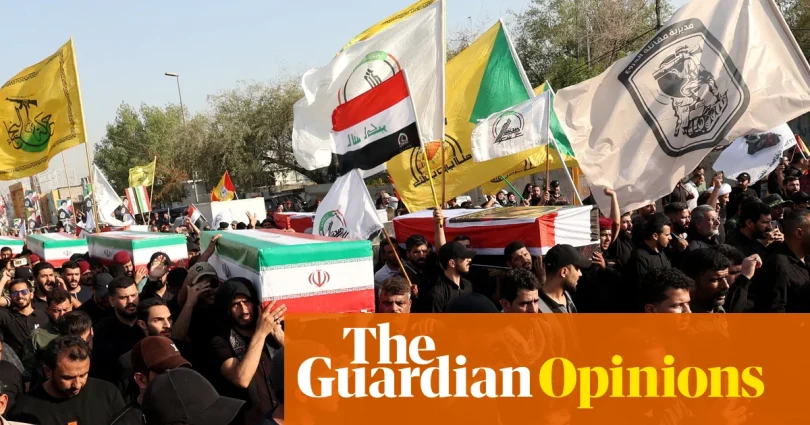
The most serious escalation took place on Wednesday, when Saudi Arabia announced it had joined the US in carrying out a series of airstrikes inside Iraq, against the Iranian-backed Popular Mobilization Forces (PMF), killing at least 20 fighters. Saudi officials had blamed the Iraqi-based militias for launching drone attacks against Saudi oil facilities on 27 July, and warned that the kingdom would retaliate if the Iraqi government did not restrain the groups. The PMF is a network of mostly Shia Muslim militias that was created, with Tehran’s support, in 2014 to fight the Islamic State terror group that had taken control of large parts of Iraq.
Trump said the US and Saudi militaries coordinated with the Iraqi government before carrying out airstrikes, but Iraqi leaders quickly denied having any prior knowledge. That denial highlighted the fact that many regional leaders don’t want to be associated with Trump’s expanding regional war. And the attacks threatened to undermine a fragile power balance within Iraq, which has struggled to stop the US-Iran war from spilling over its borders and to maintain a good relationship with both sides.
After the US invaded Iraq in 2003, it ousted Tehran’s enemy, Saddam Hussein, and his Sunni-dominated regime from power. Washington then helped install a Shia-led government for the first time in Iraq’s modern history, opening the door for Iran to extend its influence over its neighbor and cultivate powerful Shia militias. Iran’s efforts were largely overseen by Qassem Suleimani, a general who headed the foreign operations wing of Iran’s Islamic Revolutionary Guard Corps. Suleimani was assassinated by a US drone strike in Baghdad in January 2020, on Trump’s orders – an attack that helped set the stage for the current war and fueled further animosity between the US and Iraq’s PMF coalition, whose deputy chief, Abu Mahdi al-Muhandis, was killed alongside Suleimani.
Beyond drawing Iraq’s Shia militias further into the regional conflict, the US and Saudi Arabia risk expanding the war in even more dangerous directions. The kingdom is reportedly planning for a major military offensive against the Houthi militia, another Iranian ally, which controls large areas of Yemen.
After Trump launched his war in late February, Iran effectively shut the strait of Hormuz, through which a fifth of the world’s oil and liquid gas supplies passed each day. As a result, some oil producers, especially Saudi Arabia, shifted their exports to the Red Sea. But the Houthis are able to disrupt international shipping through the Red Sea, as they did after Israel’s invasion of Gaza in 2023, when the Yemeni militia began firing missiles and drones at ships near the Bab el-Mandab strait. That caused insurance premiums to soar and forced companies to reroute vessels around Africa, adding weeks to a typical journey and increasing the cost of goods in Europe and elsewhere.
So far, the Houthis have not tried to disrupt ships passing through the Red Sea on a large scale, via the Bab el-Mandab chokepoint, which comes closest to Yemeni territory. But on 20 July, the militia declared a blockade on Saudi vessels transiting the Red Sea, claiming it was in retaliation for an air and naval blockade that the kingdom had imposed years ago against Houthi-controlled areas of Yemen. The Houthis have since attacked several ships in the Red Sea, forcing Saudi Arabia to reroute nearly half of its oil exports through a longer and more expensive journey around the southern tip of Africa. On 25 July, the Houthis claimed to have struck “sensitive” oil infrastructure sites inside Saudi Arabia with missiles and drones, disrupting the kingdom’s Red Sea export hub of Yanbu. The Saudis have retaliated with air strikes against Houthi targets in Yemen.
Like Iran’s other neighbors in the Persian Gulf, the Saudi economy has been hit hard by the war, especially Tehran’s closure of the strait of Hormuz and its attacks against energy infrastructure in the Gulf. Saudi Arabia’s GDP decreased by nearly 5% in the second quarter of 2026, compared with the same period last year.
Saudi leaders are blaming Iran for the latest Houthi escalation, and they’ve vowed to establish an international maritime coalition to protect shipping in the Red Sea. On Thursday, the Saudi defense ministry announced that 14 states – including Turkey, Pakistan, Egypt and Sudan – had agreed so far to join the coalition. But it’s unclear how this new Saudi-led effort would differ from an existing naval protection mission, organized by the European Union and known as Operation Aspides, which is focused on the Red Sea.
While Saudi Arabia’s crown prince and de facto ruler, Mohammed bin Salman, has tried to steer clear of a direct confrontation with Iran, his latest conflict with the Houthis risks reopening a painful chapter in recent Saudi history. In 2015, Saudi Arabia, with US weapons and political support, led a coalition of Sunni Arab states to intervene in Yemen’s long-running civil war. The Saudis tried to dislodge the Houthis from Yemen’s capital, Sana’a, and restore the country’s internationally recognized government to power. By the end of 2021, the United Nations estimated that the conflict had killed 377,000 people in Yemen, nearly 60% of whom did not die from direct warfare. Rather, they died from food shortages, cholera outbreaks and destruction of Yemen’s healthcare system.
Despite thousands of airstrikes over seven years, the Houthis remained in control of the capital and the two sides agreed to a UN-brokered ceasefire in 2022. But negotiations over a permanent peace deal, which would recognize Houthi control over parts of Yemen and provide some form of Saudi reparations, stalled after the militia started attacking ships in the Red Sea in 2023.
Today, Saudi Arabia’s tenuous ceasefire with the Houthis is in danger of collapsing – yet another casualty of Trump’s disastrous war against Iran.