
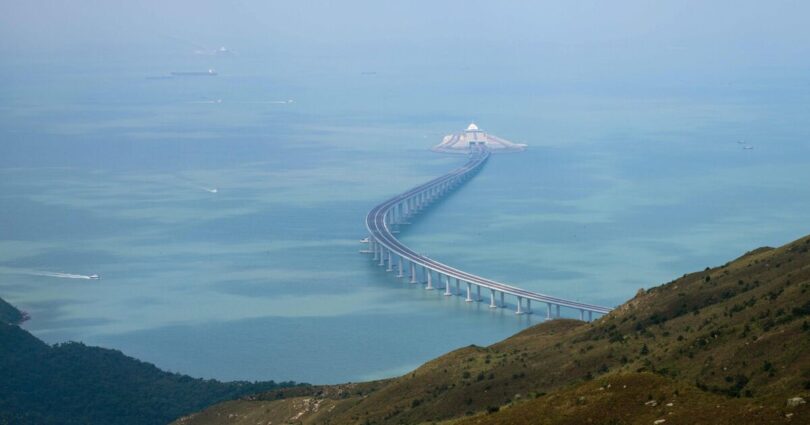
Spanning 34 miles across the Pearl River Delta, the Hong Kong-Zhuhai-Macau Bridge is the longest sea crossing ever built, linking the southern Chinese cities of Hong Kong, Zhuhai and Macau. The 55km structure was completed after nine years of construction at a cost of around £15bn.
It has significantly reduced travel times between the three cities, turning what was previously an hour-long ferry journey into a drive of about 40 minutes. The bridge forms part of a wider effort to improve transport connections across the Greater Bay Area, a region the Chinese government is developing into a major economic hub. By linking Hong Kong and Macau more directly with cities in Guangdong province, the crossing is intended to support trade and movement across the region.
Its design combines multiple elements, including a series of long-span bridges, artificial islands and connecting roads.
The main section features three navigation channel bridges — Jiuzhou, Jianghai and Qingzhou — built to allow large vessels to pass through one of China’s busiest shipping areas.
Engineers had to account for difficult conditions, including frequent typhoons and a complex marine environment. The bridge uses single-column piers embedded in the seabed to reduce disruption to water flow and limit the impact on local wildlife, including the Chinese white dolphin.
The three main bridges are cable-supported, each with a distinct tower design. These were intended to give the crossing a consistent but varied appearance, particularly given its visibility from land, sea and air.
The Jiuzhou Bridge retains its original sail-shaped towers following revisions during the detailed design phase.
Engineering firm Arup contributed to several parts of the project, including early-stage design work, artificial island development and major road and tunnel links on the Hong Kong and Macau sides.
Additional infrastructure linked to the crossing includes boundary crossing facilities and connections such as the Tuen Mun–Chek Lap Kok Link, helping integrate the bridge into the wider transport network.
Since opening, the bridge has become a key route within the region’s transport system, reflecting both the scale of China’s infrastructure ambitions and the practical need for faster connections between its major cities.