
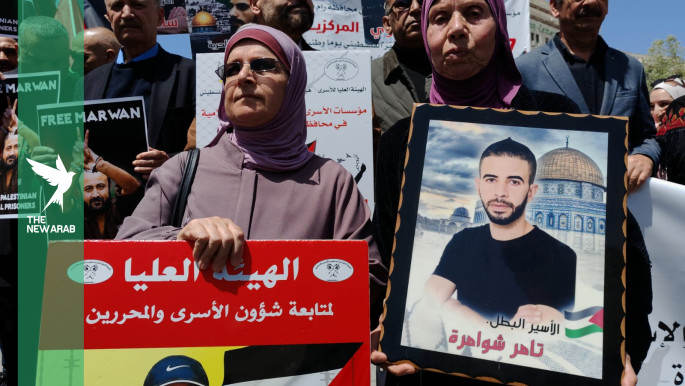
Across the occupied West Bank, demonstrations and vigils were held on Thursday, 16 April, under the slogan “Together to bring down the law executing Palestinian prisoners”. [Jihad Barakat/TNA]
During events marking the Palestinian Prisoners’ Day across the occupied West Bank on Thursday, 16 April, mothers of Palestinians took to the fore as concern grows over the fate of their children inside Israeli prisons.
In particular, these mothers are afraid that their children may return as corpses amid harsh conditions within Israeli prisons and the recent approval of an Israeli law allowing the execution of Palestinian prisoners.
Watfa Shehwan clutched a photo of her son, Fadi Hamad, an administrative detainee in Israeli prisons, to her chest among crowds marking the day in central Ramallah.
She has never missed the opportunity to speak about the burden of administrative detention, which has exhausted both her and her son. Administrative detention is one of the major shifts in the Israeli prison system, alongside the law on executing prisoners, which this year’s commemorations are focused on opposing.
Two months ago, Israeli forces rearrested Hamad after months of release, his mother told The New Arab.
Shehwan said this has become routine, though she has not adapted to it. Her son has spent nearly half his life in prison under administrative detention, without charge or trial.
“He leaves prison for a month or two, then returns because of administrative detention,” she remarked.
Shehwan said her suffering is compounded by harsh conditions in Israeli prisons, including starvation, medical abuses, deprivation of basic needs, and a lack of information about her son. She said she has not heard any news about him since this past Ramadan.
Her concern has deepened amid what she described as a series of discriminatory laws, most recently the execution law.
Although it does not apply to her son’s administrative detention, she expressed fear for his life and the lives of all prisoners due to escalating measures and the lack of information about their conditions.
“We are not reassured they will come out alive; we fear they will return as bodies,” she said.
Nearby stood Sadiqa Shawamreh, mother of Tamer Shawamreh, who has also received reports of his transfer to administrative detention but is still awaiting confirmation.
Shawamreh continues to suffer from the impact of her son’s arrest and the Israeli army’s raid on her home, during which its contents were destroyed. Since then, she has been in poor health.
Despite this, she raised her voice and that of her son, who has spent 16 non-consecutive years in prison. She repeated concerns over the execution law and pointed to statements by Israeli officials, including Itamar Ben-Gvir, about targeting prisoners.
Warnings about threats to prisoners’ lives are not hypothetical but reflect reality, according to the head of the Palestinian Prisoners’ Club, Abdullah Zaghari.
He told The New Arab on the sidelines of the events that detainees are experiencing what he described as the peak of an ongoing campaign of extermination.
Zaghari said this is a continuation of what has taken place in Gaza, but carried out through medical abuses, total isolation, sexual violence, electric shocks and starvation. These practices are no longer exceptional but have become a daily routine driven by retaliation, culminating in the recent approval of the execution law.
He described the law as discriminatory and as entrenching a culture of death that prison authorities are attempting to normalise as daily policy.
He warned that authorities are seeking to eliminate and kill prisoners, particularly leaders and prominent figures, citing repeated assaults on Marwan Barghouti, a member of Fatah’s Central Committee.
“What the prisoner leader Marwan Barghouti, the symbols of the prisoners’ movement and all detainees are subjected to, continuous assaults and the release of dogs to attack their bodies, is an attempt by the occupation system to eliminate, execute and assassinate them before a world that still looks on without responsibility,” Zaghari said.
Zaghari also called on “countries that have recognised Palestine, as well as international institutions, to take practical steps to protect prisoners”.
Despite the grim picture, Karim Younis, a member of Fatah’s Central Committee and a former long-term prisoner who spent 40 consecutive years in Israeli prisons, said detainees are becoming more resilient and predicted the execution law would be overturned.
“After everything that has happened, when we see the national security minister storm prisons with suppression units and assault prisoners, this reflects the arrogance and brutality of the occupier and attempts to subdue prisoners. But the prisoner subjected to such attacks only becomes more steadfast,” he told The New Arab.
“Today, we are facing an unprecedented confrontation at all levels, and the execution of the law is clear evidence of that. But in my view, no one will be able to accept that even one prisoner is executed, and no one will accept it,” he said.
“This is not our responsibility alone, but a global one. I want to reassure my fellow prisoners that no one will be executed, because no one will dare do so, given the consequences,” Younis added.
Following a rally in central Ramallah, a large march moved through the city’s streets. Mothers carried photos of their sons, while participants raised Palestinian flags and images of Marwan Barghouti, marking the anniversary of his arrest on Wednesday, 15 April.
Across the occupied West Bank, demonstrations and vigils were held on Thursday, 16 April, under the slogan “Together to bring down the law executing Palestinian prisoners”.
On 30 March, the Israeli Knesset approved what is referred to as the law allowing the execution of Palestinian prisoners, prompting Palestinian calls for it to be halted.
The Palestinian National Council designated Palestinian Prisoners’ Day in 1974 as an annual occasion to renew demands for the release of prisoners, particularly the sick, children and women, and to reaffirm that the prisoners’ issue remains a central national cause.
Article translated from Arabic by Afrah Almatwari. To read the original, click here.