
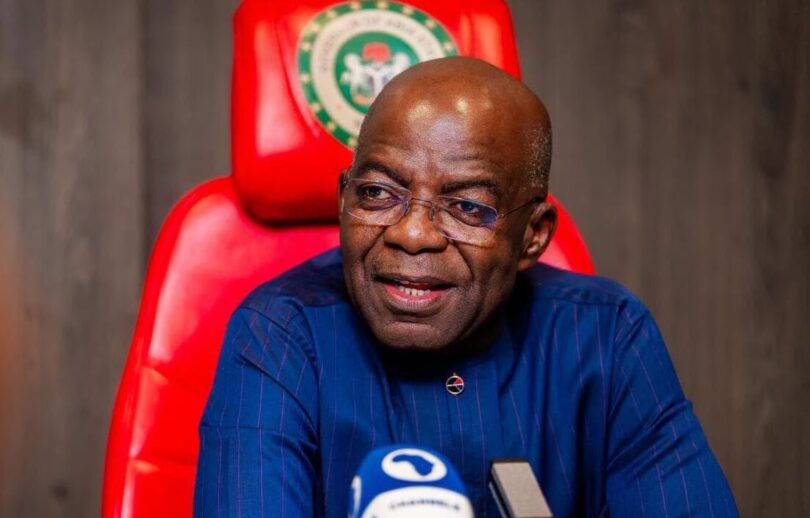
Abia State Governor, Dr Alex Otti, has said the Federal Government’s decision to remove subsidy on petrol was the right policy, arguing that the scheme largely benefited a few people rather than the Nigerian economy.
Otti, who spoke on Friday during an interview on Arise TV, said he had consistently opposed the subsidisation of consumption, stressing that government resources should instead be directed towards supporting production and economic activities.
The governor said there was no justification for returning to the petrol subsidy regime, despite the hardship associated with its removal.
“I’ve always been consistent on subsidy, and I’ve written extensively. I also refer you to my backpage columns in ThisDay, including one that I wrote in 2020 during COVID. At that time nobody was buying oil, and I said it was a good time to remove subsidy,” Otti said.
According to him, his position has remained that subsidising consumption creates inefficiencies and encourages waste.
“I’ve always held the view that once you subsidise consumption, you get exactly what you wanted,” he said.
Otti said while he supported policies aimed at encouraging production, he did not believe government should continue subsidising consumption.
“So I don’t have a problem supporting production, but consumption should not be subsidised,” he said.
The governor said the petrol subsidy regime had also become vulnerable to abuse, describing the system as a “scam” that created opportunities for people to take advantage of public resources.
“And you know, as election approaches, people will be making all sorts of arguments, but removing the subsidy was the right thing to be done,” Otti said.
“I don’t think anybody who is praying that subsidy returns means well for the country. That’s where I stand, and I have sufficient reasons, including the scam that it became.”
He explained that subsidising petrol consumption could encourage excessive use because consumers were shielded from the actual cost of the product.
“So, if you are being subsidised, you can just blast all vehicles, maybe 20 vehicles, put all of them on the road because somebody is paying for it,” he said.
According to him, the removal of subsidy may initially impose a burden on citizens, but could ultimately encourage more efficient use of resources.
“But then you find that at the time prices went up, people became more reasonable,” he said.
“There will be the pain initially, but consistency and management would eventually give way to efficiency.”
Otti’s comments came during a broader discussion on his administration’s approach to managing Abia State’s finances, reducing inherited debt and prioritising capital expenditure.
The governor said his administration had reduced the state’s inherited debt from about N192bn to N48.4bn, while simultaneously investing heavily in infrastructure.
He attributed the development to what he described as disciplined financial management, saying his administration had maintained a policy of allocating at least 80 percent of the state’s budget to capital expenditure.
“So in the last three years, 80 to sometimes 82 percent, I think in 2024, 82 percent of our budget was in capital expenditure, leaving a meagre 18 percent for recurrent spending,” he said.
Otti said the policy had enabled the state to devote more resources to roads, schools, hospitals and other infrastructure.
“If the budget is N1tn, it means that we will quarantine N800bn for capital expenditure, and then the rest can be used for operating costs and all that,” he said.
The governor also said his administration had reduced the cost of governance and kept recurrent expenditure within the remaining 20 percent of the budget.
He said salaries accounted for about 11.9 percent of the state’s costs, adding that the state had maintained its commitment to workers despite the implementation of the new minimum wage.
Otti also defended his administration’s position against electricity subsidies, arguing that businesses needed reliable power supply more than subsidised electricity.
He said consumers would ultimately find reliable public electricity cheaper than relying on generators and purchasing diesel and maintaining the equipment.
“When you have to pay, you are much more efficient and anyhow you slice and dice it, it’s still cheaper than darkness,” he said.
“And if you have to run a generator, buy the diesel, provide for the maintenance, you will find that you are paying a whole lot more than public power supply.”
The governor said businesses, particularly manufacturers, needed consistent electricity to operate efficiently and should therefore be willing to pay for reliable supply.
“But most importantly, for the people who use it for production, for their factories, those people, they really don’t need the subsidy. They just need the constant power supply,” Otti said.
“And once you’re able to guarantee them constant power supply, they’ll pay.”
He said the same principle informed his administration’s approach to economic development, adding that government should focus on creating an environment that enables businesses and producers to thrive rather than continually subsidising consumption.