
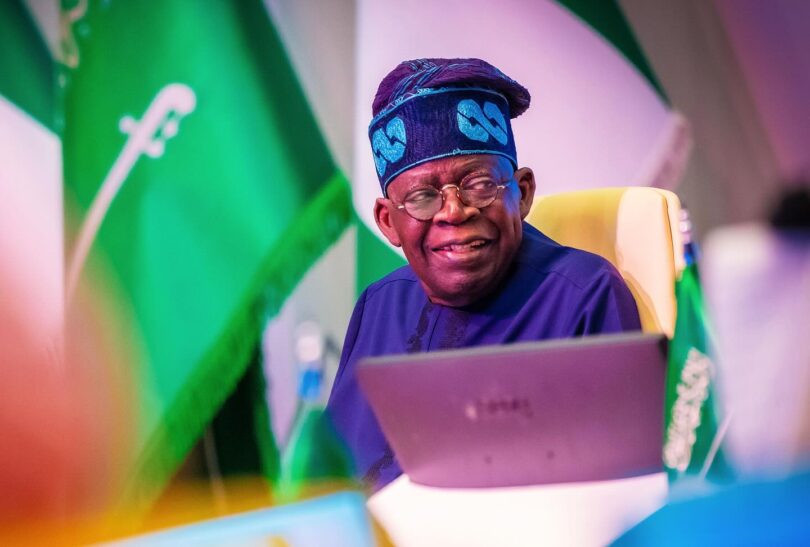
President Bola Ahmed Tinubu has said his administration has laid the foundation for Nigeria’s economic recovery, insisting that difficult reforms introduced over the past three years prevented the country from drifting into fiscal collapse and deeper economic uncertainty.
Tinubu stated this on Thursday in a statement commemorating the third anniversary of his administration, which was posted on X by presidential spokesperson Bayo Onanuga.
The President, who won the 2023 presidential election on the platform of the All Progressives Congress (APC), emerged victorious in what was widely described as a three-horse race against former Vice President Atiku Abubakar of the Peoples Democratic Party (PDP) and Peter Obi of the Labour Party.
All three politicians have secured their parties’ presidential tickets ahead of the 2027 general election.
Reflecting on his administration’s journey since assuming office in May 2023, Tinubu said he accepted the responsibility of leading Nigeria at a difficult moment in the country’s history, while expressing confidence in the resilience and potential of Nigerians despite prevailing economic challenges.
According to him, his administration inherited mounting fiscal pressures, unsustainable fuel subsidies, exchange-rate distortions, rising debt-servicing costs, insecurity, energy supply constraints, and declining public trust in institutions.
He added that multiple exchange-rate windows and foreign exchange arbitrage cost the country more than N8 trillion over three years through speculative activities and rent-seeking practices.
The President said the economic realities forced his administration to take “difficult but necessary” decisions to stabilise the economy and avert a deeper national crisis.
Tinubu acknowledged that the reforms came with painful sacrifices, including a rising cost of living that placed pressure on households, workers, and businesses, but maintained that the measures were necessary to secure long-term stability.
Tinubu said the reforms were already producing visible progress across several sectors of the economy, arguing that Nigeria is now better positioned for sustainable growth than it was in 2023.
The President also highlighted ongoing infrastructure projects, including the Lagos-Calabar Coastal Highway, Sokoto-Badagry Super Highway, Abuja-Kaduna-Zaria-Kano Road, and the East-West Road, saying over 2,700 kilometres of highways and major roads are currently under construction, reconstruction, or rehabilitation nationwide.
Rail modernisation projects, he added, are also ongoing to improve logistics, connectivity, and economic integration across the country.
He further stated that increased local refining capacity and the operation of modular refineries were helping Nigeria reduce dependence on imported petroleum products and conserve foreign exchange.
Under agriculture, Tinubu said government interventions had supported millions of farmers through improved seedlings, fertilisers, irrigation, mechanisation, and expanded access to financing and markets.
The President also said the Renewed Hope Housing Programme and projects by the Federal Housing Authority were delivering over 10,000 housing units across 14 states and the Federal Capital Territory, while creating more than 300,000 jobs.
Tinubu said thousands of primary healthcare centres were being revitalised nationwide, while health insurance coverage was expanding for vulnerable Nigerians.
He also stated that government interventions had helped stabilise the telecommunications sector, with operators expanding network infrastructure, investing in digital access, and recruiting Nigerian talent.
The President said his administration was investing in digital skills, technical education, innovation, and entrepreneurship to position young Nigerians for opportunities in technology, manufacturing, agriculture, and creative industries.
On security, Tinubu said security agencies had intensified operations against terrorists, kidnappers, bandits, oil thieves, and other criminal networks, adding that some communities and highways were gradually becoming safer.
Despite the administration’s optimism about economic recovery, macroeconomic pressures continue to weigh heavily on households and businesses across the country, raising questions about whether the government’s reforms have translated into improved living conditions for ordinary Nigerians.
Meanwhile, the Central Bank of Nigeria (CBN), at its last Monetary Policy Committee meeting, reduced the Monetary Policy Rate (MPR) by 50 basis points to 26.5% from 27%, signalling an attempt by the apex bank to ease borrowing costs and stimulate economic growth after months of aggressive monetary tightening aimed at curbing inflation.
Tinubu, who has already secured the APC presidential ticket for the 2027 election, is expected to be on the ballot next year as he seeks a second and final term in office.