
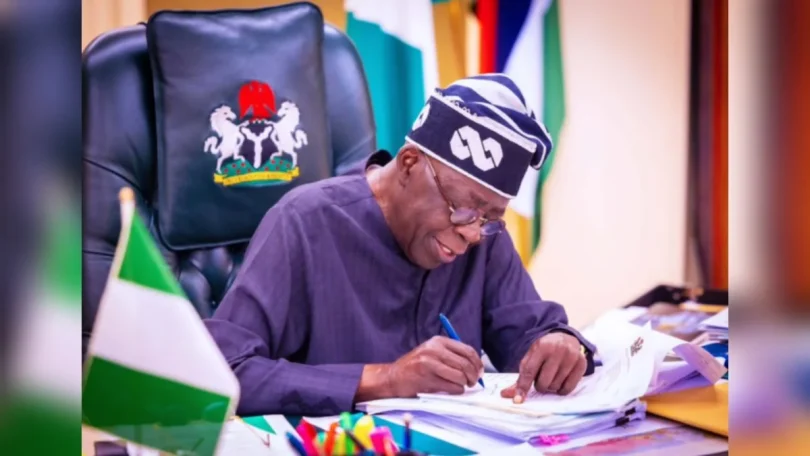
President Bola Tinubu has submitted a fresh budget proposal of N65.176 trillion to the House of Representatives, seeking approval for changes to the 2026 Appropriation Act.
The President wants the National Assembly to repeal and re-enact the existing 2026 budget to accommodate revised government expenditure, outstanding financial obligations and adjustments to the Federal Government’s fiscal commitments.
Tinubu also forwarded a revised 2026 Federal Government Fiscal Framework to the lawmakers for consideration and approval.
The proposal was contained in a letter addressed to the Speaker of the House of Representatives, Tajudeen Abbas, in which the President explained the reasons behind the proposed changes.
According to Tinubu, the adjustments are necessary to bring the budget in line with existing government obligations and available financial resources.
He also maintained that the revised framework would improve budget implementation and ensure that outstanding commitments are properly accommodated.
Under the new proposal, the Federal Government’s aggregate expenditure is projected at N65.176 trillion, representing a reduction from the N68.323 trillion initially approved by the National Assembly.
This means the revised proposal is N3.147 trillion lower than the original budget.
The President also put the government’s projected revenue, including earnings from government-owned enterprises, at N33.720 trillion.
Despite the reduction in total expenditure, the revised proposal retains a fiscal deficit of N31.457 trillion, representing 5.64 per cent of Nigeria’s Gross Domestic Product.
The capital expenditure component of the proposed budget stands at N26.232 trillion.
The allocation is expected to support infrastructure development and other priority government projects across the country.
Tinubu explained that several adjustments had become necessary to accommodate financial commitments that were either not adequately captured in the original budget or required additional provisions.
One of the major areas addressed in the revised proposal concerns expenditures incurred by the Nigerian National Petroleum Company Limited on behalf of the Federation.
The President said the new framework would provide for the regularisation of such expenditures.
It would also address debt-service obligations that were previously underprovided for in the original appropriation.
Other adjustments include the recognition of issued capital warrants and supplementation commitments.
The revised budget will equally make provisions for refunds due to ministries, departments and agencies, as well as special accounts.
Tinubu further explained that most of the capital allocations to ministries, departments and agencies were linked to funds that had already received warrants for implementation.
However, he noted that a limited number of additional capital and overhead provisions had been introduced to accommodate important national interventions.
The proposed interventions cover several sectors, particularly infrastructure, agriculture and food production.
According to the President, the government intends to make provisions for the completion of critical road projects across the country.
The adjustments will also support measures aimed at protecting agricultural production and reducing the cost of production.
Other priorities include improving farm yields, expanding access to markets for agricultural produce and addressing challenges associated with water vulnerability.
On the financing of the proposed budget, Tinubu disclosed that the Federal Government’s planned new borrowing would remain at N29.218 trillion.
The amount comprises N18.428 trillion in domestic borrowing and N10.790 trillion in foreign borrowing.
The President also provided details of the proposed external borrowing of $7.7 billion, which is equivalent to approximately N10.368 trillion at an exchange rate of N1,346.50 to the dollar.
He explained that the external borrowing would be used to finance the foreign borrowing component already provided for in the existing budget.
According to him, the proposed arrangement would not increase the government’s overall borrowing envelope.
The clarification comes amid concerns over the country’s rising debt obligations and the financial requirements of implementing successive federal budgets.
Tinubu maintained that the revised fiscal framework was designed to ensure that existing government commitments received priority attention without expanding the approved borrowing plan.
He also said the changes would strengthen the credibility of the capital budget and improve the government’s ability to execute projects for which funds had already been committed.
The President stressed the importance of maintaining fiscal discipline while ensuring that critical government obligations were not left unsettled.
He consequently appealed to the House of Representatives to give the proposed legislation urgent consideration and approve the revised framework.